Imagine standing in the sweltering Southern California heat for three hours. You are not waiting for a roller coaster, a famous musician, or a trendy food truck. You are waiting to get a whiff of something that smells like a combination of stinky cheese, garlic, rotting fish, and sweaty socks.
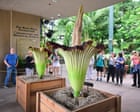
That is exactly what happened at The Huntington Library, Art Museum, and Botanical Gardens in San Marino, California. Over 7,000 people packed into the botanical conservatory on a Monday to witness a double bloom of the infamous Amorphophallus titanum, better known to the world as the corpse flower.
It is one of the strangest spectacles in the natural world. This year, it was twice as weird.
The Double Trouble in San Marino
Usually, a single corpse flower blooming is a major event. The Huntington has been cultivating these giant botanical oddities for over a quarter of a century. But having two of them burst into bloom at virtually the same time is a genuine rarity.
The two plants in question are named Odorysseus and Odora. They are actually siblings, grown from seeds produced during a successful pollination way back in 2002. While Odora is a seasoned veteran that last showed off its stinky petals in 2024, Odorysseus was making its grand public debut.
Botanists at the facility noticed the towering plants starting to unfurl over the weekend, prompting a quick alert to the public on Sunday afternoon. By Monday morning, advanced tickets were completely sold out. People ran to line up.
What makes this so urgent is the incredibly short window of opportunity. The peak bloom of a corpse flower is fleeting, lasting only 24 to 48 hours before the structure begins to collapse back into dormancy. If you miss that tiny window, you might have to wait another three years to see it happen again.
Breaking Down the Chemistry of the Stench
So, why does it smell so incredibly bad? The plant is not trying to offend humans; it is trying to survive.
In its native habitat of the rainforests of western Sumatra, Indonesia, the corpse flower relies on specific pollinators to survive. Instead of bees or butterflies, it wants to attract carrion beetles and flesh flies—insects that search for dead animals to lay their eggs in.
To fool these insects, the corpse flower deploys a complex chemical weapon. It is a carefully engineered cocktail of organic compounds that mimics the stages of animal decay:
- Dimethyl trisulfide – This compound gives off the distinct aroma of stinky cheese or boiled cabbage.
- Dimethyl disulfide – Think of a sharp, overpowering smell of garlic.
- Trimethylamine – The unmistakable scent of rotting fish.
- Isovaleric acid – The exact chemical responsible for sweaty socks and rancid vinegar.
- Benzyl alcohol – A sweet, slightly flowery scent that balances the rot.
The plant does not just sit there and let the wind carry the smell. It actively heats itself up. During the first evening of the bloom, the plant's internal temperature rises to assist in vaporizing these chemicals. This thermal blast carries the rotten scent high into the canopy of the forest, signaling to insects miles away that a "corpse" has arrived.
The Poster Child of Botanical Conservation
While the odor is disgusting, the conservation story behind these plants is vital.
The Titan Arum is classified as endangered, with fewer than 1,000 individual specimens remaining in the wild. Deforestation, agricultural expansion, and habitat destruction in Sumatra have pushed this species to the brink of extinction.
Botanical gardens like The Huntington serve as modern-day arks. Brandon Tam, the associate curator of orchids at The Huntington, often compares the corpse flower to the giant panda. One is a cute, fuzzy animal, and the other is a massive, foul-smelling botanical anomaly. Yet, both are powerful symbols that draw massive public attention to the crisis of biodiversity loss.
By carefully pollinating these specimens, sharing seeds and pollen with other research institutions, and educating the public, botanists are keeping the species alive. Every ticket purchased to see Odorysseus and Odora directly funds the ongoing research required to understand how these plants function and how we can save their wild relatives from vanishing forever.
What to Do If You Want to See It
The peak stench has passed, but the show is not entirely over.
If you want to experience what remains of this double bloom, you still have some options. Both Odorysseus and Odora will remain on public display in the Rose Hills Foundation Conservatory for Botanical Science through early August. They are now in their collapsing phase, which is a fascinating scientific phenomenon to observe as the massive structures slowly fold in on themselves.
If you are in Southern California:
- Reserve your general admission ticket online at the official Huntington website.
- Head to the Rose Hills Foundation Conservatory.
- Check out the Red Car coffee shop on campus to grab one of their limited-edition Corpse Flower cookies, which are being sold throughout July.
If you are outside of California, you can still watch the plants online. The Huntington maintains a 24-hour livestream on their website so you can watch the post-bloom collapse from the comfort of your own home, entirely odor-free.