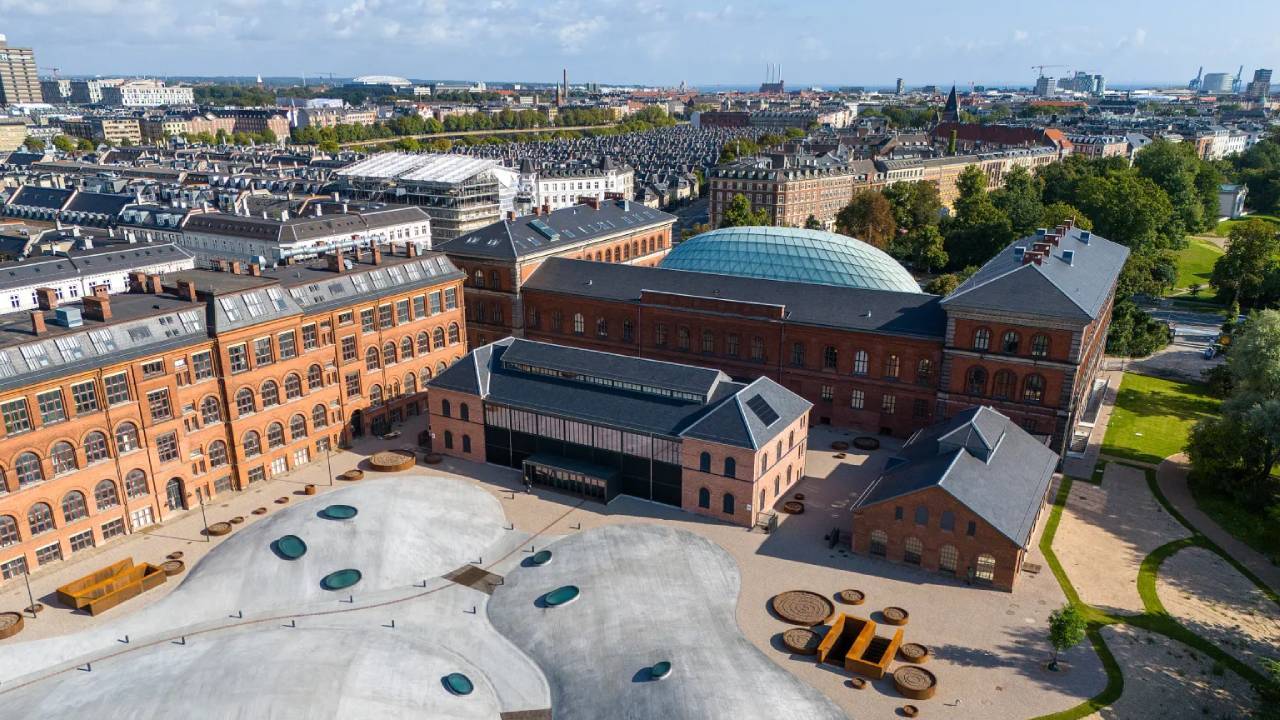
You don't usually expect a capital city to hide its crown jewel cultural project beneath the dirt. Yet, beneath Copenhagen's historic Botanical Garden, workers have spent years carving out a massive subterranean cavern. Scheduled to open on March 6, 2027, the newly redeveloped Natural History Museum Denmark is rewriting how public institutions display science.
Costing roughly £200 million and spanning a massive 32,000 square metres, this project is Denmark's largest museum undertaking in 130 years. Instead of tearing up the landscape or building a sterile glass tower that clashes with its natural surroundings, architects chose to go underground.
If you're wondering why a city would spend nearly a decade navigating delays, funding hurdles, and a 15-metre-deep excavation to build underground, the answer lies in preservation and scale.
The Subterranean Architecture of Awe
The engineering behind this space is honestly staggering. The excavation alone reached 400 metres in circumference, plunging 15 metres deep right next to delicate, protected historic greenhouses.
Designed by Lundgaard & Tranberg Architects alongside Claus Pryds Architects, the facility splits its footprint evenly between restored historic buildings and brand-new underground spaces. Visitors will enter through a meticulously rebuilt engine house, where original facade bricks and structural steel lattices have been pieced back together like a puzzle.
Once you step past the entrance, you descend into concrete galleries featuring soaring walls up to 10 metres high. To keep these vast subterranean chambers from sounding like an echo chamber, builders lined the ceilings with 180,000 individual wooden slats to manage acoustics. Natural light filters down through carefully positioned skylights, keeping you connected to the world above even while you stand deep underground.
Eight Galleries and Fourteen Million Specimens
The scale of what's waiting inside these galleries is hard to fathom. The museum houses approximately 14 million specimens gathered over 400 years of global exploration.
The exhibition footprint spans eight distinct themed zones:
- Universe: Meteorites and solar forces.
- Earth: Early life, volcanic power, and ancient fossils.
- Life: The evolutionary web connecting microorganisms to megafauna.
- Denmark: Local ecology and wildlife.
- Arctic: Greenlandic ice sheets and deep-ocean polar environments.
- Biodiversity: Fragile, species-rich ecosystems.
- Humans: Evolutionary history and our massive footprint on the planet.
- Ocean Hall: A towering aquatic showcase.
Among the headline fossil attractions are a 17-metre-long Diplodocus skeleton and intact Tyrannosaurus rex remains. But you won't just stare at glass cases. Interactive 3D touchscreen tables let visitors manipulate high-resolution digital scans of rare specimens, offering a hands-on layer that traditional museums usually skip.
Inside the Ocean Hall Dome
The standout architectural feature is undoubtedly the Ocean Hall. It stretches 16 metres wide, 23 metres high, and 50 metres long, crowned by a breathtaking glass dome.
This dome consists of 2,000 steel frames holding 1,600 triangular glass panels. Here's the kicker: only two of those 1,600 panes are identical. Building a structure like that requires extreme precision, and it serves as a massive visual anchor designed to make you feel tiny in the best possible way.
Planning Your Visit for 2027
If you want to see this engineering feat firsthand, mark March 6, 2027, on your calendar. Adult tickets will run around £200-equivalent local pricing (roughly £13.22 / 115 DKK), while children aged three to 17 will get in for about £5.75.
Museum directors have stated the core mission isn't just to show off dead bones, but to confront the reality of biodiversity loss and climate change head-on. It's a space built to spark urgency, not just passive sightseeing.
Check flight availability to Copenhagen now and book your accommodation early, because the global architecture and science community will swarm this opening week.