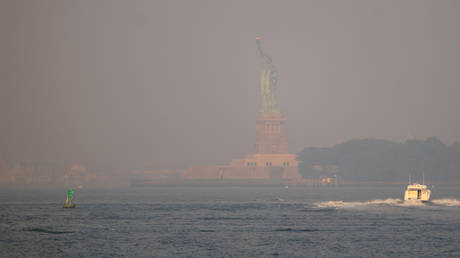
Donald Trump isn't letting anyone ruin his Sunday plans, especially not Canada. With the FIFA World Cup final between Spain and Argentina scheduled for Sunday afternoon at MetLife Stadium, a massive cloud of Canadian wildfire smoke has drifted south, threatening to derail the biggest sporting event on earth. Trump isn't just complaining about the view from the luxury suites; he's threatening massive new tariffs and dangling the possibility of postponing the entire match if the air quality doesn't improve.
If you think this is just a typical social media outburst, you haven't been paying attention to how fast sports and international politics are colliding. U.S. Ambassador to Canada Pete Hoekstra confirmed that this isn't a bluff. The administration is actively talking to FIFA organizers right now. If the air poses a real danger to players sprinting for ninety minutes or fans sitting in the open-air venue in East Rutherford, New Jersey, Trump will demand a postponement.
Here is what's actually happening behind the scenes, how it changes the game on Sunday, and what it means for your weekend.
The Tariff Threat and Forest Management
This isn't just about bad air; it's about trade leverage. Trump explicitly blasted Canadian Prime Minister Mark Carney on Truth Social, accusing the country of "willful negligence" regarding its forest management and debris removal. According to the administration, the drifting smog is an "invasion" of filthy air costing the U.S. billions of dollars.
The financial threat is real. Trump announced that the economic toll of this cross-border pollution will be tacked straight onto the tariffs Canada is already paying. Over 200 fires are currently burning out of control across Ontario, sending massive plumes down into the American Midwest and Northeast. Detroit currently ranks as the most polluted city on earth. The New York metro area saw skies turn into a murky orange soup earlier in the week, and the National Weather Service warns the smoke could easily thicken again before kickoff.
What This Means for Sunday Afternoon
Can a president actually stop a FIFA World Cup final? Technically, FIFA calls the shots on match operations. But the reality is that the U.S. government controls the venue security, local logistics, and public health mandates. If the White House declares the air quality index hazardous, FIFA will have very little choice but to comply. Andrew Giuliani, the executive director of the White House World Cup task force, confirmed that the administration is tracking the atmospheric models by the hour.
The players are already feeling the tension. Spanish midfielder Mikel Merino admitted that the squad trained in hazy, suboptimal conditions on Friday. While the team is trying to focus entirely on the pitch, breathing heavily in air loaded with fine particulate matter is a brutal physical challenge. Medical experts warn that wildfire smoke doesn't just contain wood ash; it carries complex chemical toxins that age as they travel through the atmosphere, making the particles even more toxic to the lungs.
Right now, atmospheric models predict pollution levels between 10 to 20 micrograms per cubic meter for East Rutherford on Sunday. While that is not a record-breaking disaster, it is still up to four times higher than the World Health Organization's optimal guidelines.
How to Prepare for the Weekend
If you have tickets to MetLife Stadium or you're planning a viewing party, you need to stay flexible. The situation is shifting fast based on wind patterns over the Great Lakes. Keep an eye on local air quality index updates for the East Rutherford area. If the index creeps back into the "unhealthy for everyone" range, expect immediate announcements regarding delays or stadium safety protocols. Keep your schedules clear for Sunday evening in case the kickoff gets pushed back to allow the wind to clear the valley.