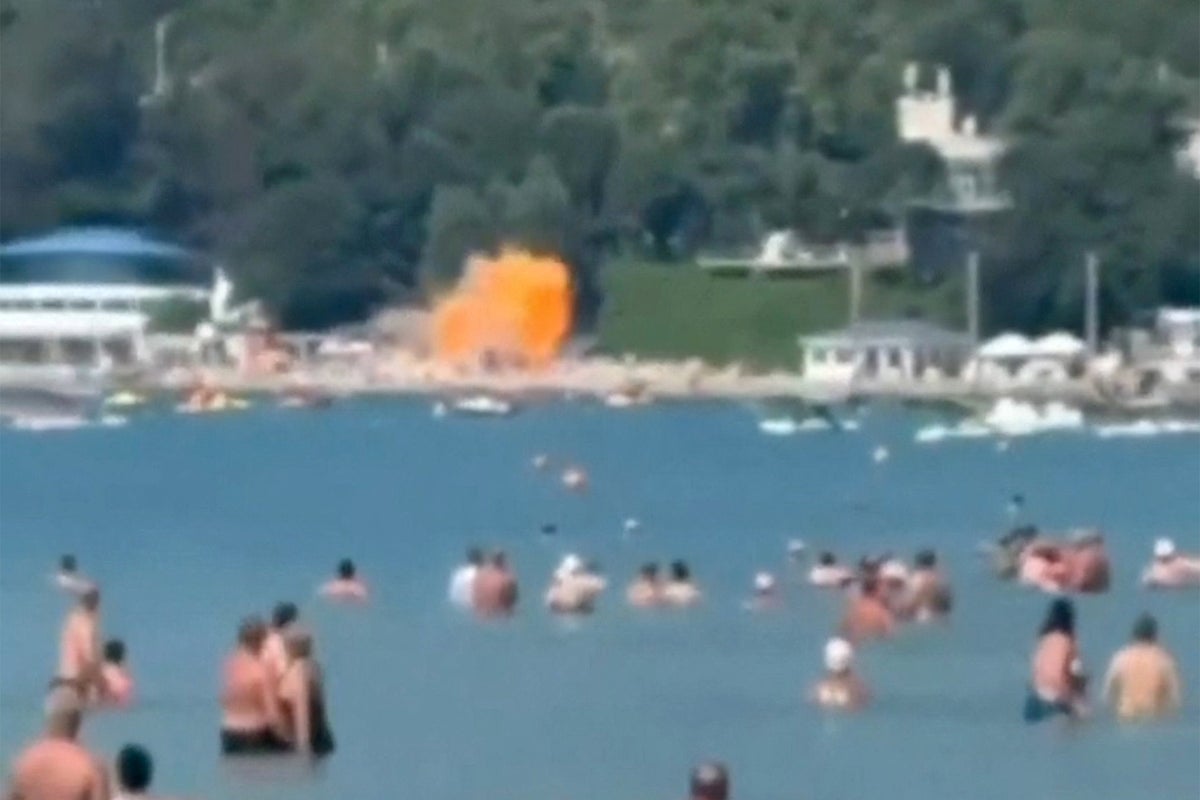
The war in Ukraine stopped being a clean frontline conflict the moment cluster munitions rained down on a crowded Crimean coastline. When American-supplied ATACMS fragments tore through sunbathers in Sevastopol, killing four people including children and injuring over 150 others, the psychological shockwaves hit Western capitals harder than they hit Moscow.
Forget the standard political posturing. Western allies are waking up to a terrifying reality: the guardrails keeping this war contained are snapping.
The Real Fear Behind Closed Doors
Ask any NATO defense planner what keeps them awake at night, and they won't talk about artillery shells or muddy trenches. They worry about proxy escalation.
When long-range Western weapons are used to strike targets inside illegally annexed territories—or areas Moscow treats as sovereign Russian soil—the Kremlin doesn't blame just Kyiv. They point directly at Washington.
- US satellite reconnaissance guides these missiles.
- American technology programs the flight paths.
- Western intelligence provides the targeting data.
This integration makes Western partners co-belligerents in Russian eyes. When civilian blood spills on a beach because a defensive system intercepted an incoming supersonic missile, the risk calculation shifts permanently. Moscow's response won't necessarily happen on the battlefield. It could happen via cyber warfare against European infrastructure or covert sabotage operations across NATO territory.
Crossing Red Lines Without a Map
Western capitals spent the first two years of the invasion obsessed with red lines. No tanks. No fighter jets. No long-range missiles.
One by one, those lines vanished. Each step crossed felt necessary to prevent a Ukrainian collapse. Yet, every escalation brings a matching counter-escalation. Striking military command nodes in Crimea makes tactical sense for Kyiv. But mixing high-end Western weaponry with dense civilian zones—whether intentional or the tragic result of air defense interceptions—invites catastrophic miscalculation.
Moscow immediately labeled the Sevastopol incident a deliberate terrorist act orchestrated by the United States. Even if military analysts note that air defense interceptors caused the warheads to veer off course, the political utility of the tragedy for the Kremlin is absolute. It justifies harsher domestic mobilization, tighter internal crackdowns, and future asymmetric retaliation against Western assets.
What Happens When the Deterrent Fails
Deterrence relies on predictable reactions. Right now, both sides are guessing.
Ukraine believes it has an existential right to strike any asset used to launch attacks on its cities, regardless of where that asset sits. Crimea is legally Ukraine. Therefore, Kyiv argues, there are no civilian tourist zones on occupied land.
Western allies are trapped in the middle. They want to defeat Russian aggression, but they don't want a direct exchange of strategic nuclear threats. Every time civilian casualties mount from advanced Western munitions, the diplomatic wiggle room shrinks.
The strategy going forward isn't about winning a clean victory. It's about damage control in a war that grows more reckless by the day. Expect tighter restrictions on certain weapon profiles, coupled with intense, quiet pressure behind closed doors to avoid targets that guarantee civilian carnage.
The illusion of a localized conflict is gone. The stakes are global, and the margin for error is effectively zero.
Ukraine claims it successfully struck Russian Black Sea navy headquarters
This video provides context on the military operations and tensions surrounding Western-supplied strikes in the Black Sea region.
http://googleusercontent.com/youtube_content/1