Nearly three years after a catastrophic airstrike flattened an entire residential block in Gaza City's Sabra neighborhood, families are finally burying their dead. First responders spent 136 grueling hours digging through crushed concrete and twisted metal, largely using bare hands and rough tools, to recover the remains of 112 people.
The November 22, 2023 bombing wiped out members of the Hassayna and Abu Sharia clans. More than 300 people died in that single attack during the ferocious early weeks of the war. While roughly 40 bodies were pulled from the dust in the chaotic days immediately following the blast, the rest stayed trapped deep beneath the rubble, lost to the scale of destruction until recent recovery efforts pushed forward under a fragile ceasefire. Also making waves in related news: Why India And Uzbekistan Are Betting Big On Parliamentary Diplomacy.
The Grim Reality of Gaza Recovery Operations
Finding bodies years after a strike isn't simple. It's a slow, agonizing process constrained by a severe lack of heavy machinery, fuel, and equipment. Civil defense teams and volunteers rely on basic hand tools, shovels, and physical endurance.
Supported in part by organizations like the International Committee of the Red Cross, these recovery operations bring a painful form of closure. As Amani Al-Naouq of the ICRC noted, thousands of families have spent years living in agonizing uncertainty, simply waiting for the chance to lay their relatives to rest with dignity. Further details on this are detailed by The Guardian.
Out of the 112 bodies recovered over the weekend from the Sabra site, the Civil Defense agency identified 40 children, 38 women, and seven people with physical disabilities. Yet, the work is far from complete at that single address. First responders report that another 157 individuals from that exact strike remain unrecovered, buried so deep that relatives describe it as if their loved ones "evaporated without a trace".
The Scale of the Missing Under the Rubble
The grim reality in Gaza is that the officially reported death toll only tells part of the story. Thousands of missing persons are still presumed dead underneath collapsed infrastructure across the territory.
According to Zaher al-Waheidi, who heads the records department for Gaza's Health Ministry, at least 7,400 people have been reported by relatives as missing under the rubble. Experts warn that the true number is likely much higher. In numerous instances, entire extended families were wiped out in a single aerial bombardment, leaving no surviving relatives behind to file a missing person report or claim the bodies.
The Associated Press has documented at least 60 distinct families across Gaza who lost 25 or more family members during just the first three months of the conflict. Entire lineages disappeared overnight, turning residential neighborhoods into unmarked tombs.
What a Mass Funeral Looks Like
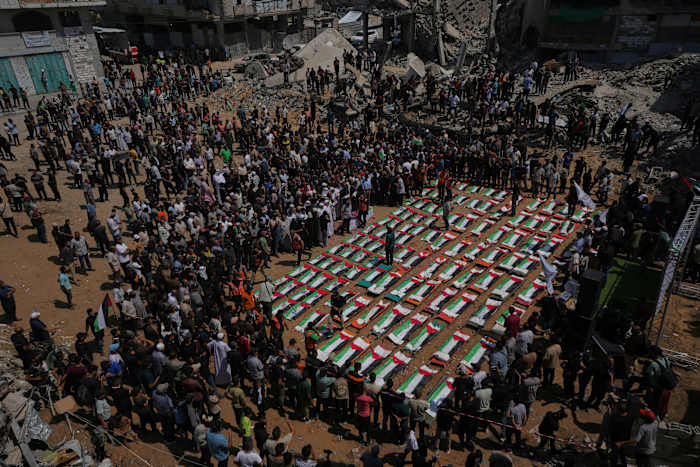
On Tuesday, hundreds of mourners gathered in Gaza City for a mass funeral that captured the profound grief of a shattered enclave.
The recovered remains, wrapped tightly in Palestinian flags, were laid out in long rows on the ground near the flattened ruins of their homes. Families placed printed photographs of the victims on the shrouds, surrounded by scattered flower petals.
Mourners crowded around the bodies for funeral prayers, with some individuals standing directly on top of the grey rubble that had entombed their relatives for nearly three decades of calendar months, compressed into years of war. Following the prayers, pallbearers carried the stretchers down narrow streets flanked by bombed-out shells of buildings, moving toward a nearby cemetery for final burials.
The Broader Humanitarian Toll
While a fragile ceasefire has allowed these localized recovery operations to inch forward, daily life in Gaza remains defined by devastation. More than two million people remain displaced, packed tightly into squalid tent camps where overcrowding, poor sanitation, and a lack of clean water continue to fuel infectious diseases like chickenpox alongside severe rodent infestations.
The physical clearing of rubble and the identification of human remains will likely take decades. For the families of the Hassayna and Abu Sharia clans, Tuesday's funeral offered a tragic milestone—not an end to their trauma, but a rare opportunity to finally look upon their dead, say goodbye, and place them in the earth.