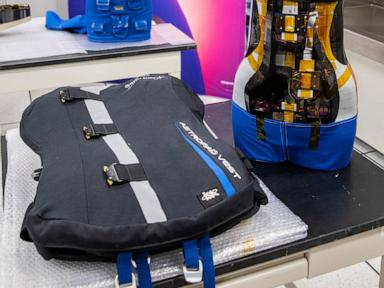
Deep space is hostile. When NASA launched the Artemis I mission, it sent more than just a spacecraft around the moon; it sent two plastic-wrapped manikins into an invisible hazard zone to test a revolutionary piece of gear. Solar storms can fry human DNA in hours. A new study shows that a specialized radiation vest could keep astronauts alive when the sun acts up.
If you want to understand how humans will ever colonize the moon or make the leap to Mars, you have to look at radiation mitigation. Space isn't empty. It's a shooting gallery of high-energy protons and galactic cosmic rays.
The Invisible Threat Beyond Earth
Earth has a powerful magnetic field. It acts like an invisible force field, soaking up the worst of space weather. Step outside that bubble, and the rules change completely.
During a solar particle event, the sun hurls high-energy protons across the solar system at terrifying speeds. If an astronaut gets caught out in the open during one of these outbursts, the resulting radiation dose can cause acute radiation sickness, organ damage, or skyrocket their lifetime cancer risk.
Space agencies used to rely entirely on heavy metal shielding built into spacecraft hulls or designated storm shelters. But heavy shielding costs massive amounts of fuel to launch. And hiding in a closet while a solar storm passes means mission productivity drops to zero.
What the Artemis I Manikin Experiment Proved
To test a smarter alternative, researchers packed the Orion spacecraft with two fake torsos named Zohar and Helga. Both were crammed with thousands of radiation sensors.
One dummy wore the AstroRad vest, a 26-kilogram garment built from high-density polyethylene. The other wore nothing at all. As the uncrewed capsule swung around the moon and passed through the intense radiation of the inner Van Allen belt, the sensors logged every single hit.
The results, published in Science Advances, blew researchers away. The vest didn't just absorb a bit of stray energy. It drastically altered the survival math for deep space crews.
When scientists plugged the Artemis data into models simulating historical solar superstorms—like the massive outbursts of August 1972 and October 1989—the performance numbers were staggering. During the 1972 storm, the vest would have cut an astronaut's radiation exposure by roughly 60 percent, dropping the dose from a dangerous 222 millisieverts down to 87.5. Even during the hyper-energetic 1989 event, it slashed exposure by about 40 percent.
Selective Shielding and the Science of Smart Protection
You can't cover an astronaut in a thick block of lead. They wouldn't be able to move. The engineers behind the vest—developed by StemRad in collaboration with Lockheed Martin—solved this through selective shielding.
Not all parts of the human body are equally vulnerable to space radiation. Stem-cell rich regions and vital organs require maximum defense.
The vest features variable thickness:
- Thicker polymer layers protect bone marrow, the lungs, the stomach, the colon, and reproductive organs.
- Thinner sections cover areas where mobility is critical, letting astronauts bend, twist, and work without feeling like they are trapped in concrete.
By protecting tissue-resident stem cells, the vest stops damaged cells from multiplying and forming cancerous mutations. It is an efficient use of mass, trading total body armor for targeted biological preservation.
What Happens Next for Lunar Explorers
NASA's career radiation limits are strict. Astronauts are only allowed to accumulate a certain amount of radiation over their working lives before they are grounded forever. A single massive solar storm can eat up a huge chunk of that allowance.
Wearing a personal radiation shield changes the logistics of long-duration spaceflight. Instead of locking down inside a cramped storm shelter and waiting out the weather for days, crew members could wear their protection while moving around the habitat or spacecraft.
Next-generation designs are moving toward modular layouts. Instead of custom-tailoring a single heavy garment for every single body shape, engineers are building adjustable systems that can scale up or down. This cuts down payload weights on cargo rockets and ensures spare parts are easy to swap out.
Space exploration is moving past the era of pure trial and error. As humanity builds permanent bases on the lunar surface, keeping crews safe from unpredictable stellar weather is non-negotiable. Wearable protection bridges the gap between ambition and survival.