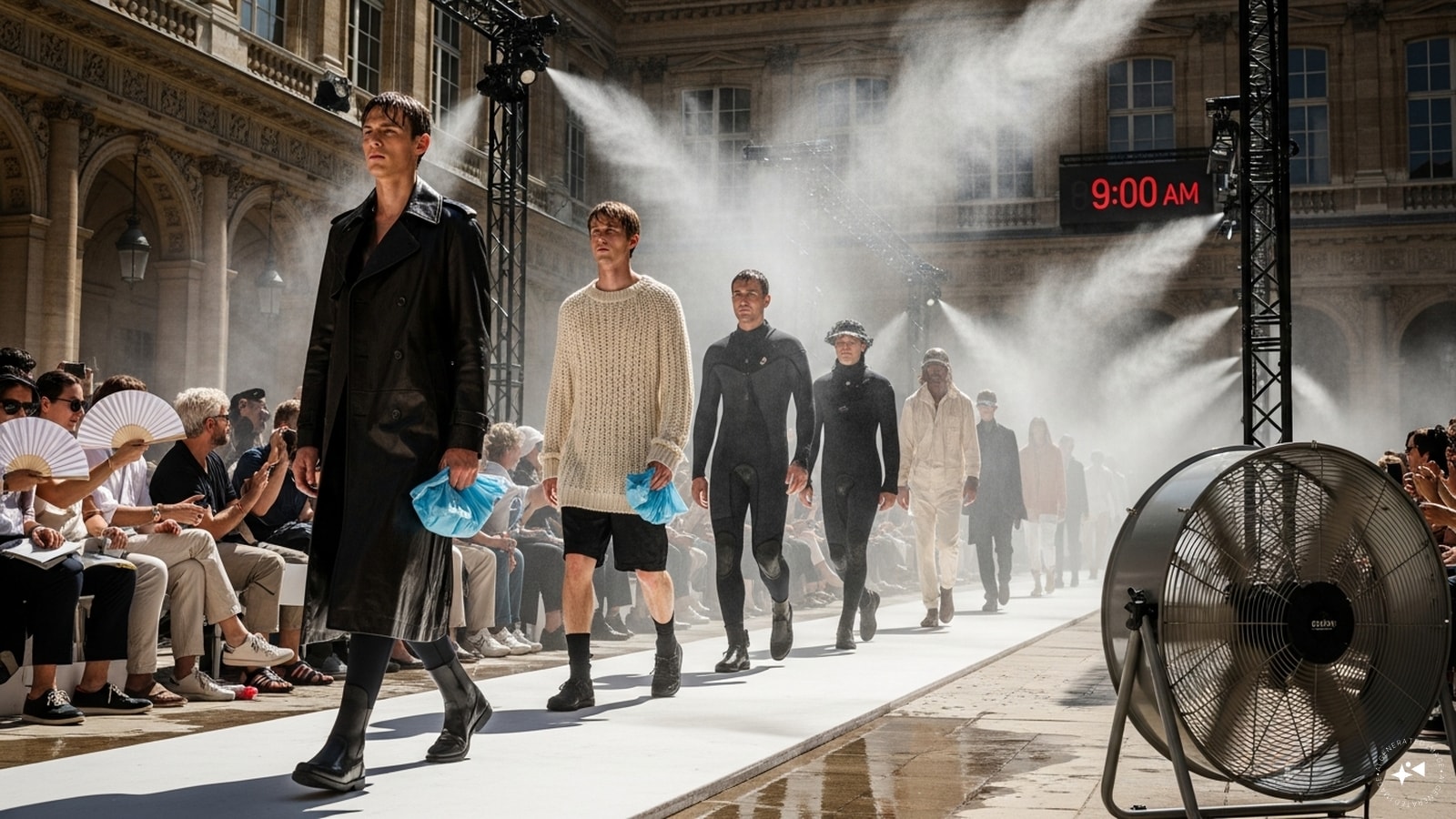
You are sitting in a historic Parisian venue, watching models stride down a runway. They are wearing heavy leather coats, thick wool knits, and layers of neoprene. The temperature inside the room is pushing past 104 degrees Fahrenheit. There is no air conditioning. Guests are pressing melting ice packs against their necks, downing lukewarm bottled water, and praying they will not pass out before the final look.
This was the chaotic scene at Paris Fashion Week Men's this June. A massive heat dome parked itself over Europe, sending temperatures soaring across France and exposing a massive structural flaw in the luxury fashion industry. It became incredibly obvious that the current system is totally broken. You might also find this connected coverage useful: Why Adopting A Stray Like Panda Is Harder And More Rewarding Than You Think.
The industry loves to talk about environmental responsibility. Yet, when faced with actual, undeniable climate shifts right outside the venue doors, the response was to hand out iced Evian on silver platters and carry on with business as usual. It did not work.
The Runway Melted in Paris This Week
The heat wave caught the industry completely flat-footed. For a week straight, the glamorous facade of high fashion cracked under the pressure of intense humidity and relentless heat. The problem was not just that people were sweating through their custom suits. The real issue is that the entire format of these historic shows relies on an environment that no longer exists. As discussed in latest coverage by Refinery29, the effects are significant.
Europe is currently the fastest-warming continent on earth. Its grandest cities are built of stone, designed centuries ago to keep heat in, not out. Paris is notoriously short on air conditioning. When you cram hundreds of fashion editors, influencers, and buyers into these historic stone buildings during a heat wave, you create a literal oven.
Organizers scrambled to adjust. Punctuality, normally a casual suggestion in the fashion world, suddenly became a matter of medical necessity. Dior moved its highly anticipated Wednesday show up from its original 2:30 p.m. slot to 9:00 a.m. to beat the worst of the midday sun. It barely helped. The morning air was already thick and heavy. Inside the venue, the lack of air circulation left guests visibly unwell. Water supplies ran dangerously low at multiple events. Critics openly wondered if they were witnessing the final days of the traditional summer show calendar.
When Wool and Leather Meet a Heat Dome
The ultimate contradiction of the week lay in what was actually walking down the runway. These are Spring/Summer collections. Theoretically, these clothes should be designed for warmer months. Instead, the runways were dominated by winter weight materials.
Look at the lineup from some of the biggest names in luxury:
- Louis Vuitton: Pharrell Williams staged a massive, visually stunning show featuring a giant artificial wave crashing onto real sand. The production value was astronomical. But look closely at the clothes. The models emerged in thick neoprene wetsuits, heavy cashmere coats, and layers of fur.
- Saint Laurent: Anthony Vaccarello sent models through thick clouds of artificial vapor inside the Bourse de Commerce. He offered some unlined jackets, but then turned the heat right back up with leather briefs, heavy choker scarves, and transparent shoes that visibly clouded with the models' sweat.
- Rick Owens: Known for dramatic presentations, Owens moved his show earlier and sent models through a wall of mist at the Palais de Tokyo. The garments actually had internal fans whirring inside them to keep the models upright. One critic called the spectacle a literal metaphor for climate catastrophe.
It is a bizarre disconnect. The world is burning, and the luxury elite are buying fur coats for July.
Splashing Cash on Mist Instead of Changing the Clothes
Across the entire week, fashion houses treated the extreme weather as a hospitality issue or a staging problem. They treated it as a minor logistical hurdle to be solved with money and branding.
If it was hot, they bought more mist machines. If guests were dizzy, they handed out branded fans and cold towels. They built elaborate waterfalls and fog installations to turn the stifling heat into "atmosphere" rather than addressing the elephant in the room.
Hardly anyone treated the heat as a core design problem.
This stems from a fundamental misunderstanding of what clothing needs to be in 2026. Fashion cannot just react to the weather by changing the set design. True innovation means changing the materials, the construction, and the utility of the garments themselves. When a brand spends millions of dollars to build an artificial waterfall but cannot figure out how to make a luxury summer coat that does not give the wearer heatstroke, its priorities are completely backward.
The Broken Retail Calendar That Rewards Global Disconnect
Why does this happen? Why do designers keep showing heavy wool and leather for summer collections?
The blame lies squarely on a fractured retail calendar that completely ignores the natural world. Jonathan Anderson, the creative force behind Loewe, admitted to reporters this week that the current calendar makes zero sense.
Luxury brands do not design for the local weather outside the window. They design for global shipping cycles and delivery windows that are wildly out of sync with actual seasons. Spring collections arrive in boutiques in the dead of winter. Autumn collections land on the racks during the sweltering heat of August.
The industry assumes its core customers spend their lives moving from one air-conditioned box to another. They assume luxury buyers step out of a climate-controlled apartment, slide into a climate-controlled vehicle, and walk into a climate-controlled restaurant. In that fantasy world, the outdoor temperature does not matter. You can wear a cashmere coat in June because you never actually feel the June air.
The historic Parisian heat wave shattered that illusion. It proved that no amount of wealth can entirely insulate the industry from a changing environment. When the infrastructure of a city like Paris strains under a heat dome, even the most exclusive guest list has to sit in the sweat.
How a Few Designers Actually Got it Right
A handful of designers chose to face reality rather than fight it with misting fans. They showed that luxury can adapt when it chooses to think creatively.
Issey Miyake’s IM Men collection provided the most practical blueprint of the week. The brand handed out ice packs at the door to handle the immediate discomfort, but the real work was on the runway. The collection, titled "In Praise of Bamboo Shadows," featured fabrics woven from bamboo thread, organic cotton, and lightweight nylon. The silhouettes were loose and intentionally moved away from the skin. They treated air as a structural component of the design, allowing the body to breathe naturally.
Jonathan Anderson also offered a glimpse of a lighter future. His collection leaned heavily into sheer silk-chiffon tailoring. It was elegant, incredibly high-end, and structurally lightweight.
Ami, helmed by Alexandre Mattiussi, embraced the reality of a sweltering city. Standing next to an industrial fan backstage, Mattiussi simply noted that Paris was burning. He then sent out a collection filled with loose shorts, washed trench coats, and casual tees. It looked like clothing a human being would actually wear to navigate a hot city.
These brands proved that lightweight, breathable clothing does not have to look cheap or unstructured. It can be just as desirable, complex, and luxurious as a heavy leather jacket.
What Luxury Fashion Needs to Do Next
The current trajectory is entirely unsustainable. Paris Fashion Week cannot continue to operate as a beautiful bubble that ignores the environment. If the industry wants to remain relevant, it needs to fundamentally overhaul how it operates.
First, the fixed global fashion calendar needs to be dismantled or completely rescheduled. Forcing hundreds of international travelers into stone buildings in the dead of summer is a recipe for operational disaster. Moving shows permanently to earlier months or shifting to regional, decentralized presentations would drastically reduce the strain on local infrastructure and lower the massive carbon footprint associated with flying thousands of people across the globe four times a year.
Second, the definition of luxury fabric must change. The industry needs to stop equating weight with value. For decades, a heavy wool coat or a thick leather skin was seen as the pinnacle of craftsmanship. In a warming world, the true luxury is temperature regulation. Brands need to invest their massive research budgets into advanced, sustainable, lightweight textiles like bamboo blends, hemp linen, and high-tech breathable weaves that offer structure without trapping body heat.
Finally, fashion houses must stop using set design to mask environmental failures. An artificial waterfall or a massive cloud of chemically produced fog is a temporary bandage on a gaping wound. True creative leadership means designing for the world we actually live in, not the world of twenty years ago.
Stop designing for an idealized, fully refrigerated world. The heat is here, it is staying, and the industry needs to start dressing for it.