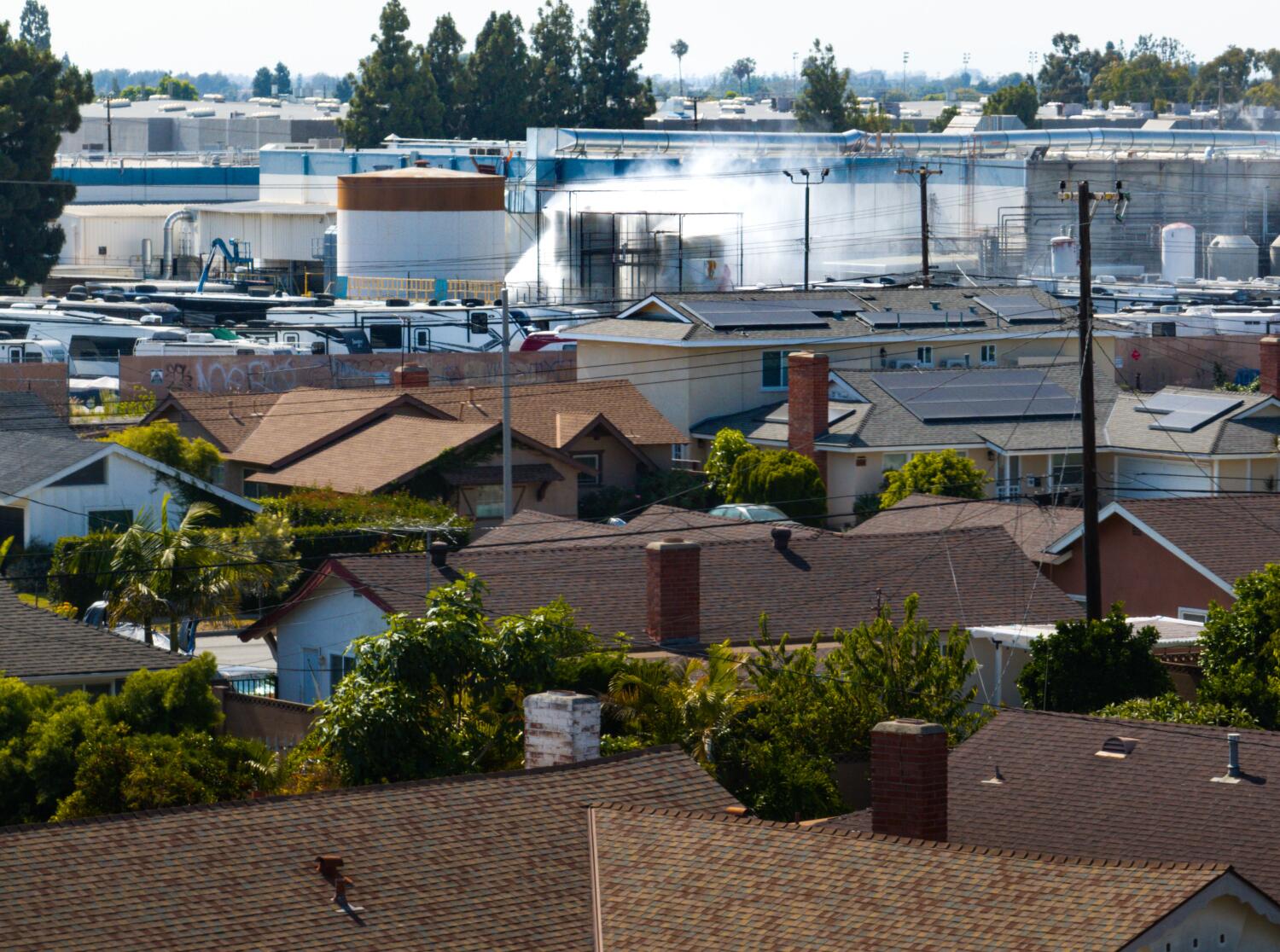
On May 21, 2026, fifty thousand people in Orange County had their lives turned upside down because a massive aerospace corporation couldn't keep a basic refrigeration valve working.
Families packed their bags in a panic. Six different cities went into lockdown. Emergency crews spent five agonizing days pumping nine million gallons of water over a boiling chemical tank that was on the verge of turning a suburban neighborhood into an apocalyptic fireball.
Now, the bill has arrived.
Orange County officials just sent a formal demand letter to GKN Aerospace. They want more than $4 million to cover the massive taxpayer expense of cleaning up the company's mess. Honestly, it's about time. For too long, industrial plants have operated right next to Southern California schools and homes, treating the surrounding community like an acceptable casualty zone. This demand letter is a line in the sand. Taxpayers shouldn't shoulder the financial burden of corporate negligence.
The Four Million Dollar Bill Sent to GKN Aerospace
The $4 million demand isn't an arbitrary penalty. It's a direct itemization of what it costs when a multi-billion-dollar company loses control of its infrastructure. The May 21 incident triggered one of the largest hazardous materials responses in the history of Orange County.
Think about the sheer scale of that response. Firefighters, law enforcement officers, and environmental specialists from dozens of jurisdictions had to drop everything. They set up unmanned water cannons, flew surveillance drones to monitor soaring internal temperatures, and manned evacuation perimeters for days. Every single hour those first responders spent on-site cost money. Every gallon of water, every piece of protective gear, and every command post vehicle added to a massive tab.
GKN Aerospace tried to get ahead of the bad press early on. They publicly patted themselves on the back for throwing $3 million into an Orange County United Way relief fund and giving another million to the Red Cross.
It wasn't enough. Not even close.
That $3 million relief fund dried up in less than a week because the sheer volume of displaced families was overwhelming. When fifty thousand people from Garden Grove, Anaheim, Cypress, Stanton, Buena Park, and Westminster are forced out of their homes over a holiday weekend, three million bucks is a drop in the bucket. Families had to pay out of pocket for hotels, meals, pet boarding, and missed work.
Orange County Supervisor Janet Nguyen recently had to step in and allocate $500,000 in discretionary funds just to help the local residents who were locked out of GKN's initial fund. Local politicians are furious, and they should be. Westminster City Council members recently voted unanimously to demand full financial accountability. City officials are making it clear that throwing a few millions at a charity doesn't absolve a company of the hard cash they owe to the local government units that saved their facility from exploding.
Inside the Western Avenue Meltdown
To fully understand why this $4 million demand is completely justified, you have to look at how close Orange County came to a catastrophic disaster.
The GKN Aerospace facility sits on a 15.5-acre site right on Western Avenue in Garden Grove. It's surrounded by residential neighborhoods. There are thirteen schools located within a few miles of the plant. The facility manufactures cockpit windows and shields for military aircraft, including components for F-35 fighter jets.
The chemical at the center of the nightmare is methyl methacrylate, or MMA. MMA is a highly volatile, flammable liquid monomer used to make plastics and resins. GKN stores it in massive industrial tanks. On May 21, a tank holding roughly 7,000 gallons of MMA began to overheat.
A critical valve in the tank's cooling system had failed. Without proper refrigeration, MMA begins a runaway chemical reaction called polymerization. The liquid heats up, turns into a gas, expands rapidly, and creates immense internal pressure.
It gets worse. As the chemical reaction intensified, it basically gummed up the very valves emergency crews needed to inject a neutralizing agent. First responders were left with few options. They had to continuously blast the outside of the tank with millions of gallons of water just to keep the temperature from crossing the point of no return.
Experts later revealed that the facility came within a hair's breadth of a Boiling Liquid Expanding Vapor Explosion. If that tank had blown, it would have ignited a massive fireball, tearing through adjacent chemical storage units and sending a toxic cloud of gas over a heavily populated urban area.
What actually saved Garden Grove wasn't a corporate safety mechanism. It was dumb luck. The tank wall cracked slightly under the intense pressure. That small structural failure allowed just enough venting to relieve the pressure and let the chemical cool down and partially solidify without triggering a catastrophic detonation. GKN got incredibly lucky, but a community shouldn't have to rely on luck to survive the weekend.
The Toxic Loophole Left Wide Open
This near-miss exposed a glaring regulatory gap in California's environmental safety laws. You'd assume that a plant storing thousands of gallons of a volatile, explosive chemical right next to homes would be subject to the strictest state oversight. You'd be wrong.
It turns out that methyl methacrylate falls outside of California's toughest accidental-release prevention regulations. Because of this legal loophole, GKN Aerospace had a basic hazardous materials business plan on file, which is essentially just an inventory list of chemicals on the property. What they didn't have was a stringent, state-vetted risk management plan designed to prevent these exact types of runaway chemical reactions.
Regulators can't say they didn't see the warning signs either. GKN has a history of compliance issues at this exact facility. Back in 2021, the company had to cough up nearly $1 million to the South Coast Air Quality Management District for a string of environmental violations. Those violations included operating equipment without permits, failing to keep proper emission records for volatile compounds, and utilizing toxic chemicals unlawfully in their plant operations.
As recently as March 2025, the company was hit with notices to comply regarding their operating records and equipment registration. They kept operating with minimal changes, and the surrounding neighborhood paid the price.
Raids, Lawsuits, and Criminal Liability
The $4 million county bill is just the tip of the iceberg for GKN Aerospace. The legal walls are closing in on multiple fronts.
On June 10, 2026, the FBI and the Environmental Protection Agency executed a federal search warrant right at the Garden Grove plant. Federal agents seized internal documents, digital devices, maintenance logs, and communication records regarding the storage and management of their hazardous substances. A federal raid of this scale indicates that investigators are looking at more than just a mechanical accident; they are hunting for evidence of systemic, knowing non-compliance or cover-ups.
Simultaneously, Orange County District Attorney Todd Spitzer launched a formal criminal investigation. His office has ordered the strict preservation of all internal telemetry data and maintenance logs. Spitzer has openly called for whistleblowers within the company to come forward, hinting that his investigators are not getting straight answers from corporate leadership. Whistleblowers have already alleged to legal teams that employees had previously complained about faulty plant conditions that could lead to a major leak or explosion.
On top of the government crackdowns, a wave of civil litigation is hitting the courts. A major class-action lawsuit is moving through the Orange County Superior Court, alongside individual mass tort claims representing dozens of displaced residents. Local attorneys note that individual claims are easily stretching into six figures due to the psychological trauma, medical bills, and forced displacement.
Residents are completely justified in their anger. During a standing-room-only Garden Grove City Council meeting, locals voiced their terror, with one resident stating that families feel like they are sleeping with a corporate monster under their beds. The community coalition is now fiercely demanding the permanent closure of the plant.
Next Steps for Impacted Orange County Families
If you live in Garden Grove or the surrounding cities and were impacted by the May evacuation, you shouldn't wait around for GKN to voluntarily do the right thing. Corporate leadership has historically dodged direct questions about long-term compensation and facility relocation. Take these proactive steps immediately to protect your health and your legal rights.
- Secure your medical records. Even if you feel fine now, methyl methacrylate exposure can cause delayed respiratory issues, skin irritation, and neurological symptoms like severe headaches or dizziness. Get a formal medical evaluation and make sure the doctor notes potential chemical exposure in your file.
- Itemize your financial losses. Pull together every single receipt from the late May evacuation window. Gather hotel bills, restaurant receipts, gas purchases, pet boarding invoices, and documented proof of any lost wages or income.
- Track local air and cleanup updates. The hazardous materials removal process is still actively ongoing at the Western Avenue site. The Orange County Health Care Agency is using an interactive online dashboard to track real-time air monitoring data as crews pump out the remaining neutralized chemicals. Pay close attention to localized odor notices and safety thresholds.
- Engage with local city actions. Attend the upcoming city council meetings in Garden Grove and Westminster. Local politicians are currently leveraging public pressure to force GKN executives into a public town hall. Your voice matters in pushing for strict zoning changes that prevent high-risk chemical storage from operating near local schools.
The days of letting massive corporations privatize profits while socializing the hazardous fallout are over. Orange County is entirely justified in demanding every single cent of that $4 million emergency response bill.
Orange County seeks $4M from GKN Aerospace over May chemical leak incident
This video provides an immediate news report detailing the official $4 million demand letter sent by Orange County leaders to hold the aerospace company financially accountable for the massive emergency hazmat response.