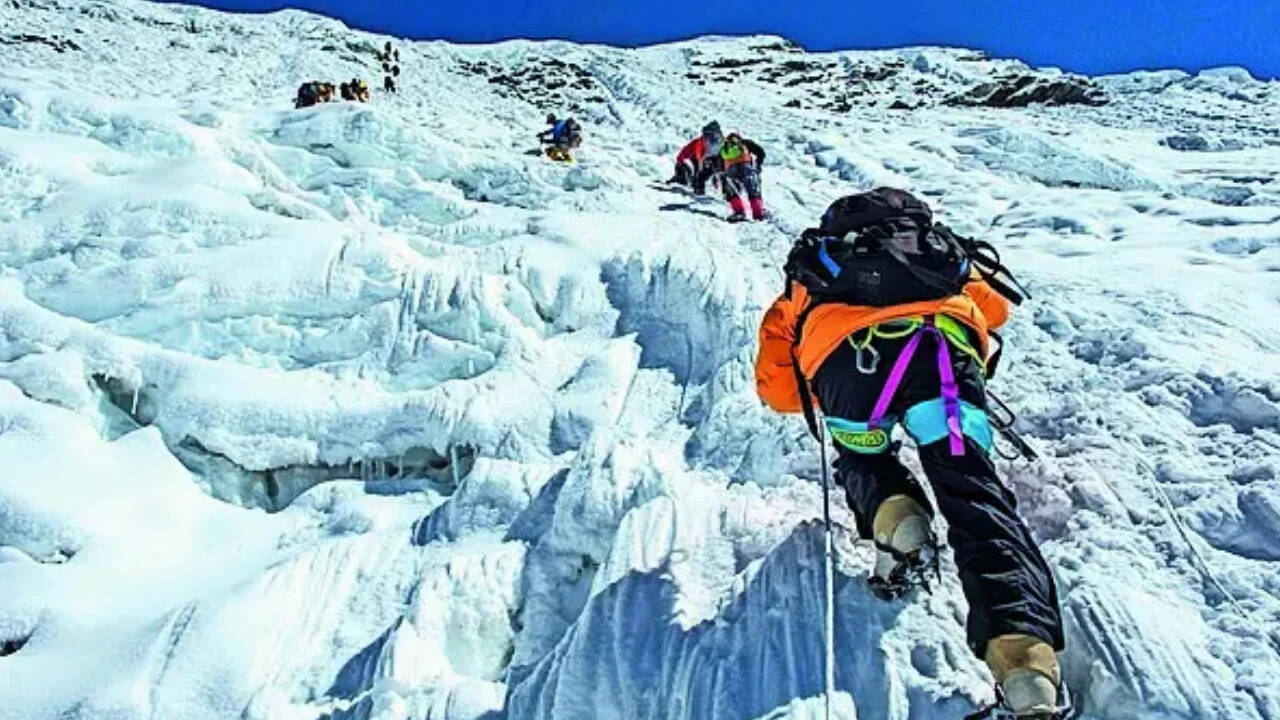
If you've got $60,000 burning a hole in your pocket and a burning desire to post a summit selfie from 8,848 meters, Nepal might be about to throw a massive wrench in your plans.
For years, Mount Everest has suffered from a deadly, open-secret problem: rich tourists paying their way onto the world’s highest peak without knowing how to put on crampons or handle basic fixed-rope ascents. But the era of the absolute novice on Everest is rapidly coming to an end. Learn more on a related issue: this related article.
Nepal's Parliament is currently hammering through the Integrated Tourism Bill, a massive overhaul of the country's mountaineering laws. Among 263 proposed amendments, one crucial requirement is shaking up the commercial climbing industry: before setting foot on Everest, climbers will likely have to prove they’ve successfully summited at least one 7,000-meter peak.
Some lawmakers want to push it even further—requiring proof of climbing a 7,000m peak and another 8,000m peak within Nepal before getting an Everest permit. Additional journalism by Travel + Leisure highlights comparable perspectives on the subject.
Here's why this rule is long overdue, what it means for future expeditions, and why the mountaineering world is divided over the fine print.
The Death Zone is No Place for Beginners
Let's cut through the romanticized rhetoric around mountaineering. In recent years, Everest has transformed into a high-altitude traffic jam.
In a single recent spring season, Nepal issued a staggering 492 permits for Everest. Toss in the essential Sherpa guides and support staff, and you had well over 1,000 people pushing for the exact same narrow summit ridge during tiny weather windows.
When inexperienced clients choke up critical chokepoints like the Hillary Step or the Balcony, people die. In 2023 alone, 17 climbers perished on Everest. At 8,000 meters—inside the Death Zone—your body is literally dying cell by cell. If the person ahead of you takes 45 minutes to execute a simple jumar transition on a fixed line because they learned it in Base Camp three days ago, your supplementary oxygen ticks away. You get cold. Frostbite sets in. Brain function deteriorates.
The proposed 7,000-meter prerequisite acts as an automatic filter. It weeds out clients who rely 100% on guide power and zero percent on personal skill. Climbing to 7,000 meters requires multi-week acclimatization, navigating complex glacier systems, enduring severe cold, and making high-altitude tactical decisions. If you can't handle a 7,100-meter mountain, you have no business standing in line at the South Col.
The Catch inside the Law
While almost every veteran mountaineer agrees with the intent of the law, the specific wording in Nepal’s draft bill has sparked heated debate across the global climbing community.
As written, the proposed amendment mandates that the qualifying 7,000m peak must be located inside Nepal.
Think about what that means. Under a strict interpretation of this text:
- If you’ve summited Aconcagua in Argentina (6,961m) or Denali in Alaska (6,190m)—both notoriously harsh, physical climbs—it won't count.
- If you’ve summited K2 (8,611m) or Nanga Parbat (8,125m) in Pakistan, you still wouldn't qualify because those mountains aren't in Nepal!
- Even Ama Dablam, Nepal's iconic, highly technical 6,812m peak that serves as the world's premier testing ground for Everest, falls just 188 meters short of the cutoff.
Critics argue this specific wording is a protectionist revenue strategy aimed at funneling permit fees and trekking business strictly into Nepal's local climbing infrastructure. Foreign guides and western operators are pushing for the law to accept qualifying peaks worldwide.
Nepal, however, holds all the cards. Half of Everest sits in Nepal, and after decades of cleaning up western-led messes and watching overloaded Sherpas risk their lives for undertrained clients, the government in Kathmandu is reclaiming control.
What a 7000m Training Ladder Looks Like
If this bill passes into law without major alterations—or if you simply want to be a responsible climber who doesn't risk other people's lives—your road to Everest is going to change.
Instead of jumping straight from a basic trekking peak like Island Peak (6,189m) or Mera Peak (6,476m) directly to Everest Base Camp, you'll need to build a true high-altitude resume.
The Nepalese government and local agencies are pushing several designated 7,000m peaks as the new stepping stones:
- Himlung Himal (7,126m): Located in the remote Nar-Phu region near the Tibetan border, Himlung has fast become the top candidate. It’s relatively straightforward, semi-technical, and offers ideal long-duration high-altitude conditioning without extreme technical ice walls.
- Baruntse (7,129m): Located in the Khumbu region, Baruntse presents a genuine expedition feel, complete with heavy load carrying, sharp snow ridges, and real cold-weather management.
- Putha Hiunchuli (7,246m): Situated at the western end of the Dhaulagiri range, this peak offers a steady, less crowded alternative for building high-altitude stamina.
Expect these mountains to get busier—and expect expedition budgets to rise. Climbing a preparatory 7,000m peak adds anywhere from $15,000 to $25,000 to your total career climbing cost, along with an extra 3 to 4 weeks of expedition time away from home.
More Than Just Altitude: The Rest of the Draft Bill
The 7,000m rule isn't the only hammer dropping on Everest operations. The Integrated Tourism Bill contains sweeping changes designed to tighten safety, authority, and environmental protections across the entire Nepalese Himalaya:
1. Banning Direct Foreign Sales: Amendments propose that all commercial expeditions must be operated and sold exclusively through licensed Nepalese agencies, preventing foreign companies from bypassing local outfitters.
2. High-Altitude Load Limits: High-altitude workers and Sherpas will have a strict weight limit capped at 20 kilograms above base camp to reduce physical exploitation.
3. QR-Code Gear Tracking: To eliminate abandoned gear and trash on the mountain, expeditions will be required to digitally tag items with QR codes at Base Camp and weigh everything back in upon descent.
4. Mandatory Local Guides: All climbing support, cooks, Sirdars, and photographic crew must be Nepalese citizens.
5. Permit Quotas and Auctions: Lawmakers are evaluating carrying-capacity limits for each peak, with proposals to auction off Everest climbing permits starting at a baseline bid of $15,000.
Actionable Next Steps for Future Everest Aspirants
If you have Mount Everest in your sights over the next few years, stop planning your 8,848m summit attempt right now and adjust your timeline.
- Audit Your Current Climbing Log: Check your documented summit certificates. If your highest point is below 7,000 meters, assume you will not get an Everest permit without adding a prerequisite climb.
- Book a Prep Expedition Early: Look at autumn season climbs for peaks like Himlung Himal (7,126m) or Baruntse (7,129m). Autumn climbs in Nepal are typically less crowded, cheaper than spring attempts, and give you an ideal environment to test your cold-weather gear and acclimatization profile.
- Secure Official Summit Certification: Make sure whatever peak you climb issues a verified summit certificate issued by the Ministry of Culture, Tourism and Civil Aviation (or equivalent national governing body), as standard agency letters may not pass committee screening.
- Budget for a Two-Year Plan: Stop expecting to go from zero to Everest in one season. Budget both time and money for a multi-stage progression: 6,000m technical peak $\rightarrow$ 7,000m Himalayan expedition $\rightarrow$ Mount Everest.
The days of buying a shortcut to the top of the world are over—and the mountain will be safer for it.