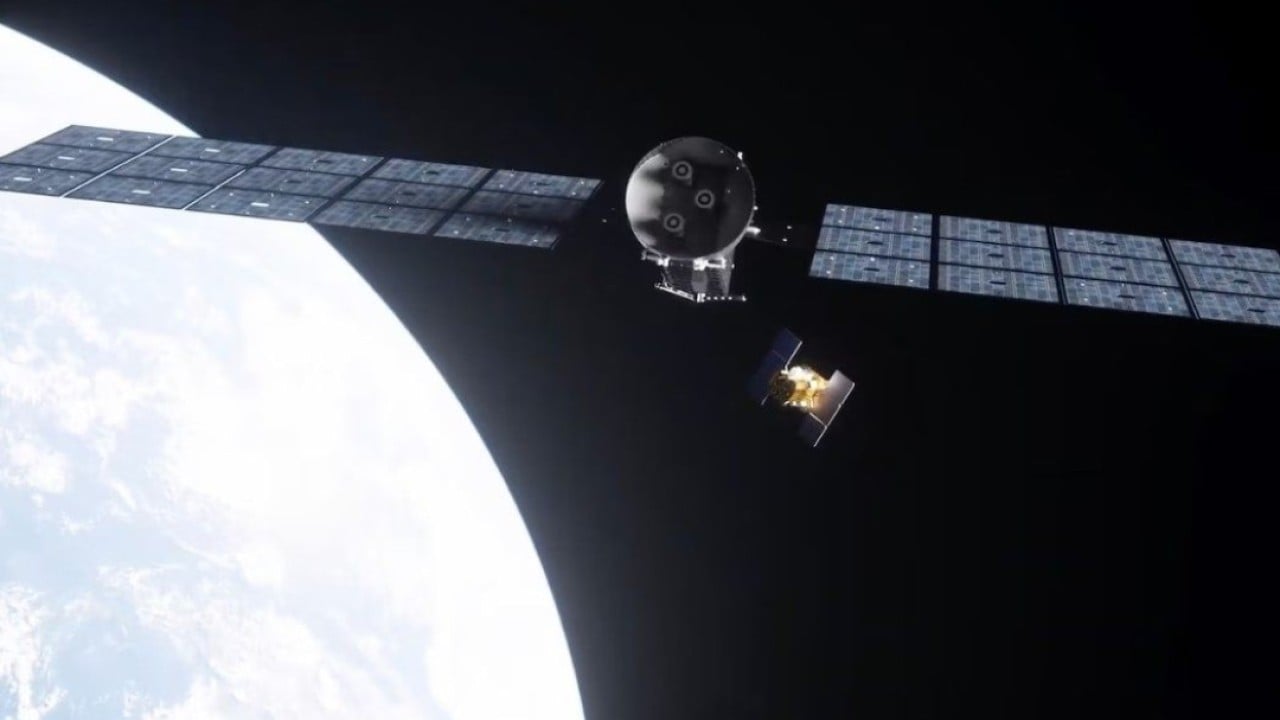
Low Earth orbit is getting crowded, but it is also getting incredibly draggy. Right now, a 1.6-ton piece of irreplaceable scientific hardware is sinking toward a fiery destruction. The Neil Gehrels Swift Observatory, a legendary space telescope that has spent over 20 years hunting down the most violent explosions in the universe, is falling out of the sky.
Instead of letting it burn up, NASA is doing something completely unprecedented. The agency just poured 30 million dollars into a high-stakes salvage mission. They hired an Arizona-based startup called Katalyst Space Technologies to launch a robotic lifesaver named Link. It is a crazy, rush-job rescue mission that could either change how we maintain things in space or end in an expensive wreck.
The sun is actively trying to kill our telescopes
Satellites do not just stay up forever on their own. Even hundreds of miles above Earth, there is a tiny bit of atmosphere. This creates atmospheric drag, which slowly bleeds a spacecraft's speed and drops its altitude. Usually, this takes decades. Lately, the sun has been acting up.
We are currently enduring an intense peak in the solar cycle. When the sun erupts with massive flares and solar storms, it pumps massive amounts of energy into Earth's upper atmosphere. That heat causes the upper atmosphere to expand outward like a balloon. Satellites that used to glide through near-vacuum are suddenly plowing through dense, heated gas.
For Swift, this has been a disaster. The telescope was launched in 2004 and originally orbited at a comfortable 373 miles up. It does not have an onboard propulsion system to boost its own altitude. Because of the solar-induced drag, it has dropped like a stone down to around 224 miles.
If it drops below 185 miles, the rescue becomes mechanically impossible. Experts predict it will hit that point of no return by October. NASA had to act fast, which means they actually turned off all of Swift's scientific instruments back in February just to buy a few extra weeks of survival time by changing its orientation.
Why Swift is worth saving
You might wonder why NASA is spending 30 million dollars on a 22-year-old telescope that was originally supposed to last only two years. The reason is simple. We do not have anything else like it, and the agency does not have the cash to build a replacement.
While the James Webb Space Telescope grabs headlines for its gorgeous images of deep space, Swift is astronomy's first responder. It is built entirely for speed. It hunts for gamma-ray bursts, which are cosmic explosions caused by collapsing massive stars or colliding neutron stars. These events release more energy in a few seconds than our sun will emit in its entire 10-billion-year lifetime.
When a gamma-ray burst happens, it flashes and fades fast. Swift is uniquely engineered to automatically detect a flash, swivel its entire body, and point its X-ray and ultraviolet telescopes at the target within minutes. It is the machine that caught the BOAT, the brightest of all time cosmic explosion ever recorded in 2022. It is also the tool that helped scientists map out exactly how precious metals like gold and platinum are forged in the chaos of colliding stars.
If Swift dies, our ability to catch these fleeting cosmic events drops to near zero.
Grabbing a satellite that has no handles
The engineering behind this rescue is terrifyingly complex. Most modern satellites intended for servicing are built with standard docking rings or grappling fixtures. Swift was built in the early 2000s. Nobody back then planned on a robot tracking it down to give it a push. It has no handles, no docking ports, and no helper markers.
Katalyst Space Technologies had to design, test, and build their Link rescue vehicle in less than a year. That is a blistering pace for the aerospace industry. Link is roughly the size of a kitchen refrigerator with a 40-foot wingspan of solar panels. To grab Swift, it uses three mechanical arms that stretch out just over three feet.
The ends of these arms feature specialized, finger-like pinching grippers. They look remarkably like the hands of a Lego mini-figure. The plan is to use these tiny claws to pinch onto structural edges of Swift without crushing the telescope's fragile golden foil insulation or snapping its solar panels.
The operational timeline is remarkably tight. Here is exactly how the rescue is scheduled to play out.
If this mission succeeds, Swift could be back online hunting cosmic explosions by September, adding up to another decade of operational life.
💡 You might also like: this guide
The bigger picture for orbital junk and Hubble
This is not just about saving one aging telescope. It is a proof-of-concept for an entirely new industry. Right now, when a multi-million-dollar satellite runs out of fuel or suffers a minor thruster glitch, it becomes a piece of space junk. We toss them away because we do not have a roadside assistance service in orbit.
China actually pulled off a similar maneuver four years ago, moving a dead satellite into a distant graveyard orbit. Link represents the first time an American space robot is going up to attempt a commercial capture of an uncooperative government satellite.
Katalyst Space Technologies is open about using Swift as a stepping stone. They are already developing next-generation robots to service satellites sitting 22,300 miles up in geostationary orbit. They want to build orbital repair shops, refueling hubs, and manufacturing platforms.
The immediate beneficiary of a success here will likely be the Hubble Space Telescope. Hubble is 36 years old and is suffering from the exact same solar drag problem as Swift. It is dropping altitude daily. Because the space shuttle program is long gone, humans cannot go up to fix it anymore. NASA is already watching this mission closely, hinting that a successful boost of Swift could pave the way for a robotic Hubble rescue mission as early as 2028.
What needs to happen next
The margins for error are razor-thin, and the countdown has already hit zero for the engineering team. To see how this affects the broader space ecosystem, keep tabs on these specific developments over the next month.
- Monitor the Pegasus XL launch telemetry from the Marshall Islands to ensure Link achieves its correct initial injection orbit.
- Watch for confirmation of the initial radar tracking lock as Link begins its autonomous approach sequence toward Swift.
- Track the daily altitude updates of the Swift Observatory to ensure solar storms do not accelerate its descent faster than Link can match it.