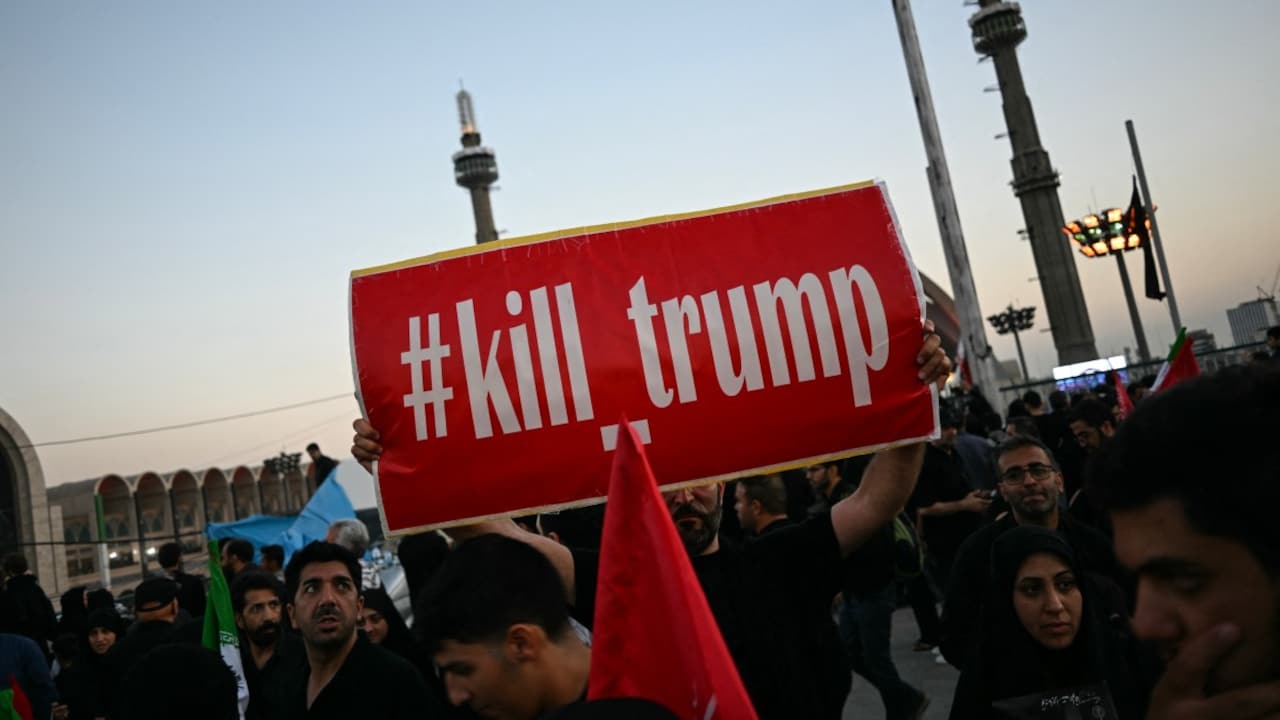
The atmosphere inside Tehran’s Imam Khomeini Grand Mosalla wasn't just solemn. It was electric with venom. Hundreds of thousands of mourners packed the streets in blistering 36-degree heat, turning a delayed state funeral into a high-stakes political theater. What started as ritualistic mourning quickly transformed into an explicit, state-sanctioned threat. The loud, public Kill Trump calls at Ali Khamenei's funeral marked a dangerous escalation in an already explosive conflict, signaling that Iran's underground leadership is coming out of hiding and they aren't looking for a quiet exit.
For months, the world wondered who was actually running Iran. Ever since the devastating February 2026 airstrikes of Operation Roaring Lion took out Supreme Leader Ali Khamenei, the upper echelons of the regime vanished. They went deep into subterranean bunkers to avoid the joint US-Israeli campaign. This funeral was their coming-out party. But instead of showing a fractured, broken government, the regime put on a calculated show of defiance.
The Calculated Choreography of the Kill Trump Calls at Ali Khamenei's Funeral
State funerals in Iran are never spontaneous. Every chant is vetted, every speaker is selected, and every microphone is controlled by the Islamic Revolutionary Guard Corps (IRGC). That is why what happened on Sunday afternoon was so significant.
Mohammad Rasouli, a well-known state poet, took the stage as the official master of ceremonies. Standing before a sea of black-clad mourners waving red flags of vengeance, Rasouli didn't stick to safe eulogies. He went straight for the throat. Over the massive loudspeakers echoing across the capital, he asked the crowd a direct question about US President Donald Trump.
"Why is the most bastard man in the world still alive?" Rasouli shouted. He didn't stop there. He told the roaring crowd that the world was no longer a safe place for the American president, declaring it a disgrace if the regime failed to assassinate the man who ordered the strikes.
This wasn't a rogue extremist blowing off steam. This was an authorized emcee executing a scripted message. The regime wanted the world, and specifically Washington, to hear those explicit threats. In the past, Iran's leaders used coded language or relied on proxy groups to whisper threats of assassination. Not anymore. By putting these words into the mouth of the funeral's official poet, the state effectively formalized the bounty on Donald Trump.
Top Leaders Reemerge from the Underground Bunkers
While the crowd screamed for blood, the real story was happening on the main stage. For the first time since the war began in February, nearly every heavyweight in the Iranian political and military apparatus appeared together in broad daylight. They had spent months dodging precision missiles. Now, they were standing side by side.
President Masoud Pezeshkian was there, trying to project administrative stability. Parliament Speaker Mohammad Bagher Ghalibaf stood nearby. But the real eyes were on the military commanders. Esmail Qaani, the elusive head of the Quds Force, made a rare appearance. Even more notable was General Ahmad Vahidi, the IRGC Commander who many intelligence analysts believe is the de facto ruler of Iran right now.
Seeing Vahidi and Qaani out in the open tells us two things. First, they feel secure enough under the current temporary funeral ceasefire to show their faces. Second, they desperately need to show the Iranian public that the chain of command hasn't been completely wiped out.
The regime is facing an existential crisis. The economy is in tatters, the military took a massive beating during the spring campaign, and the public is deeply divided. While thousands of hardcore loyalists traveled vast distances to weep over Khamenei's coffin, a large portion of the population is quietly hoping the regime collapses. Vahidi and his inner circle used this funeral to project an image of absolute control and social resilience. They want the West to believe that killing the Supreme Leader didn't break their spirit.
The Mystery of the Missing Supreme Leader
Despite the massive show of force from the old guard, there was one glaring absence that speaks volumes about the internal instability in Tehran. Ayatollah Mojtaba Khamenei, the son of the late leader and his designated successor, was nowhere to be found.
Three of Khamenei’s other sons—Masoud, Meysam, and Mostafa—stood prominently by the coffin, weeping and praying. But Mojtaba, the new Supreme Leader, remained a ghost. Official reports suggest he's still recovering from injuries sustained in the very same February airstrike that killed his father. Unofficial intelligence whispers say he's terrified of a follow-up assassination strike.
Israel has made no secret of the fact that Mojtaba remains a prime target. By staying in hiding, the new Supreme Leader avoids a missile to the face, but he also looks weak to his own people. A leader who cannot attend his own father's funeral because he's hiding in a bunker struggles to project the absolute authority required to hold Iran's volatile political factions together.
Trump's Split-Screen Response from Washington
The timing of these threats couldn't have been more dramatic. While Tehran was drowning in chants of revenge, Donald Trump was in Washington delivering a high-profile speech celebrating the 250th anniversary of American independence. The contrast was jarring.
Trump didn't mince words about the state of the conflict. He bragged openly about the effectiveness of the American military campaign over the last few months. He claimed the US had completely dismantled Iran’s military capabilities, stating plainly that the regime was dying to settle the war.
In typical fashion, Trump also couldn't resist commenting on the funeral crowd itself. He admitted to reporters that he was somewhat surprised by the sheer number of people turning out to mourn a man the West viewed as a brutal dictator. Then he dismissed the raw emotion, wondering aloud if they were just shedding fake tears under the watchful eye of IRGC enforcers.
More provocatively, Trump revealed the dark reality of the current diplomatic deadlock. He noted that the US knew exactly where all of Iran’s top leaders were gathered during the funeral. "One shot and we could take them all out," Trump said, before adding that the US chose diplomacy instead because they need someone left alive to actually sign a permanent peace treaty.
The Long History of the Plot to Eliminate Trump
We shouldn't view the threats whispered over the loudspeakers in Tehran as new rhetoric. They're the continuation of a multi-year vendetta. US federal authorities have been tracking credible Iranian assassination plots against Trump since 2020. That was the year Trump ordered the drone strike in Baghdad that killed Qassem Soleimani, the charismatic mastermind of Iran's proxy wars.
Iran never forgot, and they certainly never forgave. For the last six years, intelligence agencies have disrupted multiple state-sponsored operations targeting former Trump administration officials. The assassination of Ali Khamenei five months ago simply added high-octane fuel to an existing fire.
The intelligence community takes these threats seriously because Iran has a history of executing overseas operations. They don't just rely on standard military engagements. They use criminal syndicates, cyber warfare, and lone-wolf operatives to strike targets deep inside Western borders. With the de facto leader General Ahmad Vahidi now out of hiding and publicly backing the calls for blood, the security detail surrounding Trump will likely remain at historic highs indefinitely.
What Happens Next on the Geopolitical Chessboard
The funeral ceremonies are scheduled to last for an entire week, with processions moving to various major cities across Iran. Until those ceremonies conclude, the informal military truce seems to be holding. But once the caskets are in the ground, the clock runs out.
Tehran is trying to play a double game. On one hand, their diplomats are quietly engaged in backdoor negotiations with Washington to secure a permanent end to the war and prevent total economic ruin. On the other hand, they are screaming for the assassination of the American president to satisfy their hardline domestic base.
You can't maintain that balance forever. The next few weeks will determine whether Iran slips into a prolonged, chaotic transition of power under an absent Supreme Leader or if the IRGC launches a desperate, asymmetrical counter-offensive to prove it still has teeth.
If you want to understand where this crisis goes next, keep your eyes on these critical indicators:
- Watch whether Mojtaba Khamenei finally breaks his silence to deliver a public address, which would solidify his grip on power.
- Monitor the movement of IRGC assets back into underground facilities once the week-long mourning period ends.
- Track the progress of the quiet diplomatic channels in Oman, where negotiators are trying to hammer out a treaty before the truce dissolves.
The regime threw everything they had into making this funeral a display of strength, but the cracks are showing. The leaders are out of their bunkers, the crowd is demanding a war the country can't afford, and the target of their wrath is waiting for them to blink.
The week-long funeral procession continues to draw massive crowds across Tehran as the country navigates its deepest leadership crisis in decades. Watch this detailed report on the massive turnout and the fierce chants of revenge filling the streets of Tehran to see the raw scale of the crowd and hear the official state rhetoric firsthand.