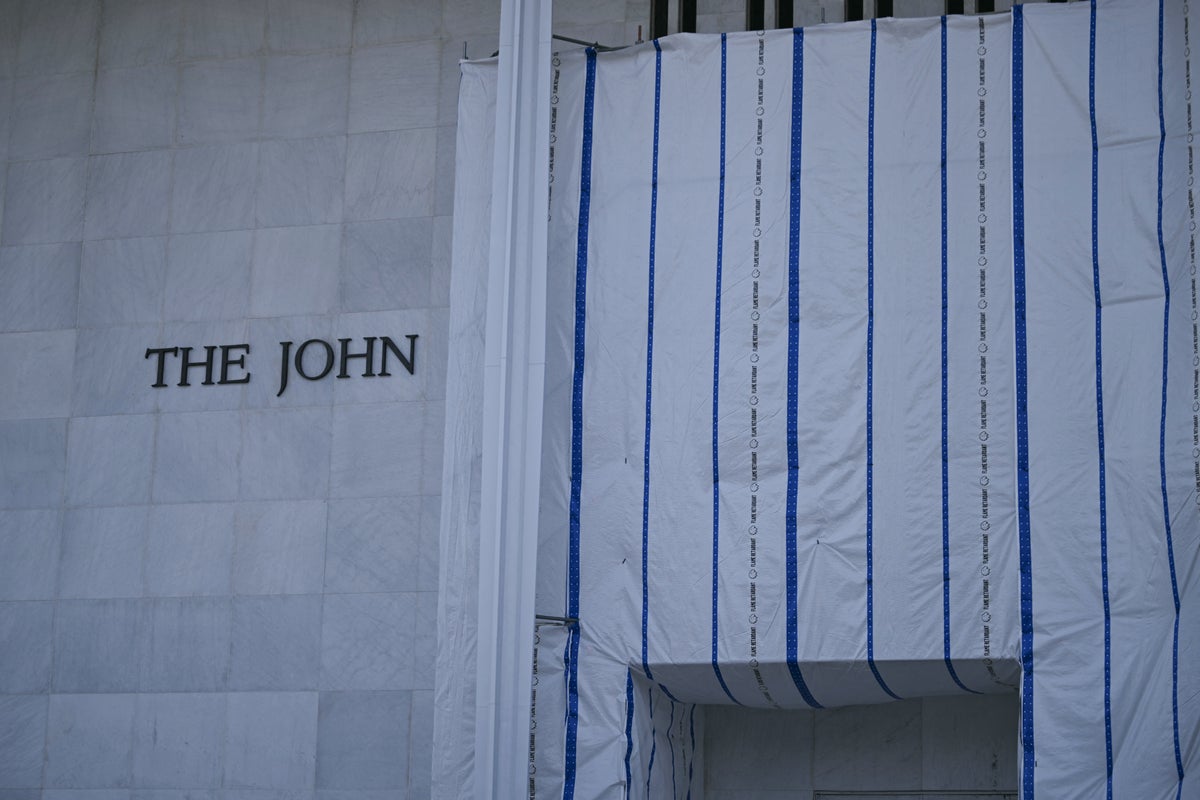
If you walk past the Kennedy Center in Washington D.C. lately, you’ll see something odd. A massive, looming wall of white tarp and steel scaffolding blocks the main entrance. It’s been there for months. People are asking questions. Why is one of America's premier cultural landmarks essentially under wraps?
It turns out, the answer is a messy mix of structural repair claims and a high-stakes legal tug-of-war over who actually gets to put their name on the building.
The official line from the institution’s legal team is straightforward. They claim the scaffolding is there because they need to perform water testing and structural repairs to the roof. They say the tarp acts as a necessary safety barrier while crews fix the marble facade—a facade that apparently sustained damage when workers were busy stripping Donald Trump's name plates off the building earlier this summer.
But if you’ve spent any time around large-scale construction projects, you know how this goes. The gap between what a lawyer says in a courtroom and what a contractor is doing on the ground can be vast.
The legal mess behind the masonry
This isn't just about a renovation project. It’s a full-blown battle over the identity of the venue. A federal judge previously stepped in, ruling that Congress intended the Kennedy Center to serve as a memorial specifically for President John F. Kennedy. The judge was clear: it shouldn't carry other names or serve as a public memorial for others via some unilateral board decision.
That order is why the Trump name came down in June. But it didn't stay down for long in the minds of the board members. The board, now heavily stacked with Trump appointees, has been pushing to bring the name back. They aren't just trying to slap a plaque on the wall, either. They’ve passed resolutions to label the area "President Donald J. Trump Plaza" and include an inscription on the building itself crediting the former president with the renovation work.
For those tracking the litigation, the scaffolding feels less like a construction zone and more like a stall tactic. Lawyers for Rep. Joyce Beatty, who has been leading the charge against these changes, pointed out that the supposed work on the "overhead soffit" is roughly 20 feet above where the actual scaffolding sits.
It’s hard to ignore that spatial reality. If the equipment doesn't reach the work area, why is it there?
Follow the money and the motives
The financial stakes here are massive. We are looking at a renovation proposal that could hit $250 million. The board has been mulling over plans that include major overhauls, with completion dates pushed out to 2028.
When you see a project of this scale, you have to look at the power dynamics. The current board is using the promise of funding and renovation to solidify a legacy. By framing the project as a necessary upgrade, they create a justification for keeping the Trump name tied to the physical structure. It’s a calculated move. Whether it survives the next round of court scrutiny is another story.
Critics argue that the board is trying to frustrate the intent of the court's order. By keeping the site under construction, they might be attempting to maintain a status quo that defies the judge’s ruling. It’s a classic strategy in administrative law: make the physical state of the building reflect your desired outcome before the courts can force you to do otherwise.
What happens next
If you are following this for the architecture or the arts, you’re stuck in a holding pattern. The board claims the name will return in some capacity by early September. They are positioning it as a way to acknowledge the funding for the renovations.
For the average visitor, the takeaway is simple. The entrance will remain obscured for the foreseeable future. If you head to the Kennedy Center, don’t expect a clear view of the historic entrance anytime soon. Expect, instead, to walk through a site that is as much a construction zone as it is a political proxy.
The next steps in this saga won't happen in the lobby. They’ll happen in the federal courthouse. Keep an eye on the filings regarding the scope of the repairs. If the court demands a transparent account of why that scaffolding needs to remain where it is, we might finally see the tarp come down. Until then, the building remains a canvas for a legal and political dispute that shows no signs of closing.
Watch the court dockets, not the construction site. That is where the real story is playing out.