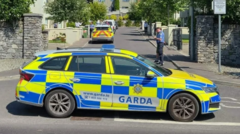
You can't just fly across the world and arrest someone because you think they committed a murder. International justice is messy, slow, and bound by strict diplomatic rules. Right now, the Irish police, An Garda Síochána, are learning this lesson the hard way as they try to track down the prime suspect in the brutal killing of Jamey Carney.
Carney, a 43-year-old mother-of-one originally from New York, was found dead on July 7, 2026, in her home off the Muckross Road in Killarney, County Kerry. She died from asphyxiation and had suffered severe head injuries. Before her body was even discovered, her 28-year-old boyfriend, Ahmad Al-Saqar, boarded a bus from Kerry to Dublin, hopped on a flight to Turkey, and vanished. He's now believed to be hiding out in tribal areas of his native Jordan.
Reports surfaced that Al-Saqar was detained by Jordan's Public Security Directorate. But don't mistake that for an extradition victory. Irish detectives didn't request that arrest. They couldn't have if they wanted to. Under Irish law, you can't request a suspect's arrest in another country until the Director of Public Prosecutions (DPP) officially approves criminal charges. The investigation is simply too fresh, and the legal hurdles ahead are massive.
The Extradition Void Between Dublin and Amman
The glaring issue here is that Ireland has no extradition treaty with Jordan. If a suspect makes it to a nation without a formal agreement, getting them back into an Irish courtroom is incredibly difficult. Justice Minister Jim O'Callaghan tried to sound reassuring, pointing out that Ireland successfully secured a one-off deal with the United Arab Emirates in the past to bring back a high-profile gangland figure.
But relying on ad-hoc diplomatic favors is a massive gamble.
Jordanian authorities aren't obligated to hand over their own citizens, especially when the suspect has retreated into tribal regions where central government control can be loose at best. The Gardaí are essentially forced to play a diplomatic waiting game, using Interpol channels to share intelligence while their own legal team scrambles to build a bulletproof case file for the DPP.
Enter the American Factor
There's a wildcard in this investigation that might completely change the dynamic: Jamey Carney was an American citizen.
Because she was originally from Westchester County, New York, Washington is paying very close attention. The United States National Central Bureau of Interpol is now actively monitoring the case. This matters because the US holds immense geopolitical leverage over Jordan, providing roughly €1.3 billion in military and economic aid to the Middle Eastern country every single year.
While Irish diplomats might struggle to get traction in Amman, pressure from elite US federal agencies could force Jordan's hand. O'Callaghan has already hinted that Ireland will use every available international channel to ensure justice is served. If the US decides to flex its diplomatic muscle on behalf of a murdered citizen, the suspect's safe haven in Jordan might shrink very quickly.
What Happens Next
The immediate next steps aren't theatrical police raids; they're bureaucratic and methodical.
First, forensic teams in Kerry must finalize their evidence gathering to prove Al-Saqar's direct involvement in the homicide. This file has to go straight to the DPP to secure formal murder charges. Until those charges are signed off, Irish police are legally handcuffed from launching an official extradition request.
Second, the Department of Foreign Affairs will need to open formal diplomatic channels with the Jordanian government to negotiate a special bilateral agreement, mirroring the strategy used with the UAE. Expect local police forces to maintain communication through Interpol to ensure the suspect doesn't slip across the border into neighboring Syria.