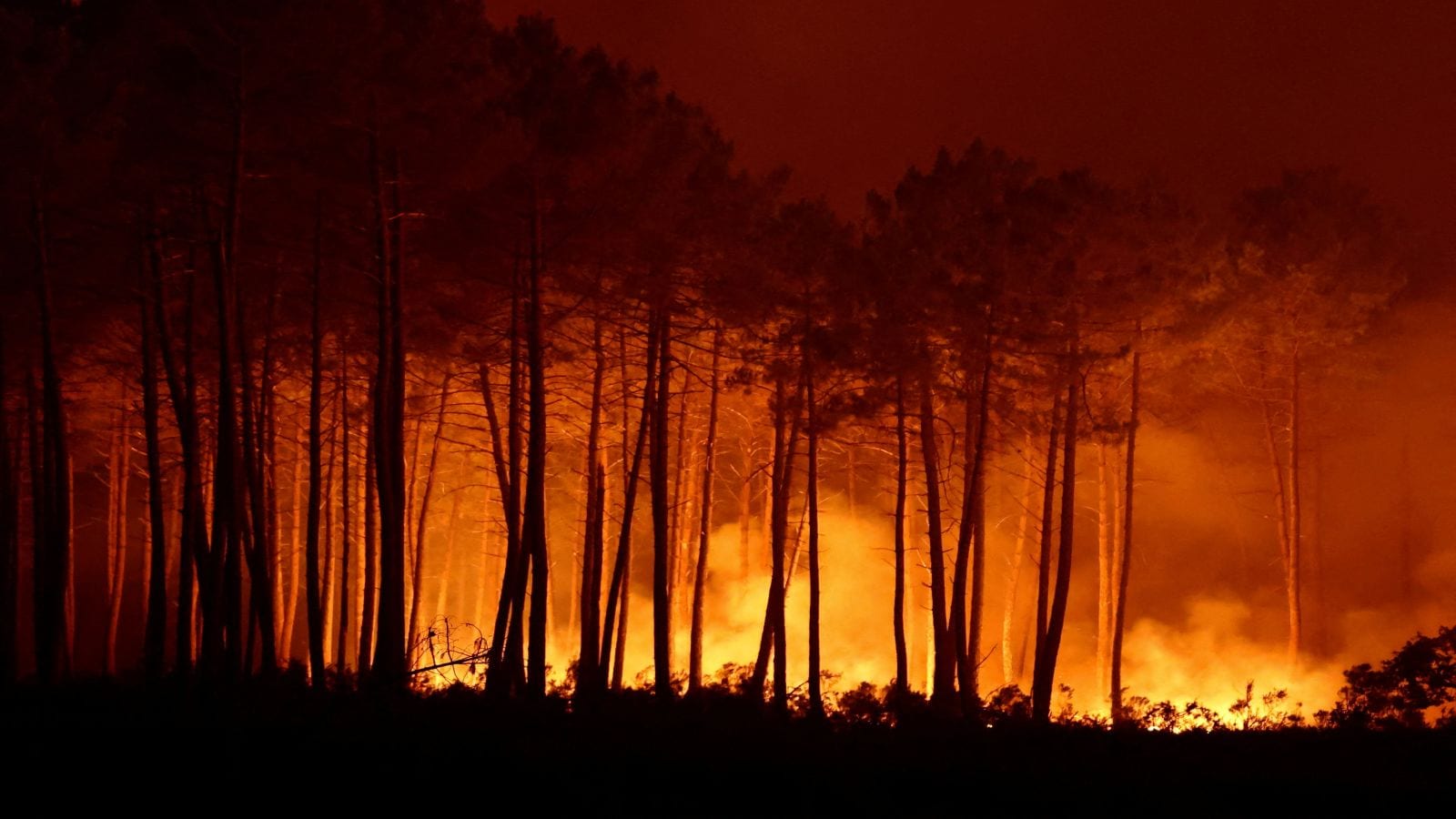
When a massive firestorm forces a country to hack away a third of its most famous sporting event just to redeploy police officers, you know the climate emergency has moved past theoretical warning lines.
That is exactly what happened in France, where raging wildfires in the Gironde region forced authorities to slash the final stage of the Tour de France. Instead of the standard route kicking off from Thoiry, Sunday's grand finale was compressed into an 89-kilometer circuit entirely contained within Paris. The missing security detail went straight to the front lines.
Over 250,000 people across France and Spain have been displaced as unusually early and punishing heatwaves transform forests into kindling. If you think this is just another seasonal brush fire, look closer at the operational chaos unfolding in southwestern Europe.
The Gironde Firestorm and the Threat to Bordeaux
The blaze began near the Cap Ferret peninsula on the Atlantic coast, roughly 60 kilometers from Bordeaux. Fueled by fierce winds and bone-dry brush, it evolved into a terrifying firestorm that generated its own internal weather systems.
Prime Minister Sébastien Lecornu noted that the intensity caught emergency crews completely off guard. By the time westerly winds began shifting toward the Bordeaux metropolitan area, mandatory evacuation orders hit mobile phones across western suburbs like Le Haillan, Eysines, and Mérignac.
Bordeaux opened a massive exhibition center to house thousands of evacuees, with local officials preparing the site to scale up to 10,000 cots if necessary. While the city's airport remained open, ground transit networks including local trams and buses faced sudden suspensions. About 140 homes vanished in the smoke, and thousands fled by boat as coastal tourist towns found themselves boxed in by walls of flame.
Heavy Machinery Versus Uncontrollable Nature
Standard firefighting trucks are useless against a wall of heat moving faster than a car. French interior ministry officials deployed an A400M military transport aircraft—normally used for heavy cargo logistics—to dump massive payloads of chemical retardant over the canopy.
This military giant joined a rotation of 18 other specialized aircraft and helicopters working through choked, smoke-filled skies. On the ground, 1,300 firefighters backed by hundreds of mobilized soldiers hacked firebreaks and dug defensive trenches.
The government also rushed 1.5 million protective face masks into the region. The air quality became toxic enough to threaten anyone left breathing outside a sealed perimeter.
Why Cutting the Tour de France Actually Matters
Critics always question the logic of prioritizing a bike race when houses are burning. But the decision to truncate the final stage was purely logistical, not symbolic.
The Tour de France requires an immense security apparatus. Thousands of police officers, traffic control units, and crowd management personnel line every kilometer of the route. By shrinking the stage down to an 89-kilometer inner-Paris loop, the Ministry of the Interior freed up hundreds of trained officers to redeploy directly to the burning southwest.
When civil protection resources hit absolute zero, national traditions get trimmed.
The Broader European Crisis
France isn't fighting alone. Across the border in Spain, 2,600 emergency personnel battled violent blazes west of Madrid that forced roughly 70,000 evacuations. Spain reported its first fatality of the wildfire wave in Valencia, a grim milestone that underscored the danger of rapid flame fronts moving too fast for direct combat.
Extreme early-summer heatwaves across southern Europe have rewritten the playbook for disaster management. Authorities are no longer dealing with isolated incidents. They are managing multi-front environmental crises that stretch national budgets, military reserves, and civilian infrastructure to their absolute breaking points.
Check local emergency alerts if you are traveling through southwestern France or northern Spain. Respect evacuation notices immediately, as air quality and rapid wind shifts leave zero margin for error.