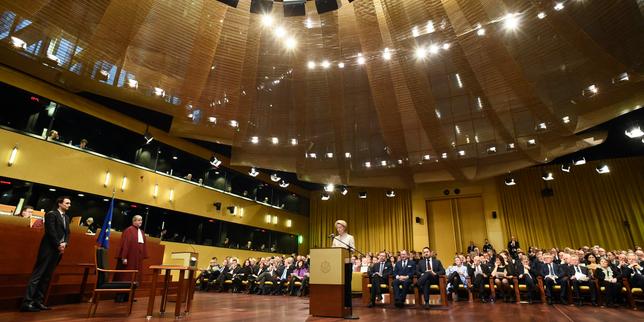
You trust the judges who shape European law to be completely neutral. You'd think that at the highest judicial level in Europe, checking for corporate or financial conflicts of interest would be automated, bulletproof, and totally transparent. It isn't.
An investigation launched by the media collective Investigate Europe alongside partners like Le Monde reveals that judges at the Court of Justice of the European Union (CJEU) have routinely ruled on massive cases involving economic sectors or corporate entities where they held personal financial stakes.
This isn't a problem of open corruption. It's a problem of institutional opacity and systemic self-policing. The Luxembourg-based court operates in a bubble where ethical vetting is left to the judges themselves, leaving European citizens in the dark about who owns what while major regulations are decided.
How the Vetting Process Breaks Down
When a major corporate case arrives in Luxembourg, you expect an independent compliance committee to run a thorough check on whether a judge owns shares in the companies involved. That's not how the CJEU works.
The court relies almost entirely on self-declaration. Judges are expected to raise their hands and recuse themselves if they feel an assignment compromises their neutrality. If they don't, the case moves forward. There is no automated cross-referencing system to catch financial ties before a judge sits on a panel.
Worse, the public cannot verify these declarations. While the European Commission publishes detailed financial declarations for its commissioners, the CJEU keeps its judges' asset declarations strictly confidential. You are asked to trust them blindly.
Real Ties in the Courtrooms
The Investigate Europe findings show that this lack of oversight has concrete consequences. Judges have repeatedly participated in rulings that directly impacted economic sectors where they, or their immediate family members, held investments.
Because the court refuses to publish full portfolios, journalists had to piece together data from national property registries, historic financial filings, and voluntary disclosures. They found multiple instances where European magistrates deliberated on regulations involving large tech platforms, banking structures, and multinational energy giants while maintaining active financial interests in those exact spaces.
When confronted, the court's typical response is that the holdings are "too small" to influence a judge's mind, or that the investments are managed via blind funds. But without transparency, the public has no way to separate a minor index fund investment from a concentrated corporate holding. The mere appearance of bias damages judicial credibility.
The Problem With Self-Policing
The European Parliament has actively pushed for tighter anti-corruption measures, specifically targeting conflicts of interest and the revolving door between public service and private lobbying. Yet, the CJEU routinely shields itself from external oversight, citing the necessity of judicial independence.
Judicial independence is vital. A court shouldn't be bullied by politicians. But independence shouldn't mean immunity from basic transparency rules. Right now, the CJEU's ethical committee is made up of its own members. They judge their peers behind closed doors. When an ethical question is raised, the internal committee decides whether a conflict exists, and their deliberations are never released.
This closed loop creates a dangerous corporate culture. It treats external scrutiny as an attack on the law rather than a normal requirement for a modern democracy.
What Needs to Change Right Now
Fixing a systemic blind spot requires structural changes to bring the CJEU up to modern ethical standards.
- Mandatory public asset declarations: Judges must publish their financial portfolios annually, matching the transparency rules enforced on the European Commission.
- Independent ethical oversight: The vetting of conflicts must be handed over to an external, independent body rather than a committee made of the court's own active judges.
- Automated screening tools: The court needs to build an internal database that automatically flags corporate litigation against a judge's declared financial interests prior to panel assignments.
Relying on a casual honor system for the most powerful court in Europe is no longer viable. True judicial authority depends entirely on public trust. If the court refuses to pull back the curtain on its internal financial interests, that trust will inevitably erode.