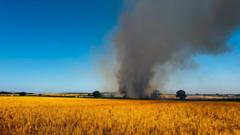
The British countryside isn't supposed to burn like this. We're used to drizzle, gray skies, and damp fields, not the sight of hillsides glowing orange in the night. Yet right now, fire crews across England and Wales are fighting at least 19 major, active wildfires. From the dry heathland of Surrey to a massive moorland blaze at Tintwistle Moor in Derbyshire, emergency services are stretched to their limits.
People want to blame the weather. Sure, we’re in the middle of our third major heatwave of 2026, with temperatures pushing past 30°C and hitting 33°C in southern regions. But focusing entirely on the thermometer misses the real problem. The truth is, we have spent two decades setting our own countryside up to burn, and now we're paying the price.
The Tinderbox We Built
We’ve changed how we manage our land, and it’s backfiring spectacularly. For the past twenty years, agricultural policies have heavily incentivized farmers to reduce livestock grazing in upland areas like our moors and heaths. On paper, the goal was noble: protect local habitats and let nature heal.
In reality, removing those sheep and cattle left massive swathes of land completely unmanaged. Without animals grazing on the young shoots, aggressive, fast-growing vegetation like gorse, heather, and dead Molinia grass has grown unchecked.
When a prolonged heatwave hits, this overgrown underbrush turns into a massive, highly combustible fuel load.
- Lush green grass doesn't catch fire easily because it retains moisture.
- Unmanaged, woody overgrowth dries out completely, acting like kindling waiting for a match.
When you couple this massive buildup of dry fuel with restrictions on traditional controlled burning—which used to help create natural firebreaks—you get the perfect storm. It's why a fire on Conwy Mountain in North Wales or the Peak District can rapidly grow to cover areas equivalent to hundreds of football pitches within hours, forcing residents to evacuate.
Why Fire Services Are Facing Extreme Pressure
The National Fire Chiefs Council (NFCC) has made it clear that our emergency services are facing extreme pressure. It isn't just about the sheer number of blazes; it's about what a wildfire actually demands from a local crew.
A standard house fire might keep a few engines busy for a couple of hours. A wildfire, by contrast, requires a committed response of at least four major appliances, specialized water carriers, and teams of firefighters working in punishing heat for six hours or more just to get a grip on the perimeter.
Wildfire Incident Demands:
- Minimum of 4 fire appliances committed simultaneously
- Crews deployed for 6+ hours per incident
- Specialized off-road vehicles and high-volume water pumps
- Constant monitoring to prevent reignition in dry soil
When you have 19 of these incidents running simultaneously across the country, local coverage completely thins out. Services like the West Midlands and Staffordshire are already taking emergency precautions to manage the spike in demand. Crews are exhausted, equipment is pushed to the limit, and the dry ground means fires can smolder underground in the peat for days, threatening to flare up long after everyone thinks the danger has passed.
The Human Spark
Nature rarely starts these fires on its own. In the UK, we don't get the dry lightning storms that spark massive forest blazes in North America or Australia. Almost every single one of our wildfires starts because of us.
A discarded cigarette thrown from a car window, a glass bottle left in the dry grass that acts as a magnifying glass under the sun, or a disposable barbecue left on the ground—these are the real culprits. Surrey Fire and Rescue recently tackled a blaze at Whitmoor Common that tore through an area the size of one and a half football pitches, sparked entirely by discarded glass.
It’s incredibly frustrating because it is entirely avoidable.
What Needs to Change
We have to stop treating wildfires as freak, unpredictable natural disasters. They are a predictable consequence of how we manage—or fail to manage—our land.
If we want to protect our rural communities, our wildlife, and our firefighters, we have to rethink our approach to the countryside.
- Bring back managed grazing: We need a balanced policy that allows upland farmers to use sheep and cattle to naturally keep vegetation levels down.
- Ban disposable barbecues in high-risk zones: Asking nicely isn't working anymore. It's time for outright bans on disposable BBQs in open countrysides, parks, and moorlands, backed by real fines.
- Create strategic firebreaks: Active land management, including cutting and controlled burning, must be used to break up massive expanses of continuous, dry fuel.
Pack up your rubbish, leave the disposable barbecue at home, and if you spot even a tiny plume of smoke in the hills, call 999 immediately. Our fire services are stretched to the breaking point, and they can't afford to fight any more preventable blazes.
To see the scale of the destruction firsthand, you can watch this news report on the UK wildfires showing firefighters battling the blazes on our dry moorlands.