Most corporate history pages read like corporate PR fluff, but the story of how Cathay Pacific transformed from a single post-war aircraft into a global aviation titan is genuinely wild. You don't build an international powerhouse in one of the world's most competitive financial hubs without taking massive risks, making brutal cuts, and surviving geopolitical chaos.
Let's look at how it actually happened.
The Humble Beginning With Betsy
Back in 1946, the world was picking up the pieces after the Second World War. Two former pilots—American Roy Farrell and Australian Sydney de Kantzow—bought a single Douglas DC-3 aircraft. They nicknamed her "Betsy."
They didn't start with a grand vision of a five-star airline. They started by flying wool, machinery, and general cargo from Australia up to China. It was scrappy, dangerous, and entirely dependent on the physical endurance of two guys and one plane.
When colonial authorities in Hong Kong noticed what they were doing, the airline was officially founded on September 24, 1946. But they quickly realized cargo alone wasn't going to pay the bills long-term. Passenger demand was surging as displaced people and expats tried to navigate a drastically shifting Asia.
The Swire Partnership That Changed Everything
Operating an independent airline in the late 1940s was a financial roller coaster. Regulations were messy, fuel was expensive, and capital was hard to come by.
Enter John Swire & Sons.
In 1948, Swire took a major stake in the airline. This single move provided the financial muscle and corporate backbone required to survive. While other regional carriers went under during economic downturns, Cathay had the backing of a massive British trading conglomerate that knew how to operate in Asia inside and out.
With secure funding, the airline stopped acting like a local air-taxi service and started buying better regional planes, like the Lockheed Electra in 1959. Suddenly, Tokyo, Bangkok, and Singapore were within regular reach.
Entering the Jet Age and the Jumbo Era
You can't talk about Cathay Pacific's rise without talking about the Boeing 747.
In 1979, the airline took delivery of its first jumbo jet. That airplane changed the math of long-haul travel. Instead of making multiple refuelling stops to get to Europe or North America, passengers could fly direct from Hong Kong.
The 1980s turned into a massive expansion boom. Cathay added flights to London, Vancouver, San Francisco, and across Europe. They didn't just compete with legacy Western carriers; they often beat them on service quality, introducing things like dedicated cargo services and advanced personal entertainment systems years before competitors caught on.
Surviving Kai Tak and Moving to Chek Lap Kok
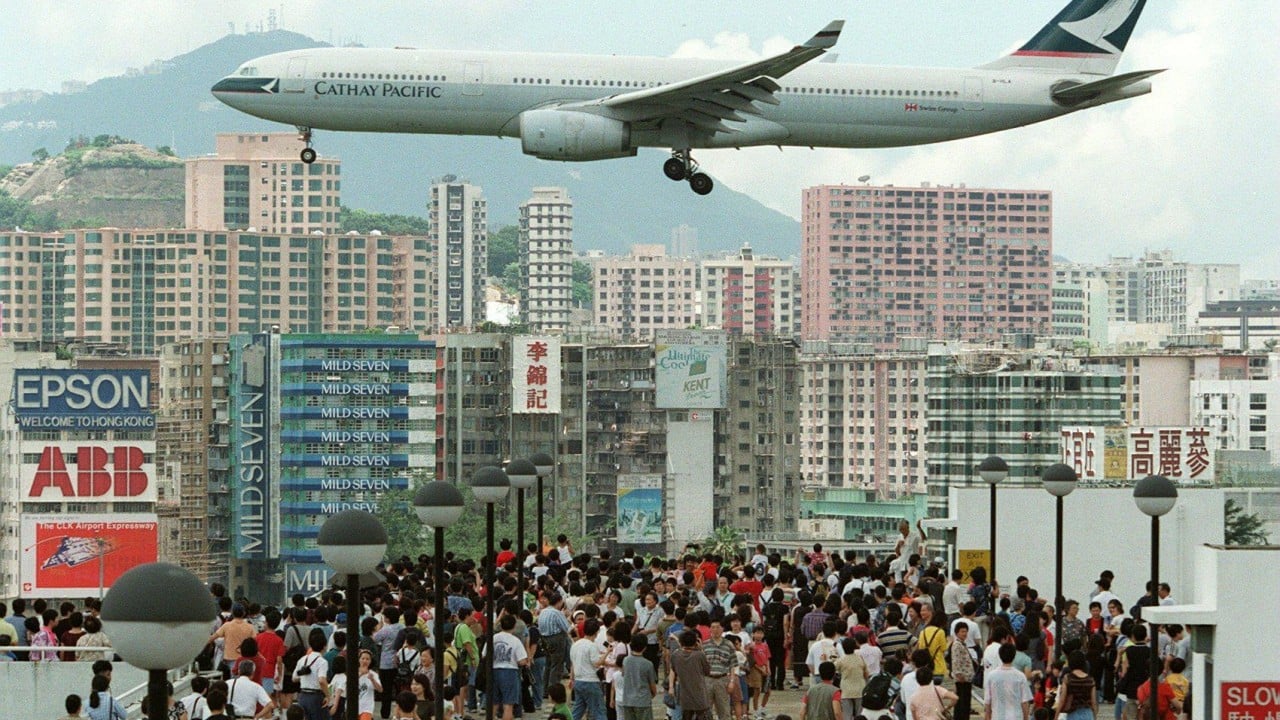
Every frequent flyer who remembers old Hong Kong aviation remembers Kai Tak Airport. Landing there was a heart-stopping experience. Pilots had to navigate low over Kowloon apartment buildings, banking sharply past checkerboard markers to hit a single runway jutting out into Victoria Harbour.
Cathay owned that airspace. But by the late 1990s, Kai Tak was completely maxed out.
The transition to Chek Lap Kok on Lantau Island in 1998 wasn't just a relocation; it was a logistical nightmare executed overnight. Cathay operated the very last flight out of Kai Tak (bound for London) and welcomed the new airport with the historic "Polar One" non-stop flight from New York. That move unlocked massive capacity and allowed the airline to scale up to the mega-carrier status you see today.
Bouncing Back From Turbulence
It hasn't all been smooth cruising. Cathay has weathered severe shocks over the decades—from the 1997 handover, the 2008 financial crisis, and major pilot labor disputes, to the absolute devastation of the COVID-19 pandemic when most of the fleet was grounded.
Yet, the core DNA forged by Farrell, de Kantzow, and Swire keeps pulling them through. They restructured, trimmed fat, and doubled down on premium regional connectivity.
Today, operating alongside sister brands like HK Express and managing massive cargo fleets, Cathay proves that survival in aviation requires relentless adaptability. You can't rely on past glory when fuel prices spike and global travel habits shift overnight.
If you are tracking how iconic global brands evolve, look closely at their operational resilience, not just their marketing campaigns. Study their balance sheets during crises, analyze how they acquire regional competitors, and watch how quickly they upgrade passenger cabins when luxury expectations change. That is where the real aviation playbook lives.