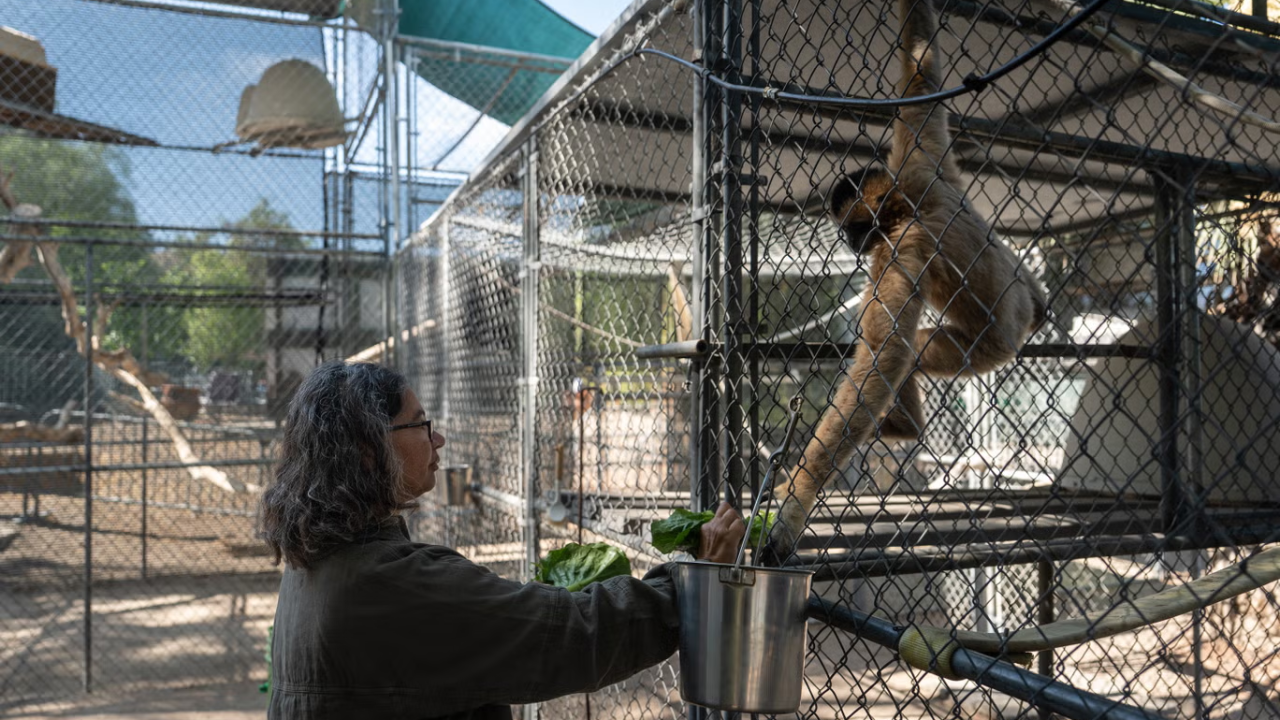
Dawn breaks over the dry, dusty hills of the Santa Clarita Valley north of Los Angeles. Before the sun fully clears the horizon, a strange noise splits the morning air. It sounds like a cross between an emergency siren, a booming football stadium chant, and a chorus of high-pitched bird screeches.
This is the morning song of the Gibbon Conservation Center. For fifty years, this ten-acre sanctuary has operated quietly on the edge of suburban Southern California. Right now, it houses roughly forty gibbons across five distinct species. Some of these small Asian apes face populations numbering fewer than two thousand individuals left in the wild.
Most people don't realize how close these primates are to vanishing entirely. Deforestation in Southeast Asia and the brutal illegal pet trade are wiping them out. This California facility tells a rare story of survival against the odds.
How a House Painter Built an Ape Sanctuary
The place exists because of one man's obsession. Back in 1976, a self-taught primatologist named Alan Mootnick answered a newspaper ad to buy a pet gibbon named Spanky. Mootnick didn't have a fancy biology degree or backing from a major university. He ran a home painting and remodeling business in the Los Angeles area.
He used the profits from his painting business to buy a 10-acre plot of land in 1980. He turned that dirt lot into the premier institution for gibbon research and protection in the Western Hemisphere. Scientists used to send him audio recordings of calls or blurry photographs of rescued animals just to figure out what species they were looking at. Mootnick knew his stuff better than almost anyone alive.
When Mootnick died unexpectedly in 2011 from heart surgery complications, the future of the sanctuary hung in the balance. Enter Gabi Skollar. She had moved from Hungary to California in 2005 specifically to study under Mootnick. Instead of leaving after her studies wrapped up, she stayed to keep the gates open. She now runs the daily operations alongside a dedicated crew of animal caretakers and volunteers.
Inside the Daily Chaos of Primate Care
Running a refuge for endangered apes isn't glamorous work. It means endless cleaning, chopping, and cooking. Staff members like longtime caretaker Jodi Kleier prepare meals five to six times a day. The menu features washed lettuce, steamed sweet potatoes, and chopped bananas. This frequent feeding schedule is designed to mimic how gibbons forage in the wild, constantly moving and snacking instead of eating massive meals all at once.
Caretakers sometimes have to step in when nature goes off script. Kleier hand-reared a young gibbon named Rocky after his mother abandoned him right after birth—a heartbreaking reality that sometimes happens with first-time primate mothers dealing with difficult deliveries. Rocky survived, grew up, and even earned a permanent spot tattooed on Kleier's thigh.
Every resident here has a distinct personality. Pepper, a young northern white-cheeked gibbon, usually kicks off the morning screaming sessions. A pileated gibbon named Violet joins in with her partner Truman to round out the duet. Then there is Pierre, a rescue who holds a fierce grudge against male visitors and makes sure everyone knows it with his booming calls.
Why Captive Breeding Programs Save Species
People often question the ethics of keeping wild animals in enclosures. But for animals facing total habitat collapse, specialized facilities like this one serve as an essential lifeboat.
The center meticulously manages breeding programs to protect genetic diversity across family groups. One of its crowning scientific achievements was becoming the first facility anywhere to successfully breed the critically endangered Javan gibbon in captivity. Native to the Indonesian island of Java, these ghostly-sounding apes face relentless pressure in their native forests. Facilities share animals with accredited zoos to keep populations stable, such as preparing pairs of northern white-cheeked gibbons to move to the Pittsburgh Zoo.
The Ongoing Threat of the Exotic Pet Trade
Apes do not make good house pets. They look cute when they are tiny, but they grow up fast, possess immense strength, and have complex social needs that a living room couch cannot satisfy.
Too many people buy exotic animals illegally, only to surrender them or abandon them once they become unmanageable. Sanctuaries like the one in Santa Clarita absorb the casualties of the illegal pet trade. By partnering with local educational programs—including the teaching zoo at nearby Moorpark College—the center trains the next generation of animal keepers to spread the message that wild animals belong in the wild.
Fifty years down the line, the mission hasn't changed. The founders are gone, but the morning songs keep echoing across the dry California hills, reminding anyone who listens what is at stake.
If you want to support their work, skip the roadside attractions that exploit wildlife, donate directly to accredited sanctuaries, or plan a weekend visit to see how these remarkable primates live when given a safe place to call home.