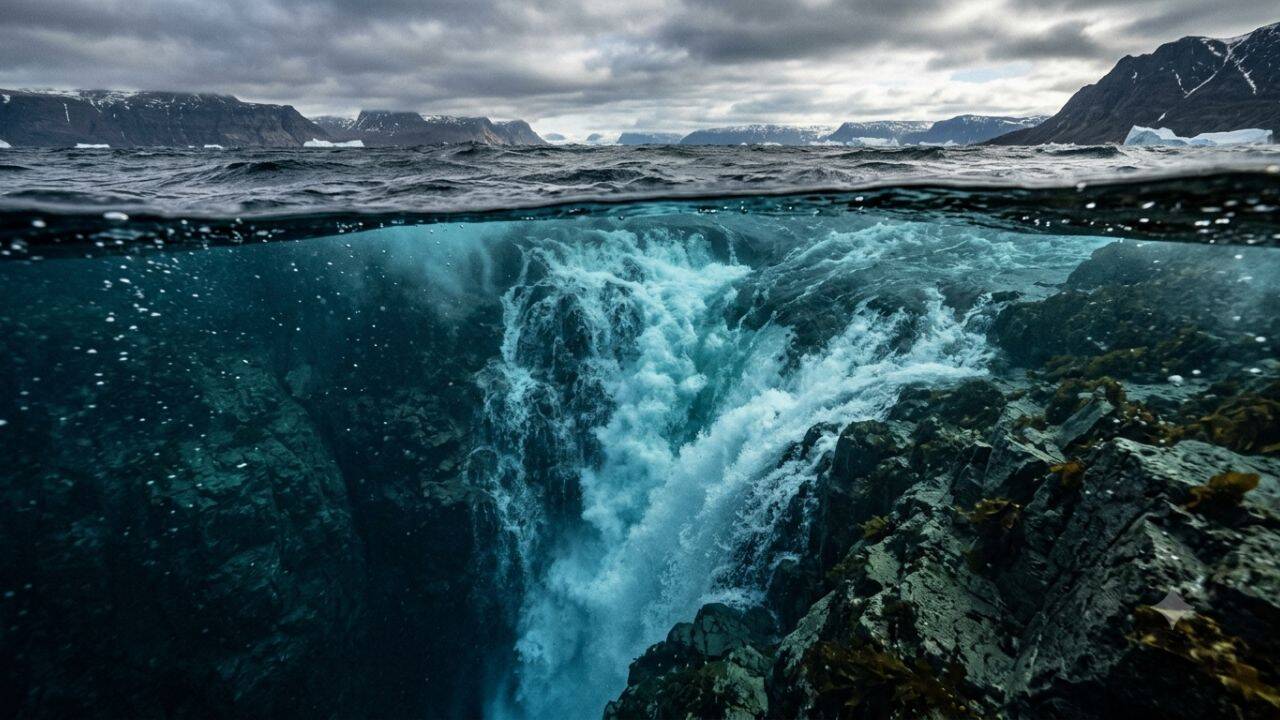
If you ask almost anyone to name the biggest waterfall on Earth, they'll usually point to Angel Falls in Venezuela or maybe Niagara Falls on the US-Canada border. They're completely wrong. The world's largest waterfall isn't on land at all. It sits hidden hundreds of meters beneath the choppy, freezing surface of the North Atlantic Ocean between Greenland and Iceland.
It's called the Denmark Strait cataract. Every single second, roughly 3.5 million cubic meters of freezing ocean water plunge down a submarine drop over three kilometers tall. That's over 3.5 billion liters of water cascading downward in a single second. To put that in perspective, Niagara Falls moves roughly 2,400 cubic meters per second during peak flow. The Denmark Strait waterfall carries well over 1,000 times that volume.
You can't buy a ticket to see it. You can't fly a drone over it to take photos for Instagram. If you sailed a boat right over the top of it today, you wouldn't feel a bump or see a spray of mist. Yet this invisible underwater monster shapes global ocean currents and keeps North America and Europe temperate.
Here is how Earth's biggest waterfall actually works, why it exists in the ocean, and why oceanographers are watching it with extreme urgency today.
How an Underwater Waterfall Actually Works
At first glance, an underwater waterfall sounds like a physical impossibility. How can water fall through water?
The short answer is density.
Water isn't all the same weight. Cold water is significantly denser than warm water because its molecules pack together much tighter. Salty water is also heavier than fresher water. In the Denmark Strait, two massive ocean currents meet head-on.
From the north, freezing Arctic water flows down through the Nordic Seas via the East Greenland Current. It's icy, super-dense, and heavy. From the south, warm water from the Irminger Sea flows north near the surface.
Right between Greenland and Iceland sits an underwater mountain ridge called the Greenland-Iceland Rise. The ridge rises up to about 600 meters below the sea surface.
When that freezing, heavy northern water hits the top of the ridge, it doesn't mix right away with the warmer Atlantic water. Instead, gravity grabs the heavy cold water and pulls it down. It spills over the edge of the ridge and plummets straight down the sloping seafloor into the deep Irminger Basin.
The drop is staggering. The vertical distance from the ridge top down to the ocean floor is around 3,500 meters (11,500 feet).
For comparison:
- Angel Falls (Venezuela): 979 meters tall
- Burj Khalifa (Dubai): 828 meters tall
- Denmark Strait Cataract: ~3,500 meters tall
The Denmark Strait cataract is more than three times taller than the highest land waterfall on planet Earth.
What the Downward Cascade Feels Like Deep Down
Don't picture a sheer, white-water vertical drop like Yosemite Falls. Because the falling water is moving through surrounding liquid, it moves slower than water falling through air.
The dense current hugs the ocean floor as it slides down the continental slope. It moves at about 0.5 meters per second (around 1.1 miles per hour). That sounds slow until you remember how wide and thick the stream is. The descending column of dense water is roughly 200 meters thick and spreads out across miles of the seafloor.
Another fascinating detail: Earth's rotation messes with the water as it falls. Thanks to the Coriolis effect in the Northern Hemisphere, the falling current gets deflected to the right. As a result, the water piles up roughly 1,000 meters higher on the Greenland side of the underwater channel than on the Iceland side. It's a tilted waterfall.
As this cold liquid crashes down the seafloor, it pulls surrounding seawater into its stream, a process oceanographers call entrainment. By the time it hits the bottom of the ocean, the total volume of moving water has expanded even further.
Why the Denmark Strait Waterfall Controls Global Climate
This isn't just an interesting trivia point to surprise friends at a bar. The Denmark Strait overflow is an essential engine driving global ocean circulation.
Oceanographers refer to this system as the Atlantic Meridional Overturning Circulation, or AMOC for short. Think of AMOC as a massive planetary conveyor belt. Warm, tropical surface water flows north toward Europe, releasing heat into the atmosphere and keeping places like Great Britain and Scandinavia significantly warmer than they should be given their latitude.
Once that surface water reaches the far north, it cools, freezes into sea ice, loses heat, gets denser, and sinks. The Denmark Strait cataract acts as the primary drain plug where that cold deep water surges back south toward the equator.
Without this constant, heavy plunge of deep water in the North Atlantic, the entire conveyor belt slows down. Oceanographers estimate that the Denmark Strait overflow supplies about half of all the deep cold water flowing into the deep North Atlantic.
If you turn off the waterfall, you alter weather patterns across the globe.
How Scientists Actually Measure Something Invisible
Since humans can't swim down 3,000 meters in sub-zero water, how do we know any of this is happening?
Researchers rely on specialized moorings anchored directly to the sea floor across the strait. These moorings hold long lines of sensors that sit suspended in the water column for years at a time.
They record three main metrics:
- Temperature: Identifying where cold Arctic water meets warm Atlantic water.
- Salinity: Measuring salt concentrations, which dictate weight.
- Acoustic Doppler Current Profilers (ADCPs): Bouncing sound waves off particles in the water to calculate flow velocity and volume.
Oceanographic vessels also conduct ship surveys, dropping sensors (called CTDs) from the surface down to the seabed. Combining satellite data of surface currents with deep-sea anchor readings gives scientists a 3D picture of this undersea giant.
The Real Danger Facing Earth's Underwater Engine
Is the Denmark Strait cataract in danger? Oceanographers are actively researching that exact question.
As polar ice caps melt at accelerated rates, massive amounts of fresh, cold water pour into the Nordic Seas. Fresh water is much lighter than salty ocean water. If the water flowing toward the Denmark Strait becomes fresher, it loses density. Less density means it doesn't sink as quickly or forcefully over the ridge.
If the density difference between the northern water and southern water shrinks, the underwater waterfall slows down. A weaker waterfall means a weaker Atlantic conveyor belt.
Scientists have already documented shifts in localized ocean currents near regional overflows. While the Denmark Strait overflow hasn't collapsed, monitoring it is crucial for predicting sea level changes, European weather patterns, and global storm intensity over the coming decades.
How to Learn More About Ocean Circulation
You can't take a boat cruise to view the Denmark Strait cataract, but you can track real-time research on deep-sea currents and oceanography.
Here is what you should explore next:
- Track NOAA Ocean Exploration: The National Oceanic and Atmospheric Administration regularly publishes deep-sea bathymetry maps and updates on North Atlantic currents.
- Read up on AMOC Studies: Look up published research from the Woods Hole Oceanographic Institution (WHOI) or the National Oceanography Centre (NOC) regarding North Atlantic overflow monitoring.
- Explore Ocean Mapping Tools: Check out GEBCO (General Bathymetric Chart of the Oceans) to view 3D topographic maps of the ocean floor between Iceland and Greenland.