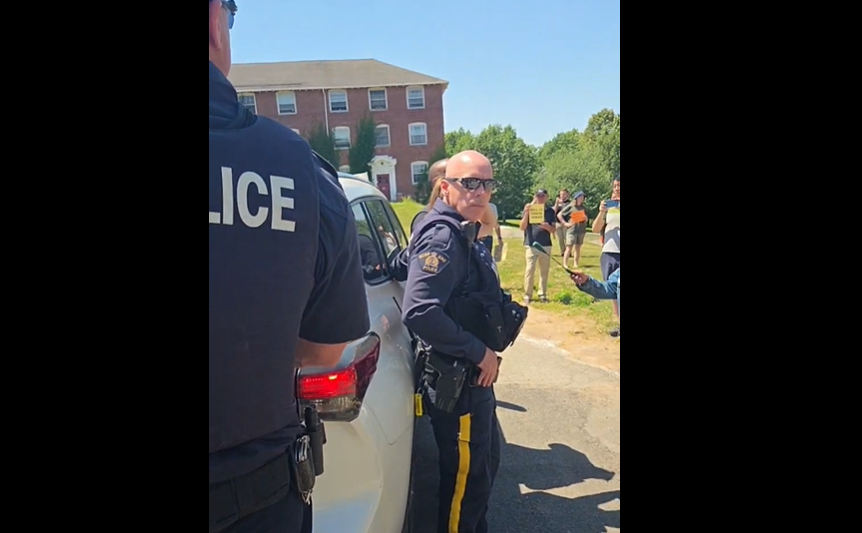
What happened on the Acadia University campus on July 15, 2026, wasn't just a security scare for Nova Scotia Premier Tim Houston. It was the physical boiling point of a state of tension that has been quietly simmering across the province for months. When a premier’s vehicle is swarmed, people climb on the hood, and a windshield is shattered while the province's leader sits inside, something has broken in the democratic contract.
You can look at the shattered glass of Houston's SUV and see a simple act of property damage. But to understand why a routine stop on a business-friendly tour turned into a tactical extraction by the RCMP, you have to look at the policies, cuts, and frustrations that laid the groundwork. Read more on a connected issue: this related article.
This isn't just about a protest that crossed the line. It's about a growing divide between a government laser-focused on resource extraction and a public that feels completely shut out.
The Wolfville Spark
On July 15, 2026, Premier Tim Houston kicked off what was meant to be a smooth summer speaking tour of local chambers of commerce. The first stop was Wolfville, N.S., specifically an event hosted by the Annapolis Valley Chamber of Commerce at Acadia University. Additional analysis by Associated Press highlights similar perspectives on the subject.
The day started with a modest crowd of about 50 peaceful protesters. Their immediate focus was hyper-local: protesting potential closures of five libraries in the Annapolis Valley. But as Houston spoke inside, the energy outside shifted. The crowd grew larger and the issues became broader. By the time the premier tried to leave, a diverse coalition of activists—ranging from environmentalists to Mi'kmaw treaty defenders—had blocked his path.
What happened next is a matter of fierce debate depending on who you ask:
- The Premier's Office Account: Houston's team released a statement condemning an "extreme faction" and "rioters" who turned the event violent. They claim people blocked the vehicles, pushed police officers, climbed onto the premier's SUV, and smashed the windshield with the premier inside.
- The Protesters' Perspective: Local advocates, including Joey Brooks, who recorded the confrontation, argue that Houston wasn't in danger but was simply refusing to talk. They claim the vehicle pushed into the crowd, alleging that two protesters were injured—one during an arrest and another by the vehicle itself.
- The Police Response: The RCMP stepped in, escorting Houston back into the university building for safety. He eventually left the campus in a marked RCMP cruiser. One man was arrested but released without charges.
While the physical confrontation made headlines, the real story lies in why the crowd was so angry in the first place.
This Is Not an Isolated Incident
You can't separate the Wolfville confrontation from the massive protests that took over Province House in Halifax earlier this year.
In early 2026, the Houston government handed down a budget designed to tackle a massive $1.2-billion deficit. To balance the books, the province eliminated or reduced more than 280 community grants, cutting $130.4 million in funding. These weren't abstract numbers. They were direct hits to:
- Arts and culture funding
- Scholarships and educational support
- Caregiver benefits and disability supports
- Indigenous-led programming and African Nova Scotian initiatives
At the same time, the government has aggressively backed resource extraction. They lifted a decades-old moratorium on uranium mining and took heat for laws that heavily fine activists who block logging roads. To many, the message seemed clear: corporate interests were being prioritized over community preservation.
When you slash funding for local libraries and community projects, and then refuse to meet face-to-face with the people affected, tension builds. Wolfville was the moment that pressure cooker blew its lid.
The Line Between Protest and Property Damage
There is a massive difference between a loud protest and smashing a windshield.
NDP Leader Claudia Chender pointed this out perfectly. While she acknowledged that Nova Scotians have deeply valid frustrations with the government's budget, she made it clear that property damage and safety threats do nothing to help the cause.
When a protest turns destructive, it shifts the media narrative completely. Instead of discussing the loss of local libraries or the concerns of Mi'kmaw treaty defenders, the public conversation becomes entirely about police escorts and broken glass. The real issues get buried under the spectacle of conflict.
What Happens Now?
If you are a Nova Scotian watching this unfold, this situation demands more than just taking sides. It requires a hard look at how public engagement is failing.
First, the provincial government needs to realize that hosting business-focused chamber of commerce tours while ignoring wider community concerns is a recipe for further unrest. If leadership only speaks to friendly rooms, the unfriendly rooms will find them on the street.
Second, advocacy groups must protect the integrity of their message. The moment a protest is hijacked by property damage, the leverage to demand a meeting with policy-makers evaporates.
The premier’s tour is scheduled to move on to Yarmouth, and a formal budget engagement process is slated for the fall. If the provincial government wants to avoid another scene like the one at Acadia University, they need to start treating public consultation as a core duty, not an afterthought.