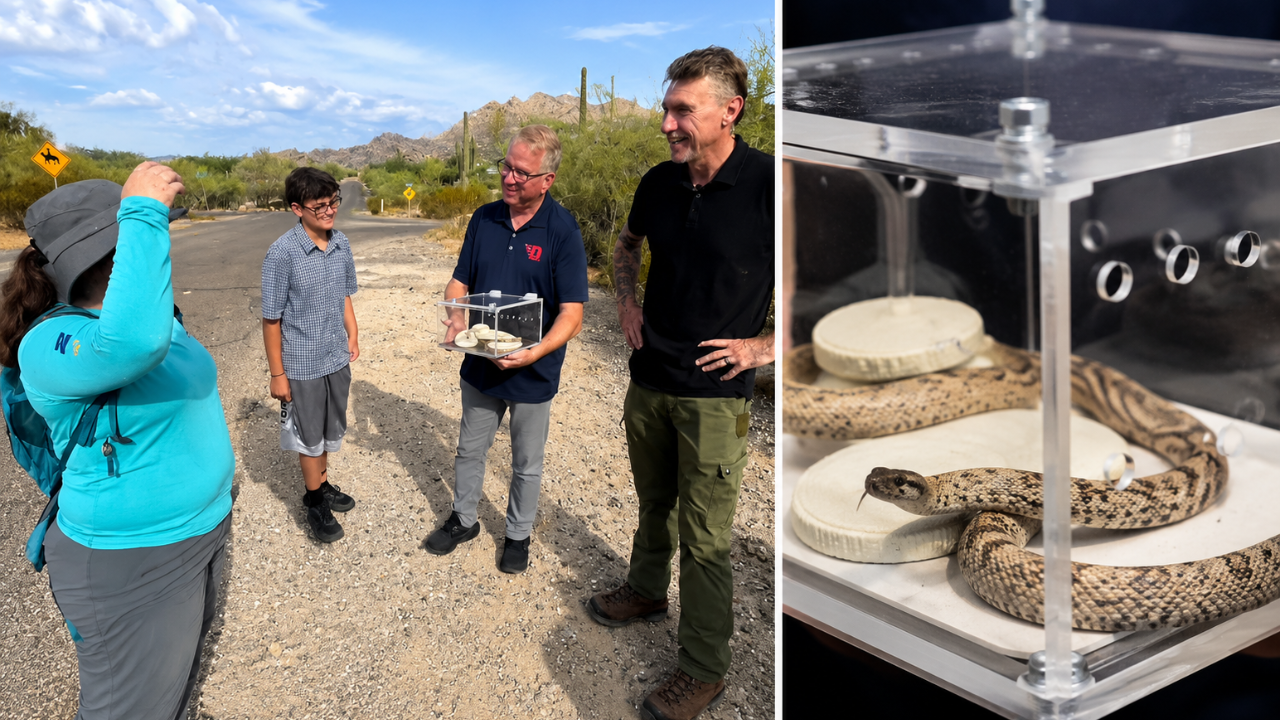
When retired Phoenix police officer Phil Roberts answered a routine nuisance call in Gold Canyon, Arizona, he expected to find a standard desert dweller. Instead, he ended up face-to-face with an animal that most herpetologists spend their entire careers hoping to see: a nearly snow-white rattlesnake resting near a residential property.
The discovery sent immediate shockwaves through the reptile community. While initial local reports tagged the creature as an albino, closer inspection revealed something much stranger. It wasn't an albino at all. It was a leucistic western diamondback rattlesnake, a genetic anomaly so extraordinarily rare that finding an adult specimen alive in the Sonoran Desert defies basic evolutionary odds.
If you've seen the photos circulating online, you know how striking the animal looks. But to understand why wildlife experts are calling this a once-in-a-lifetime capture, you have to look beyond the viral headlines and understand the biology of desert survival.
Why the Eyes prove this wasn't an Albino Rattlesnake
Most people throw the word albino around whenever they see a white animal. It's an easy mistake to make. When Roberts first spotted the pale viper, he thought the exact same thing.
The biological reality is fundamentally different.
Albinism is a complete absence of melanin. In albino snakes, pigment is stripped entirely from the skin, scales, and eyes. That absence of pigment leaves the blood vessels in the eyes visible, producing a distinct red or pink glare.
Leucism works differently. Leucism causes a partial loss of pigmentation across the body's surface, but it leaves the eyes untouched. When Roberts looked closely at the white rattlesnake in Gold Canyon, he noticed normal, dark eyes staring back at him.
That dark eye color was the giveaway. The snake possessed leucism, a far more unusual genetic expression in wild Crotalus atrox populations than simple albinism.
How a White Predator Survives in the Sonoran Desert
Wild snakes don't have the luxury of sitting safely in a climate-controlled terrarium. In the harsh expanse of Arizona's low desert, camouflage is survival.
A typical western diamondback relies on intricate, dirt-toned geometric patterns to blend into granite rocks, creosote bushes, and dry wash beds. Camouflage does two vital jobs every single day. First, it prevents red-tailed hawks, coyotes, roadrunners, and owls from spotting the snake from above. Second, it allows the snake to set up ambush sites to catch unsuspecting kangaroo rats and pocket mice.
A white rattlesnake loses both advantages immediately.
Imagine wearing a bright neon jacket while playing hide-and-seek in an open field. That's what life is like for a leucistic rattlesnake in the wild. From the moment it hatches, a pale snake sticks out like a flare against dark soil and rocks.
Predators spot white neonates quickly. Even if a white snake manages to hide from hawks, its prey can easily spot the ghostly intruder before coming within strike range. The simple fact that this leucistic western diamondback survived to adulthood in the harsh Arizona landscape is nothing short of miraculous.
Was it the Same Ghost Snake seen Months Earlier?
What makes this story even more wild is that this might not have been the snake's first encounter with humans.
Roberts, who operates a free wildlife relocation service and has safely removed over 85 rattlesnakes across Arizona in the past year alone, recalled a strange call from months prior. Back in September 2025, he received a late report about a "white snake" wandering through a yard roughly 150 yards away from this exact spot in Gold Canyon. By the time he arrived at the call last autumn, the mysterious creature had vanished into the desert scrub.
Was the snake Roberts captured the very same individual that slipped away in 2025?
It's extremely likely. Rattlesnakes maintain relatively compact home ranges, often returning to the same overwintering dens year after year. If a leucistic snake found a pocket of rocky cover near Gold Canyon with enough food and shade to stay hidden from aerial predators, it easily could have spent the past year navigating that small territory unnoticed.
Why Arizona Backyards are Seeing More Rattlesnakes
Sightings like this highlight a growing trend across the desert Southwest. As housing developments expand deeper into former desert terrain, human neighborhoods and native reptile territories overlap heavily.
Snakes aren't invading human neighborhoods because they've suddenly gotten bold or aggressive. They're simply moving through the same washes and rock outcroppings their ancestors used for generations. Suburbs offer things wild snakes love: irrigated lawns that draw thirsty rodents, cool patio slabs, decorative rock piles, and artificial water features.
When suburban amenities meet natural instinct, human-snake encounters become inevitable.
After rescuing the rare leucistic diamondback, Roberts transferred the snake to the care of Rattlesnake Solutions, a dedicated reptile rescue and conservation organization in Arizona, ensuring the rare animal remains safe and studied rather than harmed or exploited.
What to Do if You Encounter a Rattlesnake Near Your Home
Finding any rattlesnake—whether standard brown or ghostly white—can shock a homeowner. How you react in the first 30 seconds dictates whether everyone stays safe.
Here is how you handle a rattlesnake sighting on your property without getting hurt:
- Freeze and step back slowly. Rattlesnakes strike when they feel threatened or cornered. Give the snake at least six to eight feet of distance immediately.
- Keep pets and children inside. Most domestic rattlesnake bites happen when dogs investigate a snake in the yard. Get pets indoors before taking any other action.
- Never try to kill or catch it yourself. Attempting to hit a snake with a shovel or grab it with yard tools accounts for a massive percentage of venomous snake bites in North America. Leave handling to trained professionals.
- Contact a professional relocation service. Look up local wildlife controllers or specialized snake removal professionals in your area. Many experts will safely relocate the animal far from homes without harming it.
- Eliminate habitat attractants. Reduce yard clutter, seal off access underneath sheds, trim low-hanging shrubs, and control rodent populations to keep snakes from choosing your yard as a hunting ground.
If you live in rattlesnake country, keep the phone number of a local, humanely operating snake relocation service saved in your phone before you actually need it.