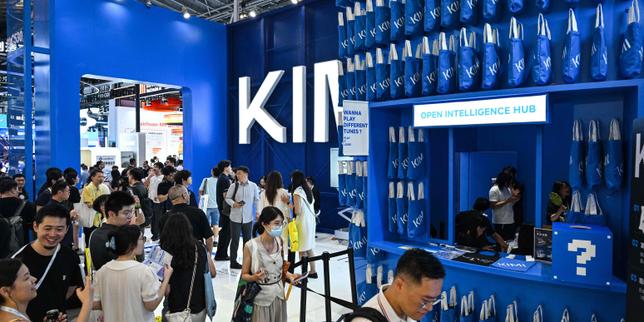
The gloves are officially off in the global AI race, and the latest clash isn't happening in research labs—it's playing out in raw geopolitical posturing. White House Office of Science and Technology Policy Director Michael Kratsios publicly accused Beijing-based startup Moonshot AI of conducting industrial espionage against American AI powerhouse Anthropic. The claim? Moonshot allegedly used covert model distillation to siphon intelligence from Anthropic's flagship Claude Fable model to build its new Kimi K3 system, while secretly routing restricted Nvidia Blackwell chips through Thailand.
This isn't just another standard IP dispute between foreign competitors. It represents a fundamental shift in how the United States intends to police foreign technology. When Treasury Secretary Scott Bessent immediately backed up the claims by threatening trade sanctions against Moonshot, Washington made its stance crystal clear: extracting capabilities from American frontier models through unauthorized distillation will now be treated as a major national security threat rather than routine competitive copying.
What Model Distillation Is and Why Washington Is Terrified
To understand why the White House is making such a massive fuss over Moonshot's Kimi K3, you have to understand how model distillation actually works on a practical level.
Building a frontier model like Anthropic's Claude Fable costs hundreds of millions of dollars in compute power, vast data center footprints, and elite research talent. Distillation bypasses that entire financial wall. In simple terms, a developer prompts a massive, hyper-intelligent model millions of times, collects its complex reasoning outputs, and uses those responses as synthetic training data for a smaller or cheaper model. The smaller system learns to replicate the larger model's logic at a tiny fraction of the original training cost.
AI labs use distillation legitimately all the time. Companies distill their own massive proprietary models into lighter, faster versions so users can run them efficiently on mobile devices or cost-effective servers.
Where things get messy—and where Washington draws a sharp line—is foreign industrial distillation. Kratsios alleged that Moonshot didn't just casually test Anthropic's systems; the company built a dedicated, highly sophisticated internal software platform specifically designed to systematically scrape Fable. By constantly switching API access points, using thousands of fake accounts, and routing traffic through proxy servers, Moonshot allegedly harvested the structural smarts of America's most expensive model while dodging security filters.
The results speak for themselves. When Moonshot released Kimi K3 as a 2.8 trillion-parameter open-weight model, it immediately shocked Silicon Valley. Benchmarks placed Kimi K3 right alongside top-tier Western systems like Anthropic's Fable and OpenAI's GPT-5.6 Sol. Even more alarming for American tech executives, Kimi K3 actually snatched the top spot on the Frontend Code Arena leaderboard, proving that a Chinese open model could directly outshine Western proprietary tools in software engineering.
The Gray Market Chip Pipeline Through Southeast Asia
Model distillation was only half of the White House's charge. Kratsios dropped an equally heavy bomb regarding hardware, asserting that Moonshot bypassed US export restrictions by operating Nvidia GB300 chips hosted in Thailand data centers.
The US Department of Commerce has spent years tightening restrictions on advanced semiconductor shipments to China. While older or downgraded processors like the H200 have seen mixed regulatory passes, the top-tier Blackwell series—including the GB300—remains strictly off-limits to Chinese firms. Washington's fear is simple: advanced silicon gives foreign entities the sheer raw computing power needed to train massive frontier neural networks.
If Moonshot accessed GB300 servers located in Thailand, it points to a gaping loophole in global tech enforcement. Middlemen and international cloud brokers can easily rent compute capacity in Southeast Asian data centers to foreign clients without physical chips ever crossing a sanctioned border.
Nvidia has consistently denied that systematic export control loopholes exist, maintaining that its global partners strictly adhere to trade rules. However, the sheer demand for AI infrastructure makes third-party server hosting in neutral nations an almost impossible market to police completely. If the Treasury Department follows through on sanctions against Moonshot, it won't just impact one startup—it will force American chipmakers and international data center operators to audit every single overseas client with extreme scrutiny.
How the IP Argument Collides with the Open Weight Movement
The allegations against Moonshot throw open a massive legal and philosophical split inside the global software community.
When Anthropic's public policy head Sarah Heck praised the White House for calling out "adversarial distillation," she framed unauthorized API scraping as outright industrial theft that undermines national security. From the perspective of Western frontier labs, spending half a billion dollars to train a model only to have a rival clone its capabilities via API queries is blatant free-riding.
Yet critics and open-source advocates point out the heavy irony embedded in this fight. The very training sets that power frontier models like Claude Fable were created by crawling millions of copyrighted websites, books, and creative works across the public internet without explicit creator consent. Many developers inside the open-weight ecosystem view distillation as a standard, unstoppable machine learning technique rather than traditional theft.
Alon Yamin, CEO of plagiarism detection firm Copyleaks, noted that model distillation is rapidly becoming standard practice because global competitive pressure is so intense. Once a model's outputs are accessible online or via API, preventing another developer from studying those outputs to fine-tune their own model is nearly impossible through technical barriers alone.
This tension creates two radically different views of the future:
- The Closed Enterprise View: Frontier models are critical national infrastructure. Their internal reasoning patterns, synthetic data, and fine-tuning outputs are proprietary trade secrets that require legal protection and state-backed defense.
- The Global Open Weight View: Knowledge transfer via model outputs is fundamentally open innovation. Attempting to criminalize prompt-based distillation is an artificial barrier designed to protect American market monopolies under the guise of national security.
Washington's Internal Tug of War Over Tech Dominance
While the White House is eager to call out Chinese competitors, the attack on Moonshot has ignited fierce debate within American policy circles about how the US should stay ahead.
Tech council chairman and prominent Silicon Valley investor David Sacks pointed out a glaring paradox in current US policy. While American officials ring alarm bells about Chinese models taking top spots on coding leaderboards, domestic regulators are simultaneously making it harder for American labs to build big. Bureaucratic delays on data center power connections, state-level AI regulations, and threats of federal oversight are slowing down Western labs at the exact moment global competition is heating up.
The Trump administration's foreign policy on AI has bounced between aggressive export bans and pragmatic trade permissions. Just months ago, federal officials briefly halted global export channels for Anthropic's top models over security concerns before reversing course. Now, with Chinese open models closing the performance gap at fraction-of-a-cent inference costs, Washington is realizing that restricting software exports doesn't stop foreign labs from catching up—it just pushes them to build their own open alternatives faster.
What Happens Next for Developers and AI Enterprises
If you're building software, managing an engineering team, or investing in tech, this regulatory fallout isn't just political noise—it directly impacts how you build products. Expect several immediate shifts across the tech landscape over the coming months.
Hardened API Protection and Anti-Scraping Rules
Expect frontier AI providers like Anthropic and OpenAI to deploy far more aggressive detection algorithms on their public APIs. Account verification will become significantly stricter, enterprise proxy access will face deeper audits, and high-frequency querying patterns that resemble distillation workloads will trigger instant account bans.
Stricter Compliance for Overseas Cloud Providers
Companies using third-party cloud infrastructure outside the US will face far tougher compliance demands. If the US Bureau of Industry and Security begins targeting cloud brokers in Southeast Asia and the Middle East, businesses will need clear documentation showing who owns the workloads running on advanced hardware.
Accelerating Enterprise Adoption of Open Weight Models
Despite the trade disputes, models like Moonshot's Kimi K3 demonstrate that open-weight systems are approaching parity with closed, high-cost APIs. Enterprises looking to cut inference bills will increasingly evaluate open models for internal coding pipelines, forcing Western companies to lower their API pricing to stay competitive.
Legal Clarification on Model Distillation Rules
The line between legitimate AI research and unauthorized IP theft is going to be tested in court. Policy groups are pushing Congress and federal agencies to establish clear statutory definitions separating standard open-source fine-tuning from unauthorized, large-scale industrial scraping.
To protect your tech stack in this uncertain environment, audit your API dependencies today, build multi-provider redundancy into your software architecture, and ensure your data pipelines don't rely on single foreign model endpoints that could be hit with sudden trade sanctions.