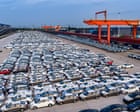
Western policymakers thought they could build a wall of tariffs high enough to keep Chinese automakers out. They were wrong.
The latest official customs data out of Beijing just shattered expectations. In June 2026, China exported a record-breaking 1.06 million vehicles in a single month. That's a staggering 71.2% jump from the same period last year. It marks the first time the country has cleared the one-million-export milestone in a 30-day window.
While politicians in Washington and Brussels debate trade barriers, Chinese brands like BYD, Geely, and Chery are quietly routing their vehicles around the blockades. This massive export surge isn't a temporary blub. It's a fundamental restructuring of the global automotive trade, and the West is losing ground.
The Panic Behind the Numbers
To understand how big this moment is, look at the trajectory. In 2023, China exported 4.9 million vehicles. In 2025, that climbed to 7.1 million. Now, the country is comfortably on track to clear 10 million vehicle exports this year.
This isn't happening because global demand for cars suddenly exploded. It's happening because China is aggressively offloading its manufacturing capacity abroad.
Chinese Vehicle Exports (Annual Trajectory)
2023: 4.9 million
2025: 7.1 million
2026: 10.0+ million (Projected)
Inside China, the domestic market is a brutal sandbox. The property sector slump continues to depress local household budgets. Beijing phased out its major electric vehicle subsidies, sparking a fierce domestic price war that is eating margins alive. Local sales actually fell 26% in June.
Faced with a cooling home market, Chinese carmakers have a simple choice: expand overseas or die. As Wei Haigang, president of GAC International, bluntly put it at an auto expo recently, companies that don't venture overseas right now face immense difficulties surviving. They have to dump cars onto the global market to keep their factories humming.
Breaking Down the Border Defenses
The mainstream consensus was that protectionism would stop this wave. After all, Donald Trump returned to the White House with a fresh arsenal of aggressive tariffs, and the European Union slapped punitive duties on Chinese electric vehicles.
Yet, China's total exports jumped 27% year-on-year in June, blowing past Wall Street forecasts. How? By exploiting structural loopholes and shifting target demographics.
The Hybrid Loophole
When the EU structure targeted pure electric vehicles (EVs), Chinese manufacturers quickly shifted their export mix toward plug-in hybrids and conventional internal combustion vehicles. Brands like Chery and Geely are flooding Europe with gas-powered SUVs and smart hybrids that slip right under the EV tariff barriers. Chery alone exported over 191,000 vehicles in June, setting a historic company record.
Geopolitical Redirection
If one door closes, Chinese automakers find three others. Exports to Southeast Asia surged nearly 35% in June. Shipments to Latin America grew by more than 28%. Even regions with growing tax barriers are seeing structural workarounds. Canada approved a specific annual import quota of 49,000 Chinese EVs at a low tax rate, which Chinese auto groups are already using as a tactical staging ground.
Global Factory Shifting
Tariffs only apply to cars shipped from China. To defeat this, players like BYD are rapidly building assembly plants inside Europe, Southeast Asia, and South America. BYD exported 175,000 cars in June—a 95% jump year-on-year—and international sales now make up a staggering 43% of its total output. Once their local factories open, regional tariff walls become completely irrelevant.
The Real-World Fallout for Western Legacy Auto
This export tsunami isn't a theoretical issue for Western legacy auto brands. It's an existential threat.
Look at Germany. Volkswagen is currently going through what CEO Oliver Blume calls the "most comprehensive realignment in the company’s history." The company has faced tense board standoffs over plans to shutter domestic factories and potentially cut tens of thousands of legacy manufacturing jobs.
For decades, European automakers relied on high margins from gas-powered vehicles to subsidize their slower R&D operations. Now, they are getting squeezed out on two fronts.
- Software Superiority: Chinese cars aren't just cheaper; they boast highly advanced integrated software and battery ecosystems that Western suppliers are struggling to match at scale.
- The Tech Convergence: This export boom is tightly linked with China's broader tech dominance. June's data showed a massive spike in semiconductor and integrated circuit trade driven by the global artificial intelligence boom. China imported 53.7 billion chip units in June alone to fuel its advanced tech and automotive sectors.
The Mercator Institute for China Studies (Merics) revealed that China ran a mind-boggling €900 million-a-day goods surplus with the EU in the first half of 2026. That isn't just a lopsided balance sheet. It's the sound of an industrial shift that can't be reversed by a few policy papers.
Actionable Next Steps for Investors and Industry Watchers
If you're trying to navigate this shifting macroeconomic terrain, relying on old assumptions about trade wars will lose you money. Here is how you need to adjust your strategy right now.
- Stop tracking just pure EVs: If you are evaluating Chinese auto stocks or global supply chains, look closely at their plug-in hybrid (PHEV) pipeline. This is the tactical vehicle category keeping export numbers high despite Western EV tariffs.
- Monitor localization timelines: The real winners won't be the companies shipping the most cars from Shanghai ports. Keep an eye on which Chinese brands successfully operationalize their greenfield factories in Hungary, Brazil, and Turkey. Those factory launch dates are the true metrics for long-term market capture.
- Short defensive legacy portfolios: Legacy automakers without a radical software overhaul or a viable low-cost manufacturing strategy are structurally exposed. If a legacy brand relies heavily on European domestic sales without a deep tech edge, its market share is directly in the crosshairs of this 10-million-vehicle export wave.
The data is clear. Trade barriers didn't kill the Chinese automotive expansion; they just forced it to evolve.