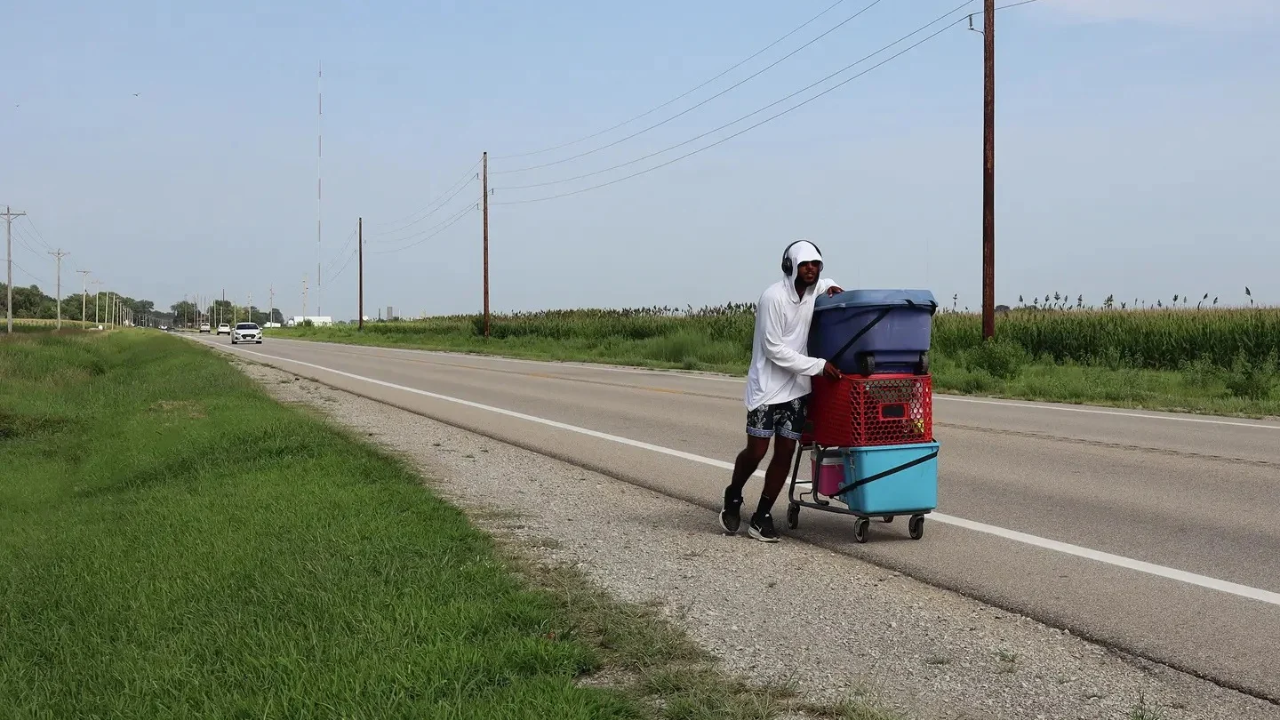
Chantz Rivera didn't pack ultralight titanium cookware or sign up for a curated wilderness retreat when he left the Bronx on May 31, 2026. He had roughly $500, a couple hundred more from his parents, zero hiking or camping experience, and a plan to walk 2,500 miles to California pushing a shopping cart. One hundred and forty-nine days later, on October 26, he reached the San Francisco Bay Area after crossing 11 states.
People read stories like that and see instant freedom. Open road. Big sky. No boss or alarm clock. Honestly, that's a pretty romanticized lens for something that started out limping through sore knees, broken wheels, and roadside tents. Rivera's walk worked because he made a radical break from a dead-end routine, yet the reality of pushing a heavy cart along American highways comes with real gear failures, awkward police stops, and moments where you're just trying not to get clipped by passing traffic.
What Actually Drove the 2,500-Mile Walk
When a story frames a cross-country trek as "seeking freedom from monotony," it's easy to treat the walk like a clean wellness makeover. Rivera's actual starting point was much messier. Born and raised in the Bronx's Gun Hill Houses, he'd spent nearly his whole life in New York City, making only two brief trips outside the East Coast before setting out. He worked temporary warehouse shifts through shift-booking apps and washed dishes at a restaurant for around two years. When a military recruiter turned him down over past misdemeanors and marijuana-related charges, he found himself unemployed in April 2026 with a growing sense that staying put wasn't going to change anything.
So he walked. Not because he had a polished five-year plan, and not because he was an experienced thru-hiker. As he told The New York Times, he wanted to use his free will and see what else existed beyond his usual blocks.
That motivation hits on something real that researchers have studied in long-distance walkers. A systematic scoping review indexed on PubMed Central found consistent links between long-distance walking and lower emotional distress, while qualitative research on long-distance hikers points to stronger well-being and fresh perspective when people step out of chronic stress routines. Still, walking hundreds of miles isn't magic. Soreness, bad weather, and uncertainty don't vanish just because you're moving west.
Why a Shopping Cart Sounds Clever Until Mile One
On paper, pushing gear on wheels sounds way easier than carrying 40 or 50 pounds on your back for five months. In practice, standard grocery carts and foldable wagons aren't built for 2,500 miles of asphalt, cracks, gravel shoulders, and steep climbs.
Rivera's first cart broke on day one. Over the course of the trip, wheels and frames gave out repeatedly, forcing him to swap carts and wagons along the way. Pushing roughly 50 pounds of gear up steep hills in Pennsylvania or long mountain grades in Colorado turns a convenience into a full-body push-and-brake workout. Downhills can be sketchy without proper brakes, and narrow road shoulders leave almost zero margin for error when semis or fast trucks pass.
If you ever plan a long walk with wheeled gear, keep a few hard lessons in mind:
- Cheap caster wheels die fast: Small, hard plastic wheels catch on cracks and wear down quickly on rough pavement. Larger wheels with sturdy bearings handle uneven surfaces much better.
- Gear fails without warning: Zip ties, spare parts, and basic repair tools aren't optional when you're miles from a hardware store.
- Highway shoulders aren't sidewalks: Many rural and semi-rural stretches have no pavement for pedestrians, narrow ditches, or steep drop-offs.
The Social Reality Nobody Warns You About
Here's the part of Rivera's trip that separates real life from viral clips. Online, his following grew to around 60,000 people, and plenty of strangers stepped up. People in Indiana brought water and iced tea, a man in Indianapolis spent a full day helping him with food, a haircut, and cart repairs, a pastor in Ohio arranged a lift to a motel, and crowdfunding eventually brought in roughly $13,000 by the time he reached the Bay Area (with later reporting putting the total close to $16,000).
At the same time, pushing a shopping cart changes how people read you. Police and state troopers stopped him in almost every state—sometimes multiple times a day—to check on his safety or question his cart on the road, including a stop near Sausalito over suspicion that the cart belonged to a nearby Safeway. Lodging and social spaces can get complicated when people assume a shopping cart equals homelessness, and not every offer of help goes smoothly, such as an uncomfortable motel situation in Cambridge, Ohio.
And then there's the ending. Reaching the Bay Area required wading through a flooded path near Mill Valley and Sausalito on October 26. Hours after arriving in San Francisco, while his cart sat briefly unattended outside a McDonald's on Fillmore Street, someone stole a bag holding portable chargers, survival gear, and storage media with photos and videos from the five-month walk. Losing irreplaceable footage hurts. That Rivera stayed relatively calm about it—and still talked about future travel ideas like walking across Europe after visiting Los Angeles and Las Vegas—shows how much his tolerance for disruption had shifted.
What You Can Actually Take Away From This
You don't need to quit everything and push a cart across 11 states to break out of a rut. Most people can't afford five months off the grid, and honestly, walking 20 to 25 miles a day through rain, heat, and sore joints isn't everyone's idea of a reset.
What does translate is disrupting the autopilot loop. When your days blur together through repetitive shifts, screens, and familiar streets, your sense of agency shrinks. A smaller version of a reset still works if you make it concrete:
- Take an unscripted solo day trip or multi-day walk: Pick a route you haven't walked before, leave rigid plans behind, and pay attention to how you handle boredom or friction.
- Test your gear locally first: If you ever experiment with wheeled packs, carts, or camping gear, put real weight in them on hilly local roads for a full day before trusting them far from home.
- Build a small buffer before taking big leaps: Even with generous strangers and crowdfunding, starting with tight cash adds stress fast when things break or weather forces delays.
Routine feels suffocating until you test what it actually takes to step outside it. Sometimes freedom looks like an open highway—and sometimes it looks like limping into town with a wobbly wheel, figuring out where to sleep next, and knowing you kept going anyway.