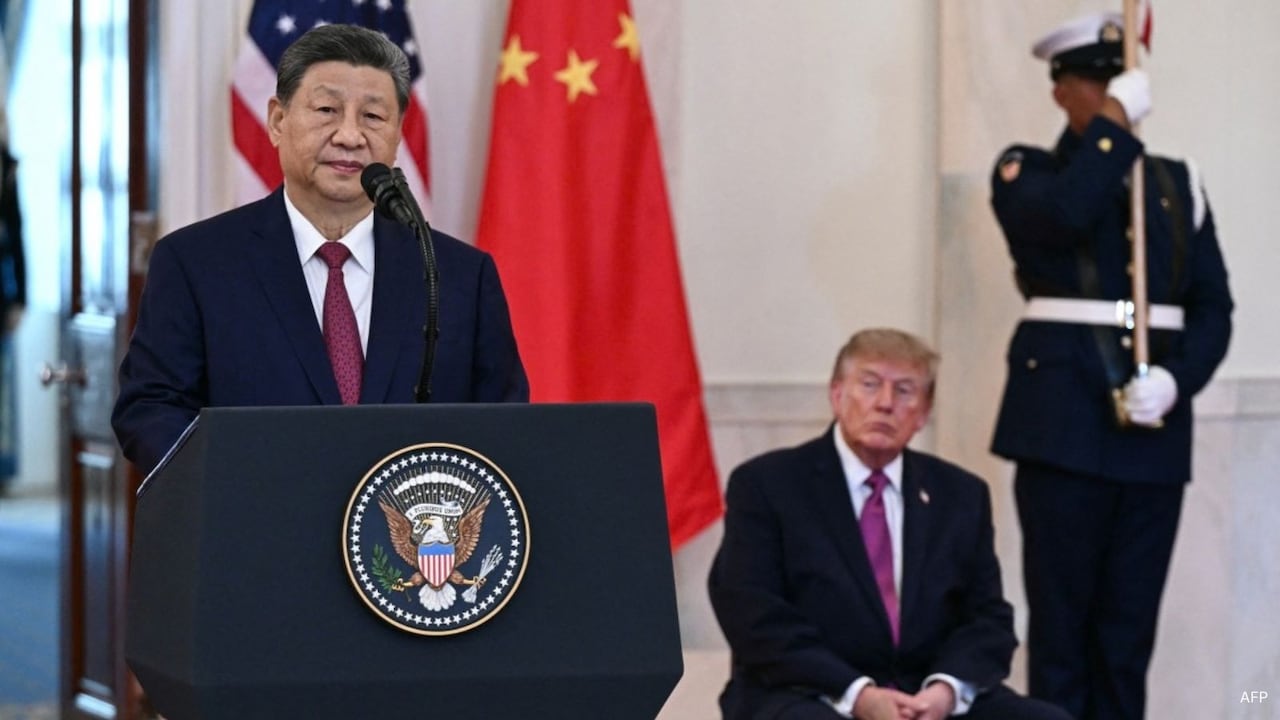
When the two biggest technological superpowers sit down in the same room, the entire world holds its breath. Artificial intelligence isn't just another software update. It's an existential shift in how global power works. Chinese President Xi Jinping recently delivered a clear message right at the White House: Washington and Beijing share a responsibility to keep artificial intelligence under strict human control.
Most people dismiss these high-level diplomatic summits as empty theater. They assume leaders just read pre-written speeches and pose for cameras before heading off to private dinners. That's a mistake. When geopolitical rivals start talking about shared guardrails for artificial intelligence, it means the risks have grown too large to ignore. Both nations realize that losing control of autonomous systems creates a security nightmare that benefits nobody.
The Real Stakes Behind the Rhetoric
Why is artificial intelligence suddenly the main topic of conversation between Washington and Beijing? Simple. Code doesn't care about borders. Autonomous algorithms are evolving faster than diplomatic protocols can keep up.
Think about how modern defense grids, financial markets, and critical infrastructure rely on automated decision-making. If an algorithm misinterprets a market signal or a radar blip, a localized crisis can escalate in seconds. Humans wouldn't even have time to pour a cup of coffee before things spiraled out of hand.
Xi Jinping noted during his White House remarks that both nations possess the capability and the responsibility to manage these technologies for the public good. It is a rare moment of alignment. Both governments spend billions trying to out-innovate each other, yet both recognize that a completely unmanaged intelligence race leads to a cliff.
Breaking Down the Safety Paradox
You cannot talk about safety without talking about competition. The United States and China are locked in a relentless race for technological supremacy. Every major lab in Silicon Valley and Shenzhen is pushing boundaries to build smarter, faster models.
This creates a dangerous paradox.
If you slow down to build safety protocols, your competitor might surge ahead. If you rush forward to win the race, you might deploy systems you cannot contain.
- The Speed Trap: Moving too fast means bypassing rigorous safety checks.
- The Stagnation Trap: Moving too slowly means losing geopolitical leverage.
Governments are trying to walk a razor-thin line. They want to dominate the market while making sure the machines don't start making independent choices about life, death, and economic stability. Keeping human control in the loop sounds obvious on paper. In practice, it means redesigning how engineers build neural networks from the ground up.
What This Means for the Rest of the World
If Washington and Beijing manage to establish informal or formal safety norms for artificial intelligence, the ripple effects will touch every corner of the tech industry. Smaller countries will have to adapt to standards set by the two superpowers. Software developers will face stricter compliance checks.
Open-source developers might feel the pinch the hardest. When governments worry about autonomous weapons or runaway algorithms, they tend to clamp down on unrestricted code sharing.
You should expect to see more regulatory frameworks pop up over the next few years. Companies building enterprise machine learning tools are already shifting resources toward explainable intelligence—systems that show their work so humans can audit every decision.
How to Prepare for the Shift
If you work in technology, business, or policy, you cannot afford to ignore this geopolitical dance. The rules of the road are being written right now.
- Audit your dependencies: Know where your third-party machine learning models come from and what safety guardrails they include.
- Prioritize transparency: Stop using black-box algorithms where you cannot explain the final output to a regulator or a client.
- Stay informed on policy: Watch how bilateral agreements between the US and China translate into actual export controls and safety standards.
The conversation at the White House is just the opening chapter. Technology moves at lightning speed, while diplomacy crawls. Closing that gap is the defining challenge of our generation.