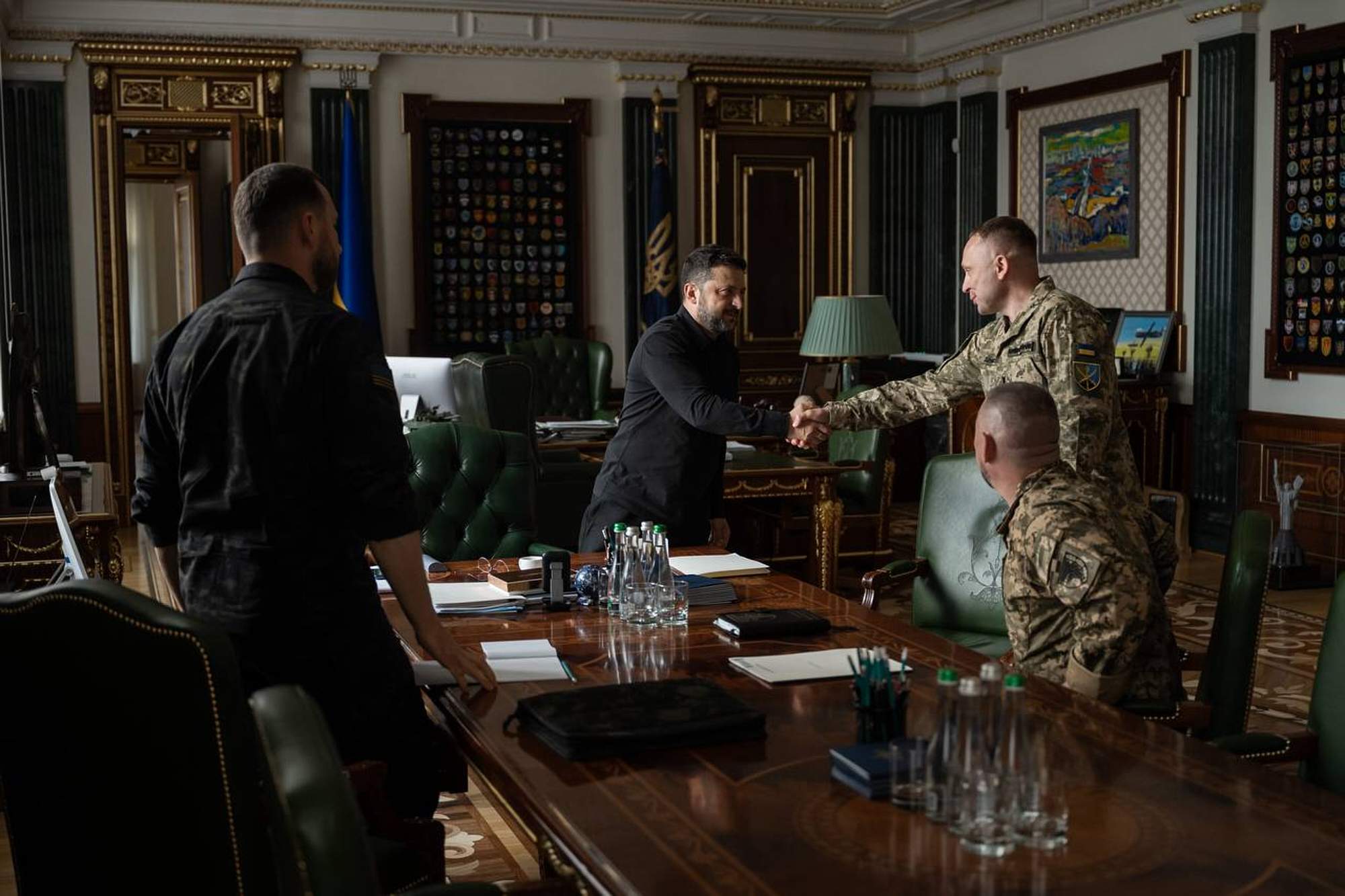
Ukrainian President Volodymyr Zelenskyy just made one of the most drastic military moves since Russia’s full-scale invasion began. He fired General Oleksandr Syrskyi, commander-in-chief of Ukraine’s armed forces, and named 43-year-old Major General Mykhailo Drapatyi as his successor.
This was not a quiet, routine staff rotation planned inside hidden command bunkers. Street pressure forced this decision. Meanwhile, you can explore other events here: Why Trump And Dhs Are Facing A Brutal Fight Over The Next Ice Chief.
Thousands of Ukrainians spent days gathering outside presidential headquarters in Kyiv and in cities across the nation. Combat veterans, medics, active-duty soldiers on leave, and ordinary citizens took to the streets demanding Syrskyi’s dismissal. They carried homemade cardboard signs, called for accountability, and warned that keeping the old guard in charge would cost Ukraine the war.
People weren't just protesting military tactics. They were fighting for the country's military survival and its future strategy. To explore the complete picture, we recommend the recent analysis by NPR.
The Boiling Point in Kyiv Streets
To understand how Ukraine reached this point, you have to look at what happened just days earlier. Zelenskyy shook up his cabinet and quietly removed Defense Minister Mykhailo Fedorov, a 35-year-old former tech leader credited with modernizing Ukraine's drone units, military software, and asymmetric strikes.
Zelenskyy tried to smooth over the firing by claiming the personal rift between Fedorov and Syrskyi had grown so severe that the two men couldn't sit at the same table. He stepped in to resolve the feud by cutting loose his defense minister.
That calculation backfired completely.
For millions of Ukrainians, Fedorov represented modern warfare, innovation, and high-tech efficiency. Syrskyi, on the other hand, represented top-down, heavy-casualty military doctrine rooted in rigid Soviet tradition. When Zelenskyy picked Syrskyi over Fedorov, the public reacted immediately.
"Syrskyi had conflicts not only with the defense minister, but also with brigade and corps commanders," said Andriy, a 27-year-old combat medic who lost his leg in battle, standing outside the presidential office. "If he stays, we will simply be ineffective. We could simply lose this war."
The outcry spread straight into active military units. The deputy commander of Ukraine's Air Force resigned in protest. Frontline soldiers posted public videos demanding structural changes. Within 48 hours, Zelenskyy realized he had miscalculated public trust and moved to defuse the crisis before it destabilized the state.
Two Fighting Philosophies Collide
The dispute running through Ukraine's military leadership isn't a personality conflict. It's a clash between two fundamentally different ways of fighting a high-intensity war.
Syrskyi is a skilled operational officer who earned genuine respect for leading the defense of Kyiv in early 2022 and spearheading the brilliant Kharkiv counteroffensive in late 2022. He also directed the Kursk border operation.
Yet among rank-and-file troops and mid-level officers, Syrskyi carried a grim reputation. Critics pointed to his command during the brutal defense of Bakhmut, where attrition rates soared. Media investigations into frontline formations like the Skelia assault regiment detailed heavy troop losses and rigid, top-down orders that left infantry units pinned under artillery without adequate flexible support.
Fedorov and his allies advocated a radically different model. They argued that Ukraine, faced with a vastly larger enemy, cannot fight a war of pure attrition. Ukraine has to fight smarter:
- Massive automation: Replacing human infantry with ground robots, automated turrets, and airborne strike drones along danger zones.
- Asymmetric targeting: Striking deep inside Russian territory against oil refineries, ammunition depots, and airfields to choke off frontline supply lines.
- Preserving troop lives: Giving tactical commanders freedom to retreat from unwinnable positions rather than holding ground at any human cost.
- Decentralized command: Trusting young, battle-tested field captains and corps commanders to make real-time decisions on the fly.
When Fedorov pushed for deep structural reforms, Syrskyi pushed back to protect traditional command hierarchies. The street protests proved that Ukrainian society overwhelmingly favors Fedorov's modern approach over Syrskyi's attrition tactics.
Who Is Mykhailo Drapatyi
In choosing Mykhailo Drapatyi to head the military, Zelenskyy tapped a general nearly two decades younger than Syrskyi, marking a clean generational break in Ukraine's high command.
Drapatyi first became known across Ukraine in 2014 during the fighting in Mariupol. Viral video captured an armored vehicle under his command smashing through pro-Russian separatist barricades at high speed. Over the decade since, he grew up inside the wartime army, rising through the ranks while earning respect from both senior staff and infantrymen.
In May 2024, when Russian forces launched a surprise cross-border assault toward Kharkiv, Drapatyi was sent in to take control of the northern sector. He stabilized the front, contained the Russian advance, and restructured local command chains under fire.
What really sets Drapatyi apart is his willingness to take personal responsibility.
Last year, after a devastating Russian missile strike on a military training ground in the Dnipropetrovsk region killed 12 soldiers, Drapatyi submitted his resignation. He publicly stated that commanders must be held directly accountable for safety failures and structural mistakes. That move earned him widespread respect across the armed forces.
"Drapatyi's decision to offer his resignation demonstrated true leadership," noted military analyst Rob Lee. "His emphasis on accountability and encouraging initiative will have a positive effect across the military."
💡 You might also like: how to calculate area
After his appointment, Drapatyi posted a straightforward message: "Serving Ukraine has always been an honor for me, and during this war for independence, it means absolute responsibility."
The Public Reality Check for Zelenskyy
This isn't the first time public outrage forced Zelenskyy to alter course during full-scale war.
Last summer, mass street demonstrations pushed the president to scrap legislation that threatened the independence of anti-corruption watchdogs. Now, civil society has demonstrated that even wartime commanders-in-chief are subject to public oversight.
Ukrainians are fiercely committed to defending their country against Russian aggression, but they refuse to tolerate unnecessary waste of human lives or outmoded Soviet-era leadership practices. They view army reforms as vital for national survival.
Zelenskyy has since met again with Fedorov, offering him a new senior government role overseeing and unifying the nation's military technology sector. Fedorov welcomed Drapatyi's promotion, calling it "a breath of fresh air and new hope in the struggle."
What Changes Immediately on the Frontline
Drapatyi steps into the commander-in-chief role with zero honeymoon period. Zelenskyy instructed him to present a revised overall defense strategy within days.
Here is what will change right away:
- Reorganization of the Corps Structure: Drapatyi will overhaul how army corps and brigades interact, reducing red tape so frontline officers can act faster.
- Accelerated Drone and Robotics Deployment: Expect automated systems to be deployed faster along contested lines, reducing human exposure in open trenches.
- Expanded Strategic Long-Range Strikes: Ukraine's deep-strike drone campaign targeting Russian oil processing and logistics networks will intensify.
- Draft and Mobilization Reform: Drapatyi faces the huge challenge of reforming recruitment and training. Public trust in mobilization has eroded, and building a system focused on soldier safety and thorough instruction is essential to rebuilding trust.
Ukraine's military pivot shows that even under intense pressure, democratic accountability and modern tactical thinking can prevail over rigid military traditions. By replacing his top general in response to public demand, Zelenskyy has handed the reins to a younger, adaptable commander tasked with preserving Ukrainian lives while delivering smart, high-tech military pressure.