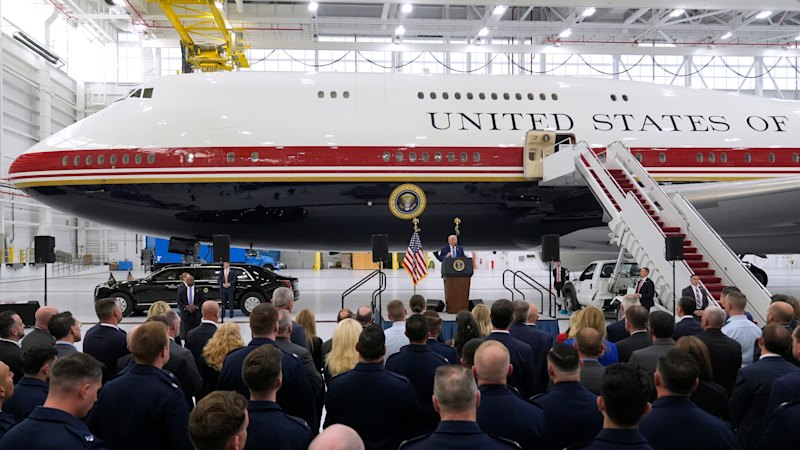
Donald Trump just showed off his new flying White House, bragging about opulence that surpasses anything ever seen in aviation. It's a shiny, modified Boeing 747-8 that looks brilliant under the lights of Joint Base Andrews. But behind the custom red, white, and blue paint and the plush carpets lies a messy reality that military planners are quietly sweating over.
This isn't the standard tech-heavy aircraft built from scratch under strict Pentagon oversight. It's a shortcut. Specifically, it's a $400 million luxury jumbo jet originally configured for the corporate head of state of Qatar, handed over as a diplomatic gift, and modified in a frantic ten-month sprint to meet a political deadline.
When you rush a multi-billion-dollar military defense system to make sure it's ready for summer festivities, things get left behind. Mainstream coverage focuses heavily on the gold-trimmed seat belts and the presidential seals. But the real story is about what's missing under the floorboards. Lawmakers are asking tough questions about whether this bridge aircraft lacks the hardened defenses needed to keep a commander-in-chief safe in a true global crisis.
The Problem With a Rushed Military Aircraft
Building a standard presidential transport usually takes years. The Pentagon spends decades perfecting the survivability of these planes because they aren't just commercial jets with nice seats. They're airborne nuclear command posts.
The Air Force accepted this Qatari gift to avoid ballooning taxpayer costs, aiming to use it as a temporary bridge until the fully custom, long-term models arrive around 2028. But Trump demanded immediate results. Aerospace contractor L3Harris was handed the monumental task of gutting and refitting a foreign head-of-state plane on an impossible timeline.
To hit the deadline, a team of roughly 400 employees worked 24 hours a day, seven days a week. Ask any aerospace engineer what happens when you run a 24/7 rush job on high-level defense machinery. Standard procedures get compressed. Software testing windows shrink. Components get chosen based on immediate availability rather than ultimate military endurance.
Recent letters from defense appropriators, including Senator Chris Murphy, show deep worry that resources were pulled away from other vital national security programs just to get this jet painted and polished. The rush means the Pentagon had to modify its strict requirements, choosing to leave much of the existing Qatari interior intact while scrambling to wire up basic secure communications.
Luxury Fits the Brand but Fails the Stress Test
Trump has called the jet the most luxurious plane in the world, and he isn't exaggerating. The interior features high-end woodwork, sprawling lie-flat seats, and premium materials designed for Middle Eastern royalty. It flies faster and further than the ancient, 36-year-old planes it's replacing. You don't have to stop for fuel nearly as often.
But high-end luxury doesn't deflect surface-to-air missiles.
The original Air Force One planes, the VC-25A models based on older Boeing 747-200 frames, are essentially flying fortresses. They contain miles of heavily shielded wiring designed to withstand the electromagnetic pulse of a nuclear blast. They carry advanced electronic jammer pods, chaff dispensers, and thermal flares to confuse heat-seeking missiles.
Because of the abbreviated 10-month refit window, defense experts openly question how much of this heavy-duty hardware actually made it onto the new bridge jet. Contractors have been notably tight-lipped about whether the plane features the exact same class of defensive suites as its predecessor. While basic secure communication networks were installed to ensure continuity of government, outfitting a plane with comprehensive missile counters usually requires structural changes that take years, not months.
The Ethical and Structural Mess of Foreign Gifts
Accepting a $400 million aircraft from a foreign government introduces a massive security puzzle. Trump argued on social media that it would be foolish to turn down a free plane that saves taxpayers hundreds of millions of dollars. From a business perspective, it sounds like a win. From a counterintelligence perspective, it's a nightmare.
Before a foreign aircraft can ever fly the American president, it has to be swept down to the rivets. Every single panel must be removed. Every wire trace must be verified to ensure there are no embedded listening devices, hardware trojans, or dormant malware in the flight control systems.
The Air Force claims they prioritized operational readiness over aesthetic overhauls, meaning they left the core Qatari layout mostly alone. If they left the layout alone to save time, did they have enough time to thoroughly inspect every hidden corner of that airframe?
The Security Versus Speed Trade-off
- Inspection Integrity: A complete forensic sweep of a commercial jumbo jet usually takes a massive team many months of quiet, meticulous work.
- Contractor Strain: Forcing 400 people into around-the-clock shifts creates human fatigue, increasing the likelihood of oversight.
- Omitted Defenses: Defensive systems require deep integration with the plane's main computer systems, which is difficult to execute securely under a tight clock.
What This Means for Future Presidential Travel
The Air Force is putting the new aircraft through what it calls commissioning flights—a final exam to check its airworthiness and basic security operations. Once these flights end, the plane will officially enter service.
It will certainly look grand on television. The deep navy blue belly and bold red accents replace the classic light blue livery that has defined the presidency since the Kennedy administration. It matches the corporate aesthetic Trump prefers, but the military utility remains compromised.
We are looking at a clear shift in how presidential assets are managed. Historically, capabilities came first, and style followed. Now, appearance has taken the front seat, leaving defense officials to figure out how to patch the defensive gaps before a real crisis occurs.
Tracks to Keep an Eye On
If you want to understand how this story unfolds over the coming months, stop reading the lifestyle pieces about the cabin luxury and look directly at the defense budget hearings. Watch for the written responses that L3Harris and the Air Force Secretary must provide to Congress regarding omitted hardware. Keep track of the specific testing phases during the commissioning period, as any delays there will signal that the rushed electronics are clashing with the plane's older architecture. The true measure of this plane isn't how it looks on a tarmac in Germany or London, but whether it can survive a hostile sky when everything goes wrong.