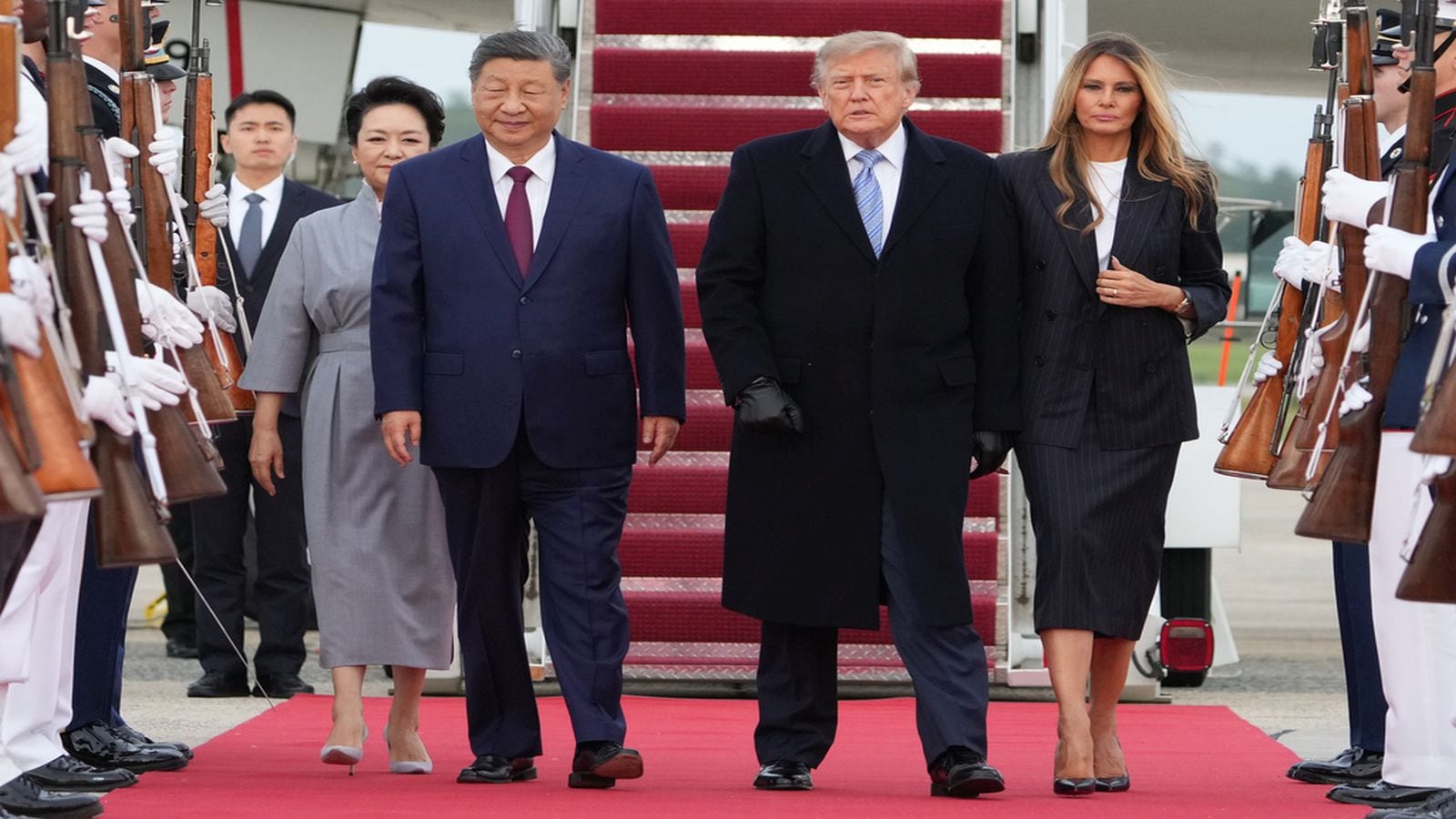
Air China touched down at Joint Base Andrews, and the diplomatic rulebook instantly went out the window. Donald Trump didn't wait for Xi Jinping at the White House porch. He took the Beast straight to the Maryland tarmac, rolling out a 100-foot red carpet complete with a 21-person honor cordon, six F-22s, six F-16s, and a thunderous low-level flyover by two B-1 bombers that sent Trump visibly wincing while Xi stood entirely unfazed.
When a US president breaks decades of protocol to personally greet a foreign counterpart planeside, you better pay attention. This high-stakes summit isn't just about pomp and circumstance. It is a calculated power dance between the world's two undisputed economic heavyweights, setting the stage for negotiations that will dictate global markets, technology, and security for the next decade.
The Real Agenda Behind the Military Spectacle
Forget the red carpet photos for a second. Why did Trump roll out the military hardware? Because optics matter immensely in Beijing. This grand reception directly reciprocated the theatrical pageantry Trump received during his visit to China earlier in the year.
Beneath the flashing cameras and military honors lies a ticking clock. The temporary tariff truce—the Busan agreement—was hurtling toward an imminent expiration date. Treasury Secretary Scott Bessent and Chinese Vice Premier He Lifeng hammered out an extension to January 10, buying breathing room. But temporary truces don't fix structural fractures.
Washington wants hard commitments on industrial overcapacity and market access. Beijing holds the ultimate trump card in the supply chain war: rare earth elements. China controls over 70% of global rare earth extraction and 90% of magnet processing. Without those minerals, America's electric vehicle ambitions and advanced defense manufacturing hit a brick wall. In exchange, Xi wants aggressive curbs lifted on high-end semiconductors and advanced chip-making machinery.
Artificial Intelligence and the Silicon Valley Guest List
You cannot talk about US-China relations today without talking about artificial intelligence. The race for technological supremacy defines modern statecraft.
Trump has made his stance crystal clear on social media and behind closed doors. He dismisses safety doomsayers, arguing that slowing down domestic innovation only hands victory to Beijing. His philosophy is brutal in its simplicity: whoever wins the AI race rules the global economy and military apparatus.
That philosophy explains Thursday night's guest list for the White House state dinner. It's a who's who of corporate and technological dominance. Leaders from OpenAI, Apple, Microsoft, Nvidia, Meta, Tesla, and Google are seated across from Chinese business delegations, including executives from electric vehicle giant BYD. When the titans of Silicon Valley break bread with the architects of China's industrial policy, you are witnessing the intersection of code, capital, and geopolitics in real time.
Taiwan, Regional Flashpoints, and Deep Distrust
Despite the champagne and private tea parties, neither side is naive about the dangers. Taiwan remains the most volatile fault line in international relations. Alongside Taiwan, discussions sprawl across regional conflicts, including the war in Iran and the ongoing quagmire in Ukraine.
Deep institutional distrust separates Washington and Beijing. Every concession is weighed against national security risks. Every export control is viewed in China as an attempt at containment. Yet, both leaders recognize that total economic decoupling is a mutual suicide pact. They need each other, even as they try to outmaneuver one another.
Watch the outcomes of these bilateral meetings closely over the coming days. The agreements forged on trade quotas, tech supply chains, and AI parameters will ripple directly down to consumer prices, tech stocks, and global stability.
Stop looking at the red carpet as mere entertainment. It's the opening salvo of a new era in great power competition.
Trump-Xi Summit Begins | Grand Welcome At Joint Base Andrews As Trade, AI, Taiwan On Agenda
This video report covers the high-profile arrival ceremony at Joint Base Andrews and outlines the core geopolitical issues dominating the current US-China summit.
http://googleusercontent.com/youtube_content/1