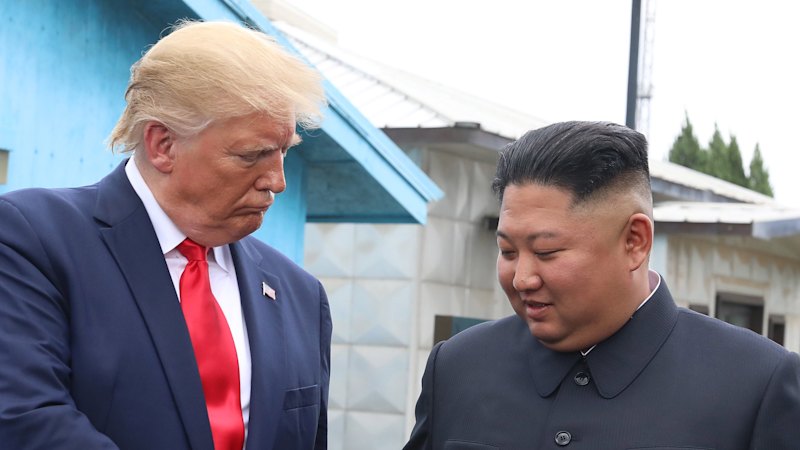
Donald Trump just threw another wrench into traditional Pacific alliance strategies. He announced on Truth Social that he ordered Defense Secretary Pete Hegseth to substantially cut back upcoming joint military exercises with South Korea.
If you track foreign policy, you know this playbook. But the timing and the explicit linking to broader geopolitical disputes bring a whole new layer of tension to the region.
Why did he do it? Trump pointed straight to his ongoing rapport with North Korean leader Kim Jong Un. He labeled the long-standing military drills costly and accused them of sending an inappropriate, hostile signal to Pyongyang.
At the same time, he threw in a grievance about Seoul declining to join Washington's push regarding Iran. Even though he claimed that snub was "somewhat unrelated," putting them side-by-side in the same public statement leaves little to the imagination.
The Real Cost of Pacific Posturing
For decades, military readiness exercises between the US and South Korea have formed the backbone of regional deterrence. These aren't minor weekend campouts. We're talking about massive operations designed to test joint precision targeting, maneuver capabilities, and rapid responses to northern threats.
Trump sees things differently. He argued that Washington bears an unfair financial burden for these maneuvers while simultaneously aggravating a nuclear-armed neighbor that he views as respectful toward him.
"Based on my very good relationship with Kim Jong Un, of North Korea, I am not happy with the fact that the United States has, long ago, agreed to participate in Joint Military Exercises with South Korea," Trump posted.
Critics always jump on these moves as a gift to authoritarian regimes. Supporters counter that diplomatic openings require breaking old molds. But when you look at the operational reality on the ground, scaling down drills scheduled to involve tens of thousands of troops alters the tactical equation overnight.
What Happens When Seoul Says No
The subplot involving Iran adds a fascinating diplomatic twist. Trump mentioned that he recently asked South Korean President Lee Jae Myung if Seoul would link arms with Washington to help denuclearize Iran, only to get a polite refusal.
South Korea has its own economic and energy dependencies to manage. Getting entangled in Middle Eastern power struggles isn't high on Seoul's foreign policy wish list. Yet, tying that rejection to a decision on Korean Peninsula defense posture signals a transactional approach to international security that keeps traditional allies perpetually on edge.
You have to ask how military planners in Seoul and Washington handle these sudden pivots. Troops were already lined up for eleven days of complex readiness drills involving 18,000 South Korean soldiers. Changing parameters at the eleventh hour because it's "too late to cancel" completely creates logistical whiplash.
The Kim Jong Un Factor
Let's address the praise heaped upon Pyongyang's leadership. Trump maintains that as long as he's in the White House, North Korea has been unthreatening.
Independent defense analysts look at the data and see a very different picture. North Korea has continuously expanded its missile inventory, conducted tactical nuclear drills, and maintained hostile rhetoric. Memory fades fast in politics, but past summits in Singapore, Hanoi, and the Demilitarized Zone produced plenty of photo-ops without a single gram of dismantled nuclear material.
Despite zero concrete denuclearization progress from those historic meetings, Trump's personal diplomacy remains entirely immune to conventional policy metrics. He measures success by letters, handshakes, and mutual flattery rather than treaty compliance.
Looking Ahead at Regional Security
Seoul now finds itself navigating a tightrope. Relying on the American nuclear umbrella while watching the White House cut defense coordination based on personal chemistry with Kim Jong Un is a stressful position for any ally.
Expect regional defense discussions to get tense behind closed doors. South Korea must weigh its sovereign independence against its reliance on American military might. Meanwhile, Pyongyang watches from the sidelines, pocketing concessions without giving up an inch of its nuclear arsenal.
Keep a close eye on how the Pentagon actually implements these reductions under Hegseth's command. Rhetoric on social media is one thing, but reshaping active military readiness on the Korean Peninsula changes the balance of power in ways that will ripple across East Asia for years.