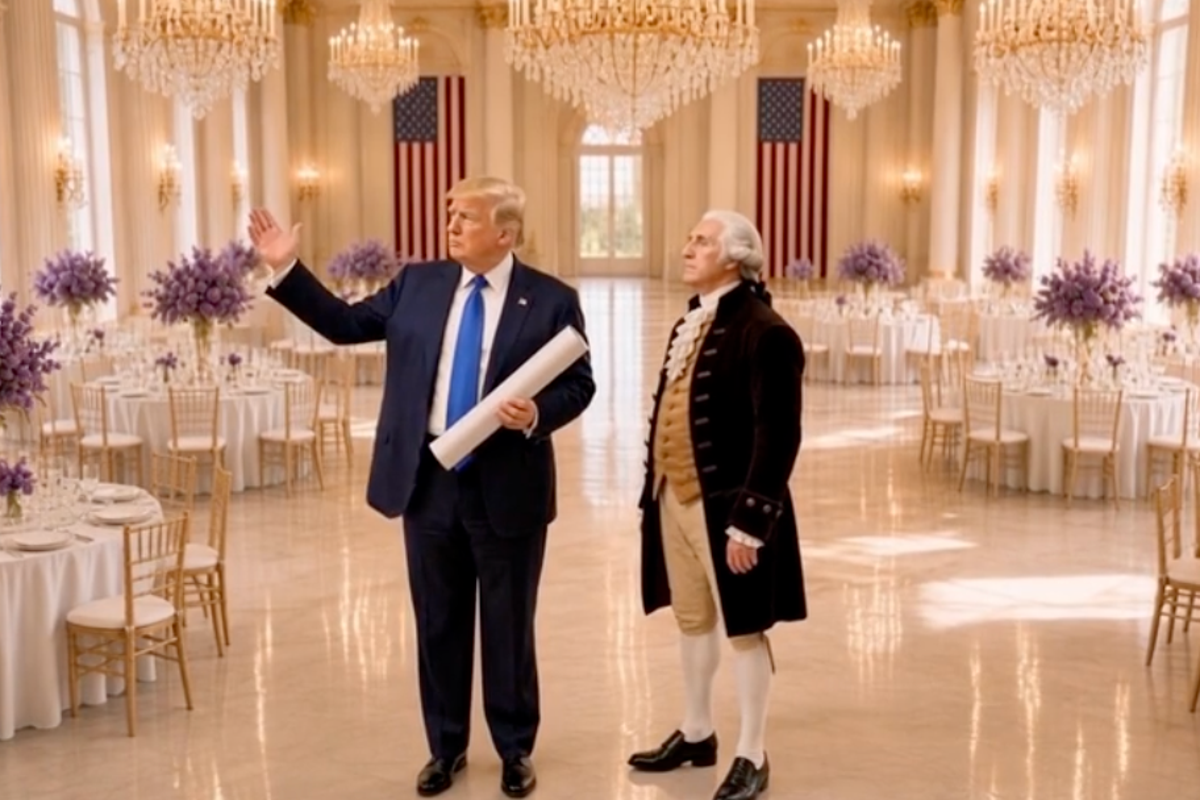
Donald Trump has a new hobby. When he isn't busy fighting federal courts over construction permits, he's hanging out in digital dreamscapes with America's founding fathers.
His latest social media spree features AI-generated videos of himself giving George Washington a personal tour of a massive, unbuilt White House ballroom. It’s strange. It’s surreal. And, honestly, it’s a calculated move to shift the conversation away from the very real, very grounded legal trouble his $400 million pet project is facing.
The disconnect between digital fantasy and reality
Most people see these AI clips as just another weird moment in a political cycle already overflowing with them. But there's a specific function here. When you see Trump "consulting" with Washington on construction plans, it isn't just about sharing a funny graphic. It's an attempt to weave his current administration's goals into the fabric of American history.
The irony? The actual, physical reality is much less grand.
While the AI-generated version of Trump walks through an ornate, gold-plated hall, the real-world project is stuck in a stalemate. A federal appeals court recently put the brakes on construction, reminding the executive branch that Congress holds the purse strings and the authority for major modifications to the White House.
Trump calls the court's interference "politically motivated." His administration claims the facility—and the secretive military-grade bunker buried beneath it—is essential for national security. The cost has doubled from an initial $200 million estimate to at least $400 million. If you’re paying attention to the details, the discrepancy between the polished AI version of a "great ballroom" and the messy, expensive reality of a contested construction site is jarring.
Why AI has become the preferred political tool
You’ll notice a pattern if you track his recent posts. These images aren't trying to pass as real footage in the traditional sense; they’re designed to be hyperbolic.
Why bother with this approach? It works because it simplifies complex issues.
- Controversial policy becomes personal legend: Instead of explaining the legal nuances of the separation of powers, the focus shifts to a visual of him working alongside a Founding Father.
- Diverting attention from costs: It's hard to get fired up about a $400 million budget overrun when you're looking at a cartoonish, idealized image of a president from 1799 approving interior design choices.
- Building a narrative of inevitability: By constantly showing these renderings, the project starts to feel real to the audience, regardless of whether the Supreme Court gives the green light by the August 21 deadline.
I’ve seen this strategy before in various forms. It’s an effective way to control the narrative when you don’t have the legal or legislative upper hand. It’s much easier to create a fantasy of success than it is to navigate the actual, grinding process of securing congressional approval.
The risks of blurring history and fiction
We're moving into a time where digital content is often untethered from objective reality. When political figures use synthetic media to "rewrite" their associations with history, it changes how their base perceives their legitimacy.
Washington becomes a prop in an argument about a ballroom. The actual history of the White House—its architecture, its limitations, and the rules governing its preservation—gets pushed aside for a gold-tinted AI hallucination.
If you’re wondering what happens next, keep your eyes on the Supreme Court docket. The court's decision regarding the project will be the final word on whether that ballroom ever gets built. Until then, expect more AI-generated scenes. It’s a cheap, fast, and visually arresting way to keep a controversial project in the spotlight.
Don't mistake the digital rendering for the construction reality. The legal battles over the East Wing are where the actual power dynamic is playing out. That’s the real story, regardless of how many AI-generated Founding Fathers you see on your feed. Stay skeptical of the visuals and watch the court filings instead. That's where you'll find the truth.