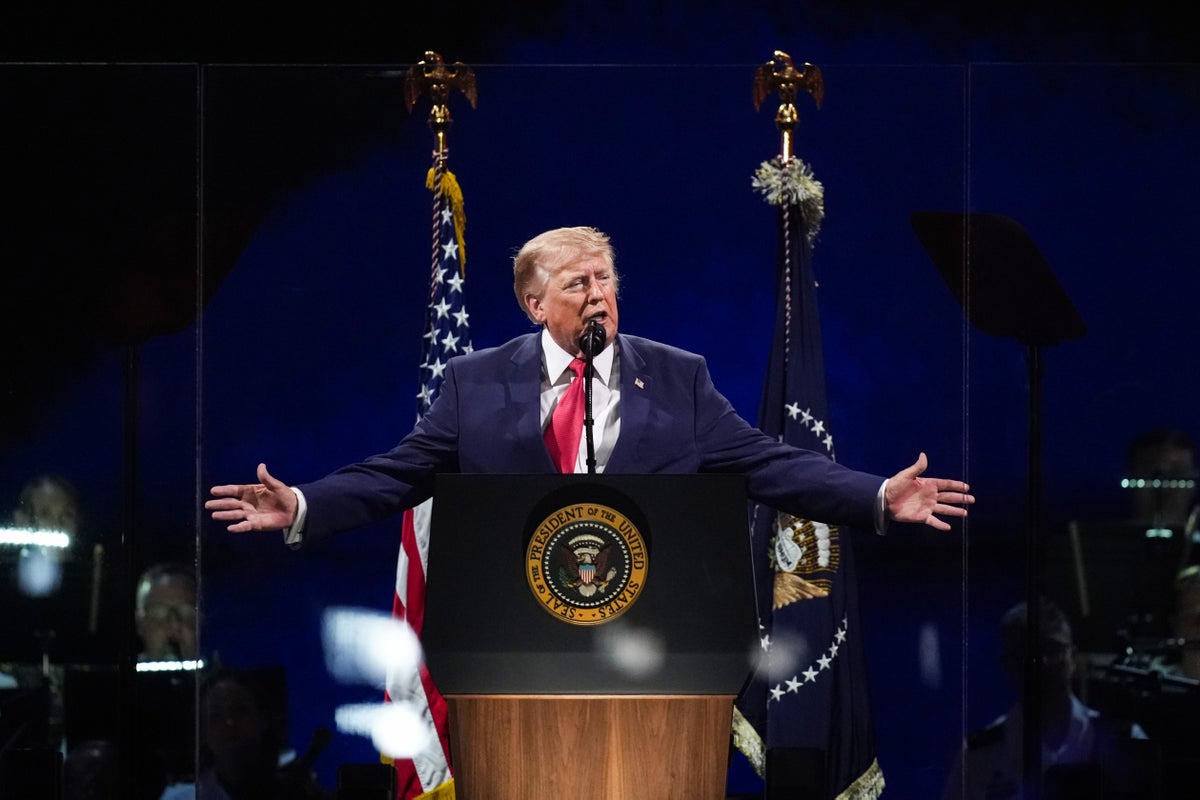
Donald Trump wants you to know that his crowds are bigger than anyone else's. It doesn't matter if there's a heatwave, a severe thunderstorm, or a literal evacuation order from federal law enforcement. If Trump is on a stage, the numbers must break records.
The latest chapter in this fixation played out during America’s 250th birthday celebration in Washington, D.C. After dangerous weather forced tens of thousands of people to flee the National Mall, Trump took to Truth Social to claim that an eye-popping 422,000 people had gathered to hear him speak. He then claimed he personally overruled safety officials who wanted to cancel the event, asserting that 150,000 loyal followers marched right back into the storm zone just for him.
But anyone standing on the sweltering, rain-soaked streets of the capital saw a completely different picture. The official numbers don't back up his claims, and they never do. Understanding why Trump continues to spin these massive baseline numbers tells us everything we need to know about his political strategy heading into the midterms.
The Chaos on the National Mall
Independence Day in 2026 was supposed to be a historic milestone. Turning 250 is a big deal for any nation, and the White House spent months turning the capital into a massive celebration hub under the "Freedom 250" banner. Trump made sure he was the star of the show. He promised the biggest fireworks display in history and a speech that would go down in the books.
Then the weather hit.
The humidity was brutal all morning. By late afternoon, dark clouds rolled over the Washington Monument. The United States Secret Service, the National Park Service, and FEMA didn't hesitate. They triggered emergency plans, blared warnings across the loudspeakers, and ordered an immediate evacuation of the entire event grounds.
Lightning was tracking straight toward the Mall. Moving more than 100,000 people on short notice is a logistical nightmare. Secret Service spokesperson Anthony Guglielmi admitted that an evacuation of that scale always causes a bump in the road. People scrambled for cover in nearby museums, subway stations, and government buildings.
For all intents and purposes, the night looked over.
Overturning the Security Team
According to Trump, he wasn't going to let a little lightning ruin his moment. In his Sunday morning post, he wrote that when he heard the event was cancelled, he immediately overturned that decision.
Think about that for a second. The most elite security agencies in the world declare an active lightning threat and clear out the open space. The president decides his speech is more important than the safety protocols planned for months. He ordered the gates reopened at 9:45 PM.
Trump praised the police and Secret Service for getting everyone back into the arena so fast. He painted a picture of a triumphant, resilient crowd that braved the elements just to hear him rail against communism and talk about sinking the Iranian navy.
But look at the timeline. The speech was delayed by hours. The massive fireworks show didn't even start until midnight. While Trump claimed 150,000 people rushed back inside the security perimeter, journalists and eyewitnesses on the ground reported that the crowd was less than half of what it had been before the storm hit.
D.C. Fire and EMS reported treating dozens of people for heat exhaustion and storm-related issues. Turning an emergency evacuation area back into a political rally on a whim isn't brilliant leadership under pressure. It's a massive safety gamble.
Where Did the 422,000 Figure Come From
Trump didn't just pull the 150,000 number out of thin air; he started with a base claim of 422,000 people present at exactly 7:05 PM.
No official agency confirmed that number. Not the Park Service, not the Secret Service, and not D.C. officials. The National Park Service famously stopped providing official crowd estimates decades ago because the numbers always became a political football. Trump knows this, which gives him the freedom to set his own baseline.
The National Mall can hold a lot of people, but filling it requires packed crowds stretching from the Lincoln Memorial all the way to the Capitol building. Aerial footage from earlier in the day showed significant gaps in the crowd, worsened by a blistering heatwave that kept sensible people indoors.
This isn't his first time playing with history either. Just a couple of months ago during a healthcare event, Trump went off on a bizarre tangent about the Lincoln Memorial reflecting pool, bragging that his past crowds were bigger than the 1963 March on Washington where Dr. Martin Luther King Jr. gave his famous speech. MLK drew roughly 250,000 people. Trump routinely inflates his numbers to beat that historical benchmark, claiming his audiences topped a million.
The Core of the Crowd Size Obsession
Why does a man holding the highest office in the free world care so much about headcounts?
For Trump, crowd size equals legitimacy. In his mind, a packed audience is visual proof that the public supports his policies, his rhetoric, and his view of the country. If the crowd is small, it means his power is waning. He can't accept that reality.
We saw this on day one of his first term back in 2017, when his press secretary stood at the podium and argued about the inauguration attendance. We saw it in 2019 during his first "Salute to America" event. We saw it again when his Great American State Fair failed to draw the massive crowds he expected.
When reality doesn't match the narrative, Trump rewrites reality. He uses these hyper-specific numbers—not 400,000, but exactly 422,000—to make the lie sound scientific. He wants his supporters to believe that someone, somewhere, was standing there with a clicker counting every single body.
What This Means for the Midterms
This isn't just harmless vanity. It's a calculated political tactic designed to keep his base energized and distrustful of mainstream reporting.
When the media reports that the Mall was mostly empty after a massive rainstorm, Trump can point to his Truth Social post and claim the press is lying to minimize his popularity. It feeds into the broader narrative that the establishment is actively working against him and his followers.
During his actual speech on the Mall, which finally happened in the late hours of the night, Trump didn't focus on national unity for the 250th anniversary. He talked about internal enemies. He compared his political opponents to a cancer that needs to be cut out. He used the platform to push the SAVE America Act, demanding strict new voter ID laws before the upcoming elections.
By tying his crowd sizes to his political strength, he's setting the stage for his next campaign. He's telling his voters that they are part of a massive, unstoppable movement that numbers in the hundreds of thousands, even when the physical evidence shows a few thousand dedicated loyalists standing in the mud at midnight.
If you want to track the true impact of Trump's events, ignore the numbers he posts on social media. Look instead at the local emergency responses, the empty spaces on the pavement, and the hours people spent waiting in the dark because a political speech took priority over public safety.
Check the local D.C. emergency management updates for accurate weather incident reports instead of relying on political feeds. Keep an eye on how local city infrastructure handles these last-minute changes the next time a major political rally rolls into town.