Inland China is not supposed to look like Tornado Alley. Yet, the terrifying wedge tornado that ripped through Hubei province on Monday night proved that traditional weather playbooks are officially useless. Triggered by the dying breaths of Typhoon Maysak, this violent atmospheric event blindsided cities that rarely see twisters, leaving a trail of collapsed factories, mangled trucks, and a rising death toll in its wake.
Most people associate typhoons with coastal storm surges and relentless rain. They do not expect a spinning vortex to drop from the sky hundreds of miles inland. This event completely shatters the conventional understanding of tropical cyclone risks in central China. At least 11 people are dead, over 330 are injured, and an industrial powerhouse is left wondering how a tropical storm from the South China Sea caused midwestern-style destruction in their backyard. Expanding on this theme, you can also read: Why The Kenscoff Massacre Exposes Haiti’s Deepening Security Crisis.
Understanding what happened on July 6, 2026, requires looking past the basic headlines. It means confronting a reality where warming oceans feed inland systems with unprecedented energy, turning weakening storms into highly volatile tornado factories.
The Four Hours of Chaos in Huanggang and Ezhou
The disaster unfolded with terrifying speed over a four-hour window on Monday evening. Between 8:10 PM and 8:30 PM local time, a massive wedge tornado touched down directly over the urban core of Huanggang and tracked across the Yangtze River into Ezhou. Winds screamed at speeds up to 149 kilometers per hour, measuring a staggering Force 15 on the Chinese wind scale. Analysts at NBC News have provided expertise on this matter.
The physical damage looks like a war zone. In the Huangzhou District of Huanggang, the tornado directly targeted residential neighborhoods, massive warehouse projects, and industrial parks. At the Qicheng Logistics Company, heavy commercial trucks were lifted into the air and thrown up to 30 meters. Entire roofs made of corrugated steel were stripped away, turning into airborne blades that shredded everything in their path. CCTV footage caught civilians trapped inside buildings screaming as winds forced glass doors open, shattering them instantly.
Emergency management authorities confirm that the wider severe weather system affected nearly 15,000 residents. At least 22 homes completely collapsed, and nearly 5,000 buildings sustained severe structural damage. Local hospitals have been inundated with hundreds of injured citizens, with several currently fighting for their lives in critical care.
Hubei province is a crucial hub for automotive manufacturing, technology, and heavy industry. It is not built for this. Unlike coastal provinces like Guangdong or Jiangsu, which expect severe convective weather, central China lacks the structural reinforcement and public awareness required to handle a sudden EF2 tornado outbreak.
The Volatile Physics of Inland Tropical Remnants
Meteorologists are pointing squarely at Typhoon Maysak to explain how this anomaly happened. The storm, named after the Khmer word for teak wood, originally whipped across Vietnam and China's southern island province of Hainan before moving inland through the Guangxi region. By the time its core reached central China, it had technically weakened into a tropical depression.
That weakening was incredibly deceptive. While the sustained surface winds of the typhoon had dropped, the system remained packed with an immense volume of warm, unstable moisture drawn directly from the scorching waters of the South China Sea. As this moisture collided with cooler, continental air masses over the Yangtze River basin, it created a hyper-unstable atmospheric environment.
Wang Xiaoling, a lead expert at the Hubei Provincial Meteorological Bureau, noted that the province had not seen a significant tornado since May 2021. The extreme wind shear—where wind speed and direction change rapidly with altitude—was supercharged by the rotation of Maysak's decaying outer bands. When that rotation combined with intense localized updrafts over the region's massive lakes, it created the perfect recipe for a violent, long-track tornado.
The lesson here is simple. We can no longer assume a tropical system is harmless just because it is downgraded to a tropical depression. The moisture and rotational energy can survive deep inland, posing a severe threat to unsuspecting populations far from the coast.
A Nation Facing a Multi Front Climate Crisis
The tragedy in Hubei is only one piece of a massive, nationwide weather crisis hitting the country simultaneously. The broader atmospheric instability is triggering disasters across multiple provinces, straining emergency rescue capabilities to their absolute limits.
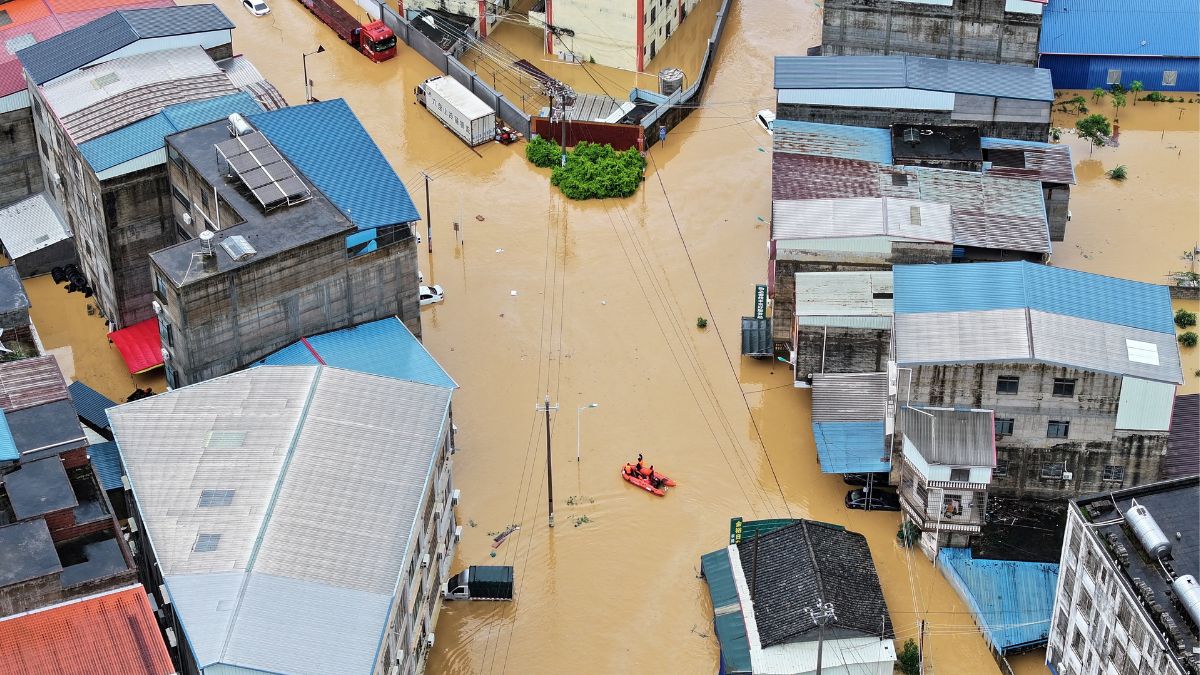
In the southwestern Guangxi region, the primary landfall zone for Maysak, the situation remains incredibly grim. The capital city of Nanning is dealing with record-breaking rainfall that has already claimed four lives. Torrents of water have triggered widespread urban flooding, forcing the emergency evacuation of more than 53,000 people. The Guigang Hydrological Station reported that water levels spiked dangerously over the weekend, prompting fears of massive riverbank breaches.
Further northwest, in the mountainous terrain of Gansu province, a devastating landslide swept away 33 people in the early hours of Monday morning, leaving at least 16 citizens missing. The extreme moisture transport from the south is destabilizing hillsides that are completely unaccustomed to such intense downpours.
If that isn't enough, the eastern seaboard is currently bracing for Super Typhoon Bavi. Currently tracking across the Pacific after lashing Guam and Rota with terrifying 180 mph winds, Bavi is expected to make landfall later this week. Taiwan is already preparing for over a meter of rainfall, and the mainland has placed tens of thousands of military personnel on standby. President Xi Jinping has officially called for all-out rescue efforts, recognizing that the country is fighting a multi-front battle against the elements.
Industrial Vulnerability and the Supply Chain Threat
For global businesses, the Hubei tornadoes reveal a massive blind spot in supply chain resilience. Companies spend millions reinforcing coastal factories against typhoons, but they leave their inland logistical hubs exposed to standard building codes.
When a logistics park gets flattened in a city like Huanggang, the ripple effects hit global tech and automotive supply chains almost immediately. The destruction of warehousing infrastructure, combined with power grid failures that knocked out electricity to thousands of facilities, halts production lines far beyond the disaster zone.
The financial losses from these events are scaling rapidly. Extreme summer heat, sudden gale-force winds, and unseasonal floods are costing the world's second-largest economy tens of billions of dollars annually. Crop destruction in Hubei's agricultural zones will also pressure regional food prices, adding economic strain to structural damage.
Actionable Steps for Navigating the New Weather Reality
The atmospheric patterns of 2026 show that historical data is no longer a reliable guide for safety or business continuity. Whether you are managing an industrial facility in central China or living in an area historically considered safe from tornadoes, you need to adapt immediately.
Audit your structural wind ratings
If your commercial or residential property is located in an inland region experiencing increased tropical storm remnants, do not assume standard building codes will protect you. Inspect roof mountings, reinforce large bay doors, and ensure that corrugated steel structures are fully secured against Force 13 to 15 winds.
Rethink the tropical depression warning tier
Do not let your guard down when a typhoon is downgraded. Track the moisture plume and atmospheric shear behind the storm. When a decaying tropical system passes over a warm, lake-heavy inland terrain, monitor local radar closely for sudden supercell development and severe convective updates.
Establish localized emergency shelters
Because tornadoes provide mere minutes of warning time compared to the days of preparation allowed by a typhoon, proximity to safety is everything. Industrial complexes must designate reinforced internal concrete rooms or underground basements as storm shelters. Do not rely on large-span warehouses or prefab office structures for safety when a twister hits.
The events in Hubei prove that climate volatility is moving faster than infrastructure upgrades. Survival, both human and economic, depends on recognizing that no region is truly immune to the wildest expressions of extreme weather. Emergency crews, consisting of hundreds of provincial firefighters and search dogs, continue to sift through the wreckage in Huanggang. The immediate priority is saving lives, but the long-term challenge will be completely rebuilding our understanding of inland storm risks.