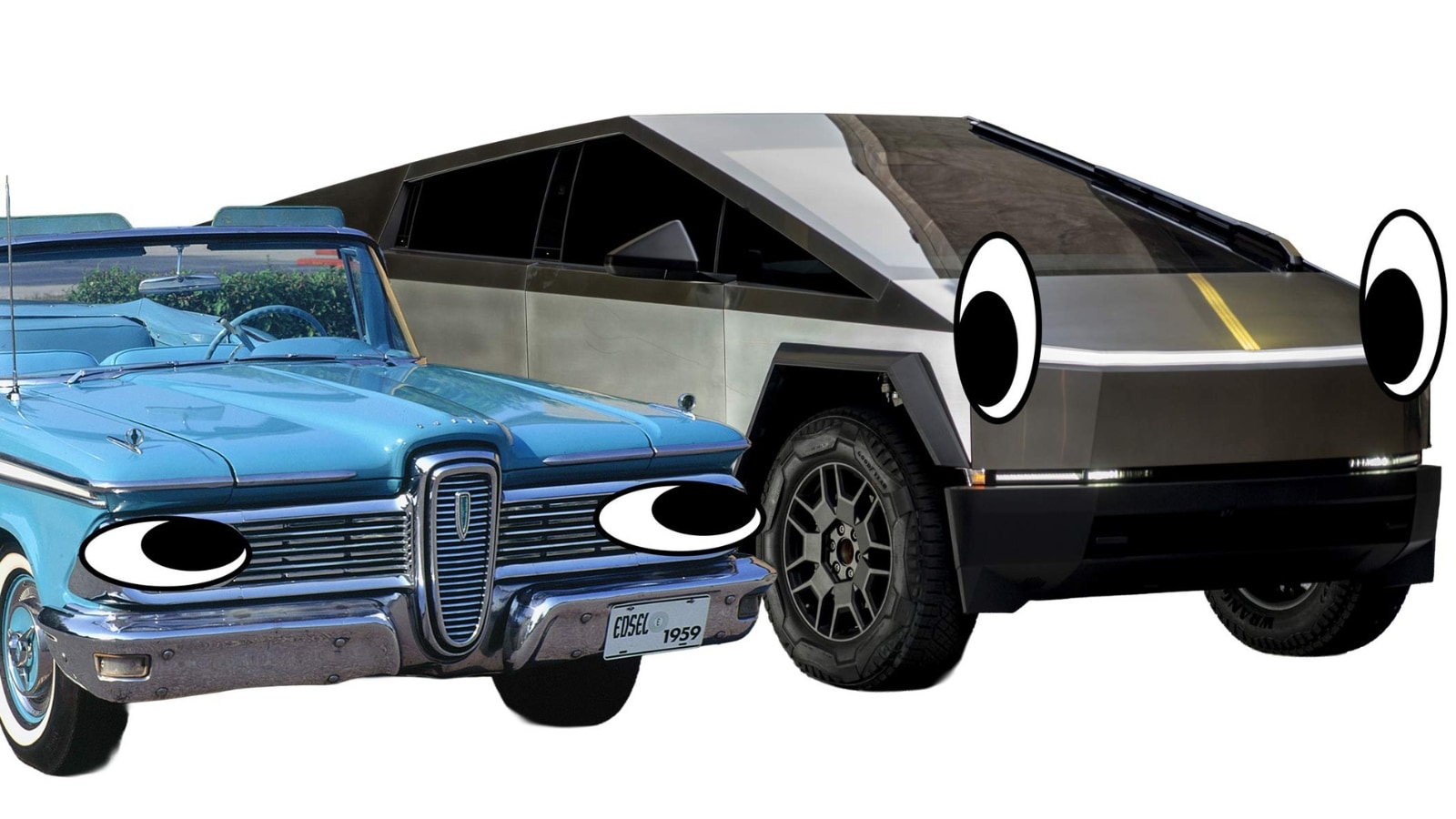
For nearly seven decades, the 1958 Ford Edsel held the uncontested title of the biggest flop in American automotive history. Automotive historians used it as the textbook definition of overhyped hubris meeting cold market reality.
That crown is officially in jeopardy. You might also find this connected coverage insightful: Why Chile Is Spending $100 Billion To Break Its China Copper Habit In 2026.
When Tesla first handed over its geometric pickup truck to customers, Elon Musk insisted that factory output could reach 250,000 units annually. Instead, registrations tell a very different story. Industry tracking data from S&P Global Mobility showed barely 39,000 Cybertrucks registered in its entire first full year—less than one-sixth of the company's internal target.
Ford managed to sell over 63,000 Edsels in 1958, hitting roughly thirty percent of its 200,000-unit projection. That means the Cybertruck isn't just failing to reach its goals. On a purely statistical basis, its initial launch trajectory is actually worse than the Edsel's. As reported in latest coverage by The Wall Street Journal, the implications are significant.
Understanding how this happened requires looking past the stainless-steel panels. The parallels between these two vehicles run surprisingly deep, offering a harsh lesson in what happens when visionary branding ignores basic consumer needs.
The Cold Numbers Behind the Cybertruck Sales Collapse
When a company misses a sales target by a few percentage points, executives blame supply chain snags or interest rates. When sales land at a fraction of the baseline forecast, something fundamental is broken.
Musk repeatedly claimed that demand for the truck was off the charts. Yet registration figures show momentum stalled almost immediately after early adopters got their vehicles. By early 2025, U.S. monthly registrations dipped so low that analyst firms like CARLAB began openly comparing the truck to historical market disasters.
To make matters worse, sales figures were padded by corporate buys. Filings show that companies controlled by Musk—including SpaceX—purchased millions of dollars worth of Cybertrucks to build out internal fleets. Take away those internal corporate transfers, and organic retail demand looks even weaker.
Price cuts and special financing offers haven't reversed the trend either. Traditional truck buyers aren't switching over from their Ford F-150s or Chevy Silverados, while luxury EV buyers have moved on to less polarizing options.
How Ford Created the Original Marketing Flop
To appreciate why the Tesla Cybertruck sold less than one-sixth of its target, you have to look back at 1957.
Ford spent over two years hyping up a secret vehicle known simply as "E-Car." They promised it would revolutionize how Americans drove. When the Edsel finally debuted, the public saw a car with an odd vertical grille that critics immediately mocked.
The problems went beyond optics. Ford built the Edsel on existing assembly lines alongside standard Fords and Mercurys. Factory workers had to swap out tools on the fly, leading to terrible quality control. Cars arrived at dealerships with loose parts in the trunk and instructions for mechanics to finish building them before test drives.
Ford lost roughly $350 million on the project—equal to about $2.5 billion today. The model survived just three model years before Ford pulled the plug in late 1959.
First-Year Target vs. First-Year Actual Sales

Ford Edsel (1958)
Target: 200,000 units
Actual: ~63,110 units (31.5% of target)

Tesla Cybertruck (2024)
Target: 250,000 units
Actual: ~38,965 units (15.5% of target)
The math is brutal. Ford reached nearly a third of its target. Tesla didn't even reach sixteen percent.
Why Engineering Innovations Couldn't Save Either Vehicle
Here is the twist that most critics forget. Neither the Edsel nor the Cybertruck was a total engineering failure. Both pushed automotive hardware forward.
The Edsel introduced genuine innovations. It featured a push-button transmission system mounted inside the steering wheel hub, dubbed Teletouch. It had self-adjusting brakes, floating speedometer dials, and a deep-dish safety steering wheel.
The tech was ahead of its time. Unfortunately, it was also glitchy. Drivers trying to honk the horn regularly slammed the car into reverse by accident.
Tesla did something similar with the Cybertruck. They implemented a true 48-volt electrical architecture, replacing the standard 12-volt wiring harness that the auto industry has relied on for decades. They added steer-by-wire capability with zero physical steering column link, which works surprisingly well in tight spaces.
The problem? Incredible underlying hardware gets overshadowed when basic manufacturing fails. Eight separate recalls in just over a year—ranging from stuck accelerator pedals to trim pieces flying off on the highway—destroyed buyer confidence.
Great engineering can't fix a product that breaks under normal use.
Where Tesla Went Wrong with Pricing and Practicality
The original Cybertruck pitch in 2019 was straightforward. Musk promised a $39,900 base price, a 500-mile range option, and utility that would outclass conventional work trucks.
That vehicle never existed.
When actual deliveries began years late, the entry price had ballooned to over $80,000, while the range fell far short of early promises. A buyer looking for a practical work vehicle can buy two standard gas trucks—or a highly capable conventional electric truck—for that price.
Practicality issues stacked up quickly.
- High, thick bed walls make side loading almost impossible for trade workers.
- Sharp stainless steel body corners create real safety concerns for pedestrians and garage spaces.
- Non-standard dimensions prevent it from fitting in many standard residential garages.
- Extreme weight limits international export opportunities due to strict European licenses.
Automotive styling works when it serves a function or appeals to broad aesthetic tastes. The Cybertruck's extreme design alienated mainstream buyers, turning the truck into a novelty purchase for tech enthusiasts rather than a mass-market workhorse.
The Danger of Polarizing Brands
There is one critical area where Tesla's situation is harder than Ford's in 1958.
Henry Ford had controversial views, but he wasn't directly tied to daily consumer purchasing decisions decades later. Elon Musk's personal brand is inextricably linked to every vehicle Tesla builds.
Driving an Edsel in 1958 meant you bought a weird-looking car. Driving a Cybertruck in 2026 makes a explicit political and cultural statement.
Market research from Edmunds shows that public sentiment around the truck is deeply divided. For millions of potential car buyers, the brand friction outweighs any technical appeal. When a product becomes a cultural battleground, you instantly cut your addressable market in half.
Actionable Steps for Product Teams and Auto Leaders
The fall of high-profile product launches offers clear lessons for anyone launching hardware or software products.
- Price to promise, not hype. If you announce a $40,000 product, coming to market at $80,000 will alienate your core waiting list every single time.
- Prioritize basic utility over novelty. Advanced architecture like 48-volt systems matter to engineers, but buyers care if the bed is easy to load and the vehicle fits in their garage.
- Fix build quality before ramping volume. Rushing flawed units out the door creates lasting brand damage through recalls that no amount of software updates can hide.
- Separate personal brand from product utility. When a product becomes a political statement, mainstream consumers will simply buy from quiet competitors.