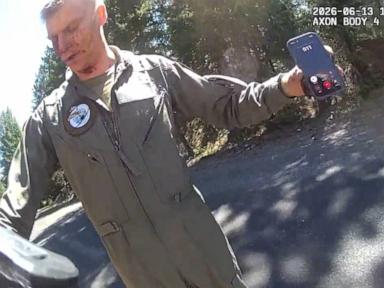
When a U.S. Marine Corps F/A-18 Hornet slammed into a Washington state mountainside, the pilot walked away with a bloodied face and a casual opening line to emergency responders: "Hey, buddy, I just crashed."
Newly released footage and details from the June crash near Rimrock Lake in Yakima County offer a rare look at the seconds following a catastrophic military aviation failure. While public fascination usually centers on the fireball, the real story lives in the split-second mechanics of modern ejection systems and the eerie calm of a pilot surviving a mountainside impact.
Surviving the Drop in Yakima County
The routine training mission turned disastrous when the aircraft clipped a tree line during a low-altitude flight, igniting the Pine Tree Fire. Assigned to Marine Aircraft Group 11 out of MCAS Miramar, the pilot faced an immediate crisis.
Ejection seats on modern jets are marvels of survival engineering, pulling up to 15 Gs of force in a fraction of a second. That kind of violence leaves marks. In the video, the pilot's face shows visible cuts and bruises, yet he remains entirely coherent.
"I came over that tree line, I hit those trees, and I'm not sure exactly... honestly I'm a little [dazed]," the pilot recalled shortly after hitting the ground.
The Reality Behind Military Ejections
Most people think ejecting from a fighter jet is like stepping off a fast-moving ride. It isn't. It is a calculated explosion that destroys vertebrae compression limits and tests human endurance.
Military flight surgeons track every single ejection because the physical toll is massive. Pilots routinely lose an inch or two of height permanently due to spinal compression during the seat rocket sequence. Surviving with minor injuries, as seen in the Washington state incident, requires a mix of absolute precision timing and sheer luck.
The F/A-18 Hornet involved in the crash cost tens of millions of dollars, but hardware is replaceable. Pilots with tactical experience are not. Training pipelines take years and millions of dollars per aviator, making every successful ejection a massive victory for naval aviation safety protocols.
What Happens After the Smoke Clears
The immediate aftermath of a crash like this involves more than just a quick medical checkup. Yakima County Sheriff's deputies, local fire crews, and federal forestry units had to lock down the Rimrock Lake area to battle the wildfire sparked by the wreckage.
Investigations into low-altitude mishaps usually take months. Flight data recorders, radar tracks, and pilot testimony are cross-examined to determine whether mechanical failure, spatial disorientation, or environmental factors caused the jet to drop below safe clearance.
Check local emergency alerts if you travel through the Okanogan-Wenatchee National Forest region, as residual military recovery operations and forestry access restrictions can shift quickly.