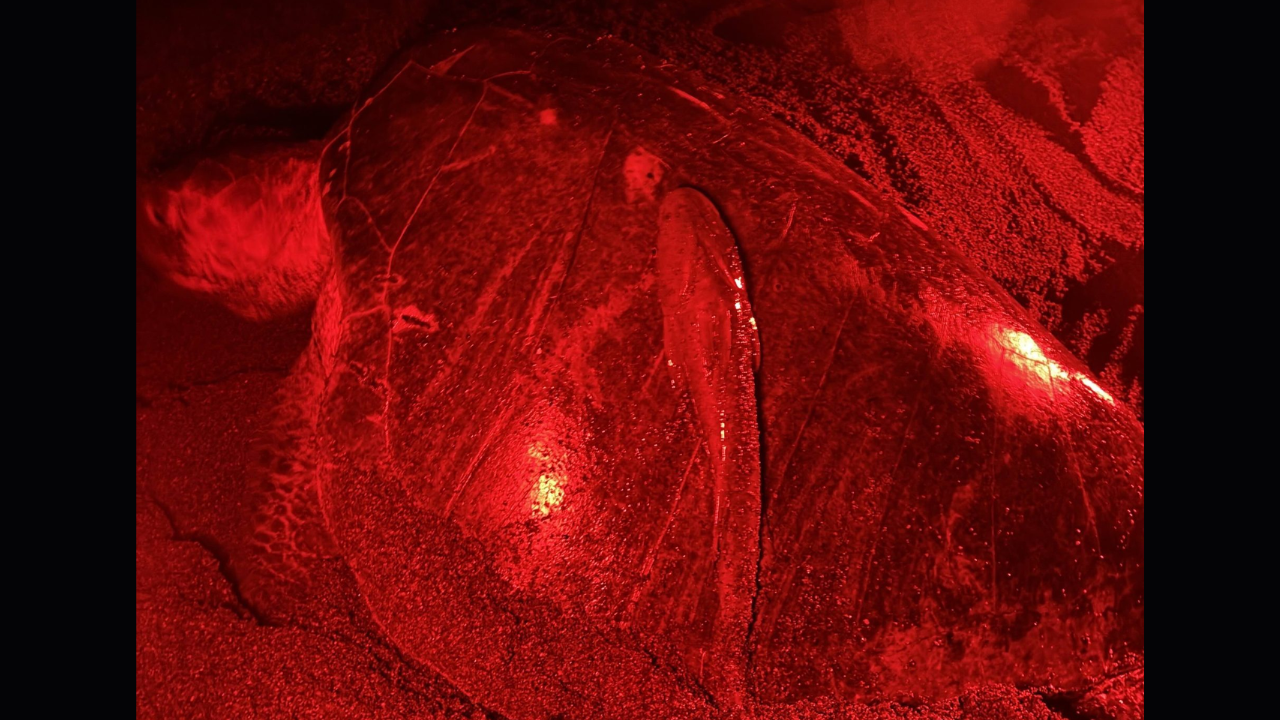
A mother sea turtle crawled out of the surf onto a dark Costa Rican beach to lay her eggs, hauling an unexpected passenger that refused to let go. Fastened tightly to her shell with a specialized suction disc, a live remora stayed attached for nineteen minutes in the open air.
Most fish suffocate within minutes when pulled from the ocean because their gills collapse without a constant stream of water. Yet this suckerfish survived high and dry on Playa Pejeperro, baffling the field researchers who witnessed it.
The Bizarre Beach Encounter on Playa Pejeperro
Field workers monitoring nesting activity for the conservation project Comunidad Protectora de Tortugas de Osa (COPROT) watched in disbelief. An olive ridley sea turtle emerged from the waves, moving heavily across the sand. Glued securely to her back was a common remora.
Researchers Megan Bullock, Vicente Peña Eisele, and Emily Yeager documented the strange event. They expected the fish to drop off immediately or panic as the environment changed from saltwater to dry sand. Instead, the hitchhiker stayed locked in position.
During the nineteen minutes of observation, the remora remained relatively still except for periodically flexing its opercula, the protective bony flaps covering its gills.
How the Remoras Suction Grip Works
Remoras are famous marine freeloaders. They use a modified dorsal fin on top of their heads that functions like a high-powered vacuum seal. This adaptation allows them to latch onto sharks, rays, whales, and sea turtles to conserve energy while traveling across the ocean.
Normally, the drag of moving through water helps test these seals. On land, gravity takes over. Without water buoyancy supporting the fish, its body weight pulls down hard against the attachment point.
The suction disc requires almost zero active muscular effort from the fish to maintain its grip. As long as the outer rim remains moist, the vacuum holds fast. That mechanical design explained why the fish stayed put while the turtle dragged its heavy shell across dry sand.
Surviving Out of Water
Nineteen minutes is an eternity for a marine fish to spend exposed to air. When researchers finally removed the remora so they could measure the nesting turtle's shell, they expected a weak or dying animal.
Instead, the fish immediately began to writhe and thrashed aggressively. The moment it hit the ocean water, it swam away with high energy.
Scientists are still trying to figure out how it pulled off this feat. While researchers know remoras require flowing water over their gills to breathe long-term, this observation hints at a higher tolerance for low-oxygen conditions than previously documented. Some species might possess physiological adaptations that buy them precious minutes when their hosts make brief terrestrial excursions.
What This Discovery Means for Marine Research
Incidents like this remind us how little we truly understand about animal partnerships in the wild. Remoras are typically viewed as opportunistic riders that exploit hosts for transit and protection.
Watching one willingly follow a host onto dry land suggests a deeper, more resilient bond between marine species than textbooks suggest. For conservationists monitoring endangered sea turtles on nesting beaches, paying attention to these minor details opens a wider window into coastal ecosystems.
Next time you watch a sea turtle crawl ashore, look closer at the shell. You might just spot an extreme hitchhiker testing the limits of marine survival.