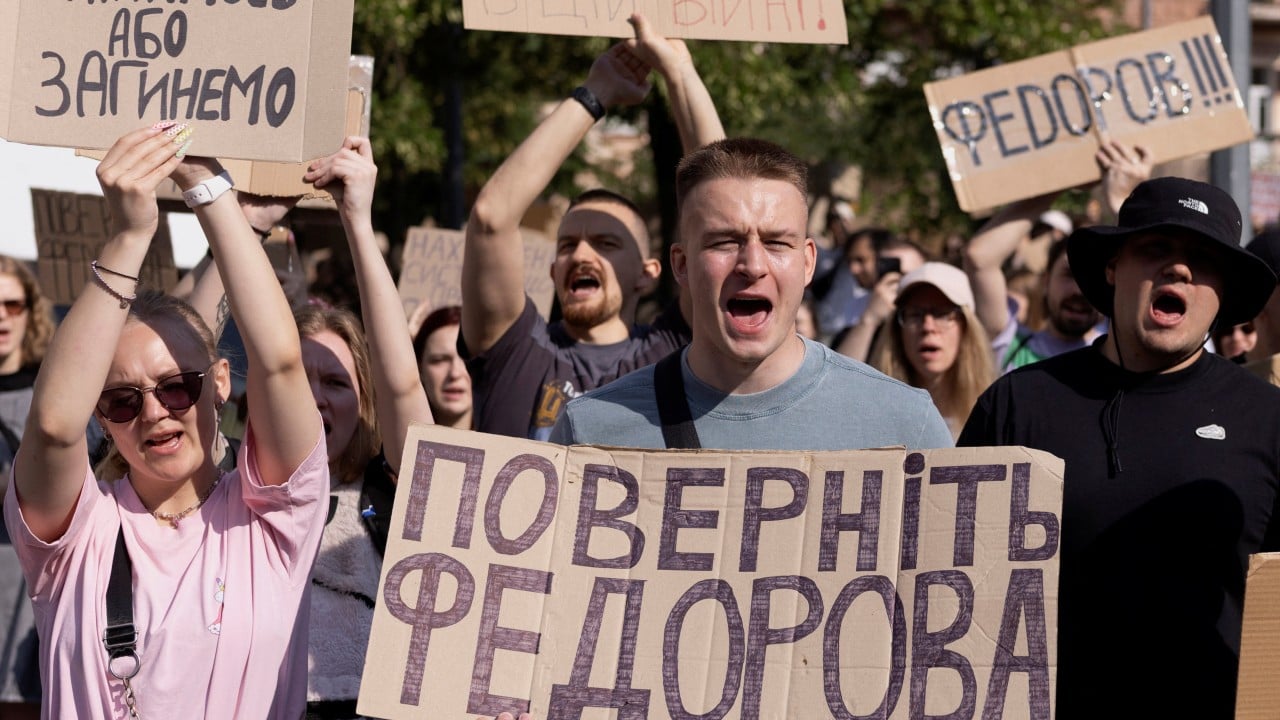
You don't usually see Ukrainians protesting their own government in the middle of an existential war. Since Russia's full-scale invasion, public dissent has mostly been shelved for the sake of survival.
That unspoken rule just shattered on the streets of Kyiv.
President Volodymyr Zelensky’s decision to dismiss 35-year-old Defense Minister Mykhailo Fedorov has sparked an unprecedented public backlash. In Ivan Franko square and across several major cities, crowds of young Ukrainians, soldiers on leave, and activists are chanting "Shame!" and holding signs reading "Hands off Fedorov".
This isn't just another routine cabinet reshuffle. It’s a deep political tremor that exposes the widening fault lines between Ukraine's traditional military establishment and the tech-forward, reformist class that has kept the country's defense agile.
The Tech Prodigy Who Rewrote Modern Warfare
To understand why people are furious, you have to understand who Mykhailo Fedorov is.
Before he took the defense portfolio in January 2026, the tech entrepreneur was Ukraine’s Minister of Digital Transformation. He didn't just digitize driver's licenses; he built the "IT Army of Ukraine" and spearheaded the "Army of Drones" initiative. He essentially weaponized the nation’s tech sector, turning commercial off-the-shelf drones into precision-guided threats that crippled Russian logistics in occupied Crimea.
When Fedorov became Defense Minister, he brought that hyper-efficient, Silicon Valley-style playbook to a notoriously bloated and bureaucratic ministry. In just seven months, he accomplished what prior ministers spent years avoiding:
- Asymmetrical warfare integration: He systematically prioritized drone and electronic warfare production over old-school hardware.
- The After-Action Review (AAR): He introduced rigorous, data-driven analysis of every major Russian aerial strike to fix air defense gaps immediately.
- Cracking down on corruption: He targeted the military's Soviet-era procurement chains, saving millions and winning trust in Washington and Europe.
His departure has triggered immediate operational consequences. Colonel Pavlo Yelizarov, the deputy commander of Ukraine's Air Force and a legendary drone unit leader, resigned in protest. In his resignation letter, Yelizarov wrote plainly that removing Fedorov was "a great evil for the country's defense capability" and warned it would lead to more Ukrainian casualties from Russian missile strikes.
The Untenables: Why Zelensky Cut Him Loose
Zelensky hasn't given the public a formal, detailed explanation for dropping his most popular minister. But behind closed doors, the story is much messier.
Sources from a closed-door meeting of the ruling Servant of the People party reveal that Fedorov had an "unresolved systemic conflict" with General Oleksandr Syrskyi, the Commander-in-Chief of the Armed Forces.
Fedorov (Technocrat, Agile, Tech-First) <---> Syrskyi (Traditionalist, Hierarchy-First)
Fedorov wanted to overhaul how the military operated, pushing for rapid decentralization, tech integration, and direct accountability. Syrskyi and the traditional brass saw this as an intrusion into their command structure by an unvetted civilian tech-bro. Zelensky reportedly told lawmakers that while he wanted both men to get along, the friction had simply become untenable during wartime, and Fedorov was the one who had to go.
But there's another, more cynical theory whispering through the streets of Kyiv: political rivalry.
Fedorov’s popularity was soaring, not just at home, but with key allies in Washington. As Zelensky's own poll numbers have taken hits under the grinding weight of a multi-year war, some in the president's inner circle began viewing the young, competent reformer as a viable future political threat.
What Lies Ahead for Ukraine's Defense
Zelensky's proposed replacement is Ihor Klymenko, the current Minister of Internal Affairs. Klymenko is a career law enforcement officer with a background in military service and policing. He's a safe, loyal, institutional choice.
But "safe and institutional" is exactly what Ukraine's tech reformers fear.
Fedorov’s supporters argue that putting a career cop in charge of the Defense Ministry will halt the momentum of high-tech military reform and drag Ukraine back into slow, bureaucratic decision-making. The timing is incredibly risky. Ukraine is facing a brutal summer of Russian drone barrages and a deeply complicated domestic mobilization drive. Removing a defense chief who was actively fixing the air defense network and modernizing troop recruitment feels, to many soldiers and citizens, like an unforced error.
The Next Steps for Kyiv
If Zelensky wants to prevent this political crisis from turning into an national security disaster, his administration must take three immediate steps:
- De-escalate the street protests: The government needs to offer a transparent, public explanation for Fedorov’s removal to combat rumors of political jealousy.
- Protect the drone programs: Zelensky must publicly guarantee that the tech-driven initiatives, particularly domestic drone manufacturing and the After-Action Review systems, will remain fully funded and independent of traditional army bureaucracy.
- Appease Western allies: Fedorov was a key liaison with tech-focused Western donors and the U.S. administration. The incoming minister must immediately reassure Washington that anti-corruption reforms and transparent weapon tracking will not be rolled back.
Zelensky has made bold political gambles before, but sidelining the architect of Ukraine’s high-tech defense is his most dangerous move yet. Unity has been Ukraine's shield. If the presidency continues to alienate the reformers, the soldiers, and the streets, that shield may start to crack from the inside.
:max_bytes(150000):strip_icc()/xochimilco_getty-56a3ea613df78cf7727fdcc0.jpg)