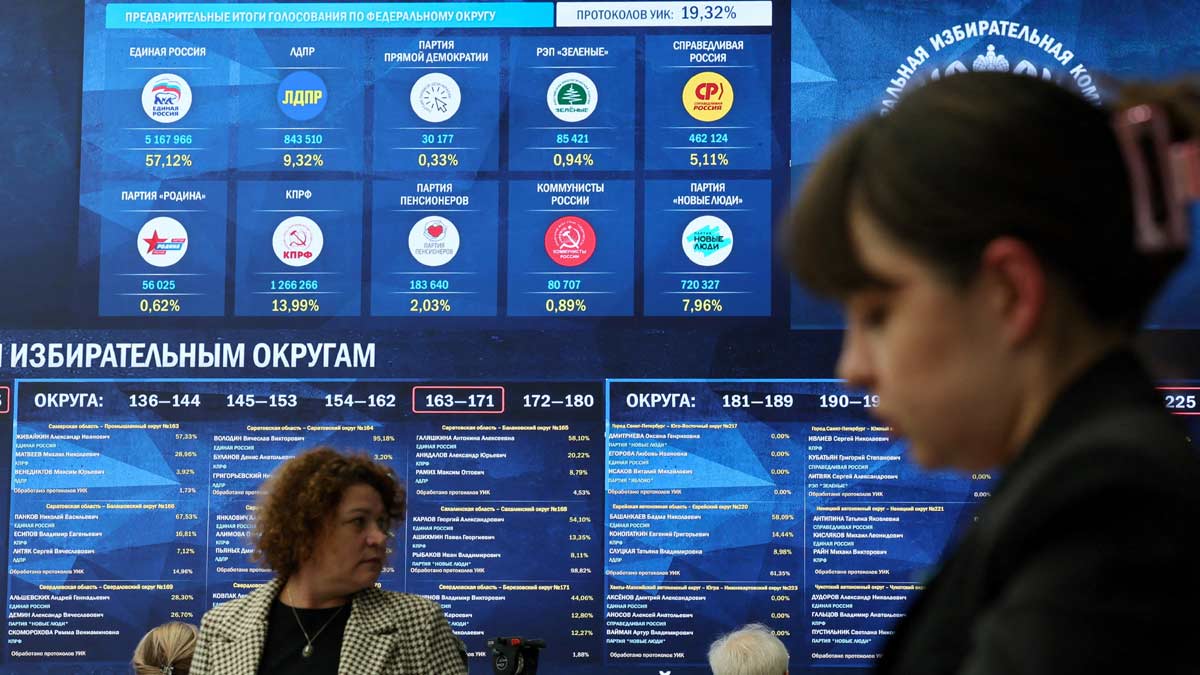
When a political system spends years clearing out every piece of genuine friction, the outcome of an election stops being a question and starts becoming a performance. That is precisely what happened across 11 time zones during Russia's 2026 parliamentary elections. With the ruling United Russia party cruising toward nearly 58 percent of the early party-list vote according to the Central Election Commission, nobody who has been paying attention is surprised. This was never a contest designed to test power. It was an exercise designed to project absolute unity.
If you are wondering why this specific vote matters right now, you have to look past the empty ballot boxes and examine the timing. This marks the first major legislative election since the full-scale invasion of Ukraine in 2022. President Vladimir Putin didn't need to be on the ballot himself—having secured his own term extension through 2030—yet he framed the three-day voting window as a referendum on state policy and military action. Don't forget to check out our earlier coverage on this related article.
The Anatomy of a Controlled Landslide
You cannot understand modern Russian politics by applying Western electoral standards. The playing field was meticulously leveled long before the first polling station opened. Independent watchdogs like Golos were effectively squeezed out of existence, and major anti-war alternatives like the liberal Yabloko party found themselves barred from the federal party-list ballot by the Supreme Court.
What remains on the ballot is what political analysts call the "systemic opposition"—parties like the Communist Party, the Liberal Democratic Party of Russia (LDPR), and New People. They occupy seats in the 450-member State Duma, but they consistently vote in lockstep with Kremlin initiatives. They provide the optical illusion of a multi-party democracy without ever offering a divergent vector of governance. To read more about the background of this, USA Today provides an excellent summary.
Early returns from the Central Election Commission showed United Russia pulling nearly 58 percent of the party-list vote with roughly 58 percent of precincts counted, alongside strong showings in single-seat constituency matchups. Turnout was reported at roughly 56.66 percent, a figure that state officials point to as proof of civic engagement, while critics argue reflects administrative mobilization and pressure in state-linked workplaces.
Voting Under Drone Fire and Digital Glitches
The logistics of this election played out against a grim backdrop of active wartime friction. As polls drew to a close across western regions, large waves of Ukrainian long-range drones targeted Moscow and surrounding areas, prompting heavy air defense responses and forcing authorities to manage security incidents alongside ballot security.
At the same time, the aggressive expansion of electronic voting turned into a technical headache. Digital voting portals suffered widespread outages, slowdowns, and registry glitches across the three-day cycle. While election officials blamed coordinated foreign DDoS attacks for the disruptions, exiled opposition groups claimed the digital system was heavily manipulated to bypass paper trails. In several cities, voters formed long lines at physical stations, insisting on paper ballots that they could control directly. Dissent was largely driven underground or expressed through spoiled ballots carrying anti-war slogans, mirroring the quiet defiance of citizens who know public protest carries severe legal penalties.
What This Means Moving Forward
Does a fresh State Duma change daily life or legislative velocity inside Russia? Realistically, no. The previous parliament already rubber-stamped Kremlin initiatives without legislative friction, and the new makeup will do the exact same thing.
The real utility of this landslide is psychological and external. By securing a commanding majority and keeping the legislature unified, the Kremlin claims a fresh mandate to absorb the mounting economic costs of the conflict, manage potential internal pressures, and sustain its long-term strategic trajectory. The numbers on the screen matter less than the narrative they build: a state forging ahead regardless of external pressure, domestic crackdowns, or ongoing warfare.