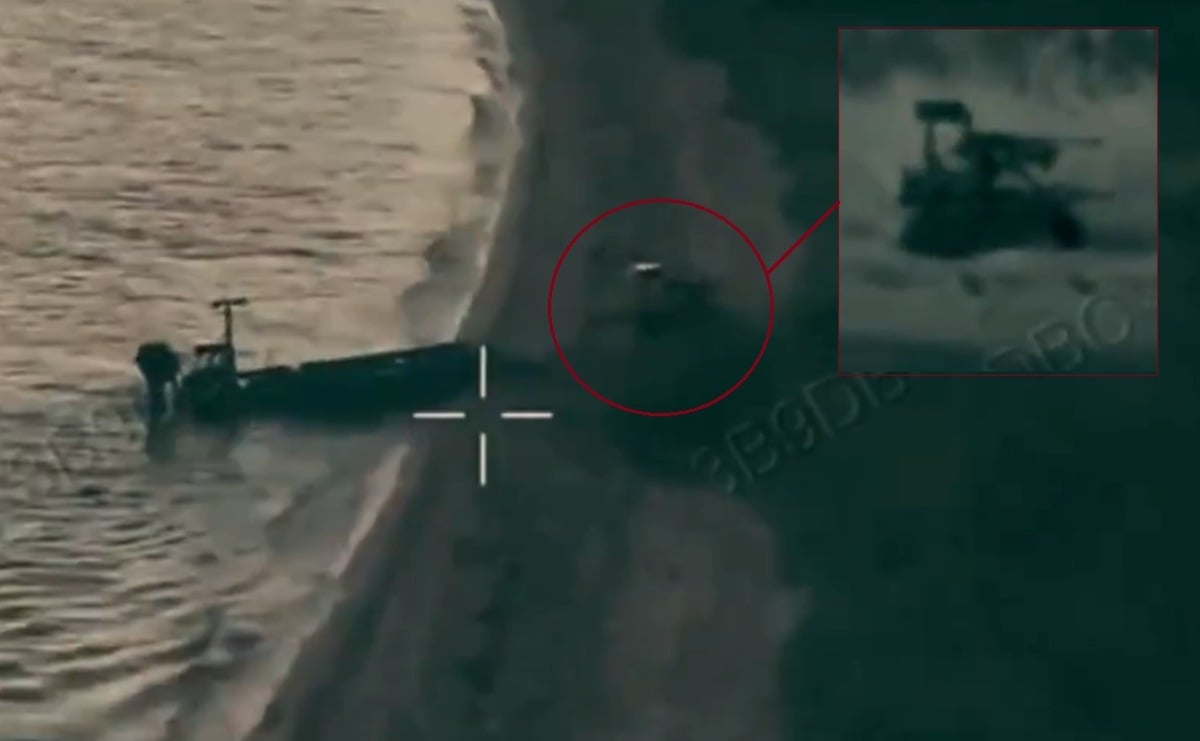
Military theorists spent decades arguing about when autonomous systems would fully take over the front lines. On a heavily fortified, mine-strewn shoreline in southern Ukraine, a single combat operation just ended that debate. Operators from Ukraine's 123rd Separate Territorial Defense Brigade ran a mission that reads like science fiction but represents the cold reality of modern conflict. They pulled off the world's first robot assault from the sea, launching a machine-gun-armed ground drone directly from an unmanned maritime platform onto the occupied sands of the Kinburn Spit.
This was not a tech demonstration or a laboratory experiment. It was a live combat operation aimed squarely at Russian positions behind enemy lines. The mission, directed by Colonel Oleh Makukha and coordinated by Major Denys Hipik of the 1st Unmanned Systems Battalion, marks a terrifying and brilliant evolution in amphibious warfare. For centuries, storming a beach has been the most costly, bloody maneuver a military could attempt. By removing human flesh from the initial breach entirely, this operation flips the traditional tactical math completely on its head.
Anatomy of the First Sea to Land Robot Strike
The mechanics of the operation show how fast battlefield innovation moves when survival is on the line. Operators did not send soldiers on zodiac boats or armored landing craft. Instead, they loaded an unmanned ground vehicle onto a custom-built, remote-controlled naval raft. This maritime delivery system crossed open water, navigating past Russian electronic jamming nets and coastal surveillance systems to reach the shoreline.
Once the sea platform hit the sand, it deployed the land combat asset without a single human handler on site. Military analysts reviewing the initial footage believe the ground weapon was a Rys unmanned ground vehicle, a hardened platform built by Ukrainian firm Roboneers. Armed with a PKT machine gun, the tracked robot rolled off the transport raft and immediately began driving inland to execute its objective.
Think about the sheer layer of technical coordination this requires. You have a sea drone navigating waves, maintaining a data link across miles of contested airspace, beaching itself at the exact correct vector, and then handing off operational control or physical clearance to a secondary land-based asset. One glitch in the remote hand-off or a single tracking failure in the surf, and you lose hundreds of thousands of dollars in gear. Instead, the delivery was precise, the deployment was smooth, and the machine went to work where human scouts would have faced certain death.
Why the Kinburn Spit Was the Perfect Proving Ground
To understand why this choice of target matters, you have to look at the map. The Kinburn Spit is a narrow finger of land sticking out into the Black Sea, controlling access to the Dnipro River and the ports of Mykolaiv and Kherson. It is isolated, marshy, and heavily fortified by Russian forces who use it to launch artillery strikes and monitor Ukrainian naval movements.
Every square meter of that coastline is an absolute nightmare for infantry. The beaches are backed by dense minefields, covered by thermal surveillance cameras, and zeroed in by pre-ranged artillery networks. Launching a traditional amphibious raid here means accepting a high casualty rate before your boots even touch dry land.
By utilizing a robot assault from the sea, the 123rd Brigade bypassed the primary meat-grinder. If a Russian anti-tank missile or a kamikaze drone strikes a robotic raft on approach, you lose steel and silicon. You do not lose a squad of highly trained operators whose experience takes years to replace. The machine takes the initial, most violent risk, forcing the defender to reveal their hidden firing positions, waste their limited ammunition, and scramble their local reserves to fight a piece of remote-controlled hardware.
Shifting From Air Superiority to Total Autonomy
What we are seeing is not an isolated event but the merging of two distinct paths of development. For the last few years, Ukraine dominated the Black Sea by using explosive-laden naval surface vessels like the Sea Baby and the Magura V5 to cripple Russia's Black Sea Fleet, forcing massive warships to retreat to safer ports like Novorossiysk. At the same time, land-based units rapidly iterated on small ground platforms for logistics and frontline defense.
Now, those two worlds have collided. The naval drone is no longer just a floating bomb meant to detonate against a ship's hull. It is a mothership. It is an autonomous delivery platform that can carry strike tools directly to previously unreachable areas. This mimics the exact tactical shift seen earlier with the Sea Baby platforms, which were modified to launch fiber-optic controlled aerial drones directly from side compartments while sitting miles out at sea.
This cross-domain coordination changes how defensive lines must be constructed. Traditionally, a coastal defense commander only had to worry about tracking incoming boats and preventing human troop insertions. Now, they must defend against low-profile, silent watercraft that can drop off heavily armed, small-stature ground combat units that can crawl under standard defensive sights and strike from the rear.
The Reality of Land Robotics on the Front Lines
While the naval insertion is brand new, the ground robots doing the heavy lifting have been quietly proving their worth in horrific conditions for months. The idea that these systems are just fancy toys controlled by soldiers hiding in nearby trenches is completely outdated. They are enduring combat assets.
Take the example of the Droid TW 12.7, an armed ground robot designed by DevDroid. In a documented deployment, a single remote-operated unit held a critical, heavily targeted crossroads completely on its own for 45 straight days. Positioned in a high-risk grey zone, the machine was operated by a soldier located more than 10 kilometers away. Aerial surveillance drones watched the road constantly, sending live targeting coordinates back to the remote operator, who engaged and broke up every single infantry breakthrough attempt. For a month and a half, that single machine prevented enemy infiltration without a single drop of friendly blood spilled.
Right now, the Ukrainian Ministry of Defense notes that ground robots are handling a massive portion of the most dangerous work on the front lines. They haul heavy ammunition crates through artillery fire, transport fresh water to isolated outposts, lay defensive minefields, and clear paths through enemy traps. The goal is to push that operational percentage even higher.
The Constraints That Keep Engineers Up at Night
Despite the success of the Kinburn Spit mission, scaling these operations into full-size robotic divisions is incredibly difficult. It is easy to look at a successful video clip and assume the problem is solved, but the practical hurdles are massive.
The biggest issue is power. Battery life remains a brutal limiting factor for any tracked or wheeled ground vehicle operating in mud, sand, or deep snow. Spinning electric motors through thick mud drains standard power packs in a fraction of their rated time. Engineers are forced to rig systems with dual or quad high-capacity battery units, adding immense weight to platforms that need to remain nimble and low-profile to survive.
Terrain navigation is another massive headache. An aerial drone pilot operates in a largely empty three-dimensional sky, worrying primarily about radio signals and weather. A ground robot pilot faces a chaotic landscape of craters, fallen trees, discarded equipment, hidden ditches, and thick mud. If a land drone high-centers on a stump or flips over in a deep trench, it is effectively dead in the water. It requires an entirely different level of pilot training, spatial awareness, and specialized local pathfinding intelligence to guide a UGV across a broken battlefield than it does to fly an FPV drone through the air.
What This Means for Global Defense Strategy
Western military observers and NATO planners are watching these developments with an intense mix of fascination and anxiety. The old doctrine of amphibious assault—relying on massive, multi-billion-dollar landing ships, heavy armored vehicles, and overwhelming air cover—looks increasingly obsolete against dense, low-cost drone defense networks. If a few cheap kamikaze boats can keep a massive navy at bay, and small robotic rafts can insert automated strike teams behind your lines, the entire structure of marine infantry units has to change.
We are entering a phase of hyper-localized, automated attrition. The side that can mass-produce these small, interconnected systems faster and refine the software controlling their interaction gains an immediate, asymmetric advantage on the battlefield. It is a system where the cost of the attack tool is a tiny fraction of the cost of the defensive weapon required to stop it.
Your Tactical Next Steps
If you are analyzing these shifts for defense technology development, policy planning, or strategic investments, you cannot afford to treat this as a single freak occurrence. The integration of maritime and terrestrial autonomous systems is here to stay.
To stay ahead of this shift, focus your attention on these primary technical areas:
- Cross-Domain Control Networks: Prioritize systems that allow a single operator or a small team to seamlessly hand off control from a maritime transit station to a terrestrial combat unit without signal drops or latency spikes.
- Power Density Solutions: Track developments in solid-state batteries and high-efficiency hybrid power units designed specifically for the high-torque, variable-load demands of off-road military robotics.
- Local Autonomy Packages: Watch for software updates that give land vehicles better automated obstacle avoidance and path selection, reducing the mental burden on the remote pilot and allowing them to focus entirely on tactical execution.
The era of the completely automated beachhead has officially started on the coast of the Black Sea. The militaries that adapt to this reality will preserve their human capital and control the future battlefield; those that cling to traditional, troop-heavy landing doctrines will find themselves holding empty strategies.
This breakdown explores the strategic impact of Ukraine's recent naval operations. To see the actual deployment mechanics and field testing of the land assets used in these operations, watch this detailed combat analysis of the Ukrainian Ground Combat Robot which explains how these exact systems hold the front lines under fire.