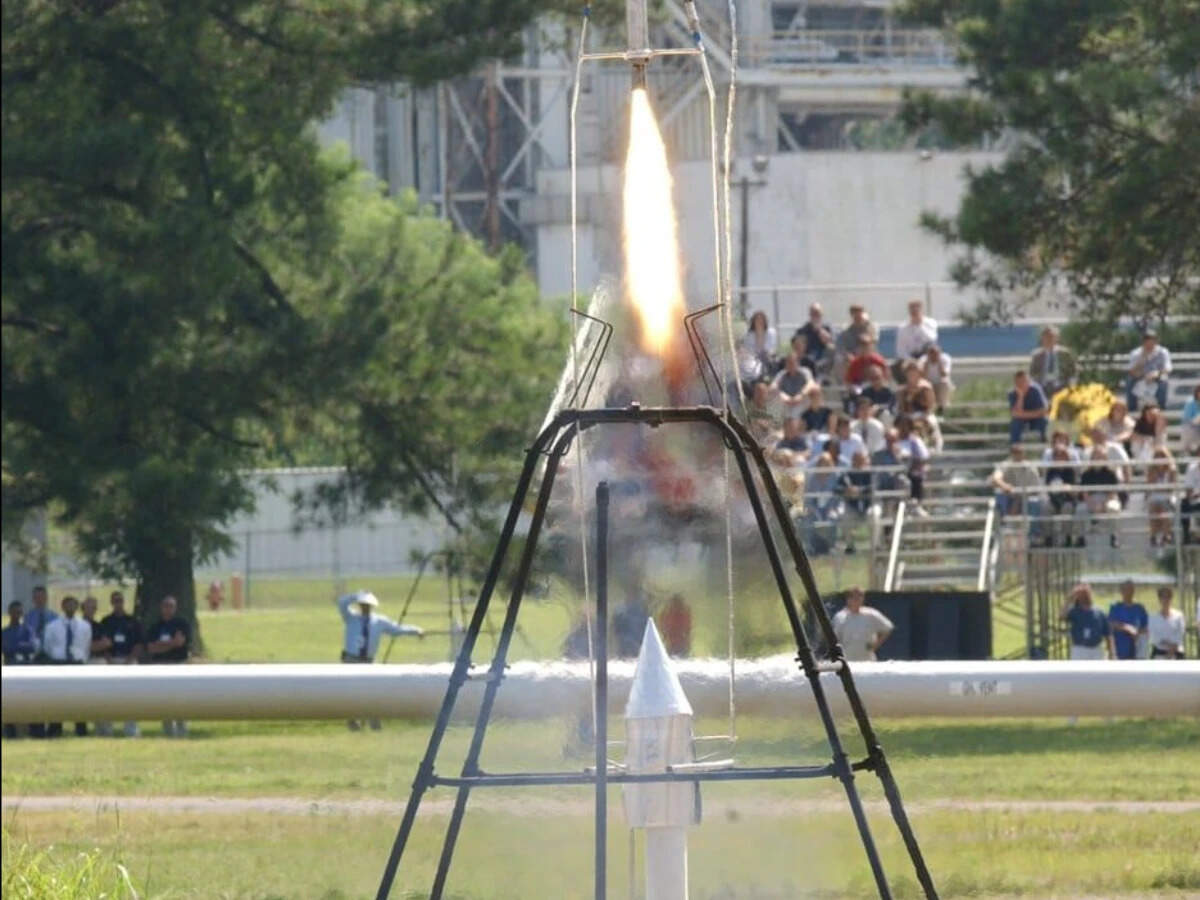
On a freezing March afternoon in 1926, a physics professor named Robert Goddard stood on a snow-covered farm in Auburn, Massachusetts, waiting to see if his life's work would explode or fly.
He had built a slender, 10-foot contraption nicknamed "Nell". Powered by gasoline and liquid oxygen, the machine sputtered to life. It climbed a grand total of 41 feet. It stayed airborne for 2.5 seconds, zipped along at roughly 60 miles per hour, and crashed unceremoniously into a cabbage patch 184 feet away.
There were no crowds. There was no media countdown. Only his wife Esther, a crew chief named Henry Sachs, and a physics colleague watched the metal tube tumble into the snow.
Yet that brief, clumsy hop marked the birth of modern rocketry.
Why That First Flight Looked Like a Failure
Most people look at early technological milestones and expect Hollywood grandeur. They expect immediate triumph. Reality is usually messier, stranger, and far more fragile.
Goddard’s choice of configuration for Nell was bizarre by later standards. He placed the fuel tank at the bottom and the combustion engine at the top. He thought pulling the rocket upward would provide better stability than pushing it from the base. He was wrong. The design was awkward, top-heavy, and difficult to scale. After the Massachusetts test, he wisely flipped the engine to the bottom where it belonged.
The press didn't help either. Six years prior to the Auburn launch, The New York Times published a scathing editorial mocking Goddard’s academic papers on space travel. The editors claimed he lacked a basic high school understanding of physics, arguing that a rocket could never push against a vacuum because there was nothing to shove off against.
Goddard retreated into intense privacy. He stopped talking to reporters. He funded his own research through his teaching salary at Clark University, supplemented by meager grants. While the public viewed him as a crackpot dreaming of moon trips, he was quietly solving the hardest thermodynamics and fluid dynamics problems of his era.
The Real Breakthrough Was Liquid Fuel
The true genius of the 1926 launch wasn't how high Nell went. Altitude was irrelevant. The breakthrough was the propellant chemistry.
Before Goddard, experimenters relied on solid fuels, essentially oversized fireworks. Solid fuel is notoriously difficult to control once ignited. You cannot throttle it, and you certainly cannot shut it down safely mid-flight.
By shifting to liquid oxygen and gasoline, Goddard proved that liquid propellants could be piped, pressurized, and burned continuously inside a combustion chamber. That single mechanism changed everything. Without liquid-fueled engines, you cannot scale up a thrust system to escape Earth's gravity well. Every single major orbital rocket—from the Saturn V units that carried Apollo astronauts to the Moon down to modern commercial launch vehicles—uses the foundational fluid dynamics principles Goddard tested in a frozen New England field.
From Ridicule to NASA Infrastructure
Goddard didn't live to see the space age he engineered. He died in 1945, exhausted by decades of skepticism and administrative battles over his patents.
History corrected course, though. Thirty-five years to the day after Nell sputtered over the Massachusetts snow, NASA dedicated its new major facility in Greenbelt, Maryland, naming it the Goddard Space Flight Center.
The lesson here isn't just about historical nostalgia. It is about how real technical breakthroughs happen. They don't start with massive budgets or viral hype. They start in cold workshops, fueled by obsession, dismissed by mainstream experts, and validated only when the machine actually leaves the ground, even if it only makes it forty-one feet.