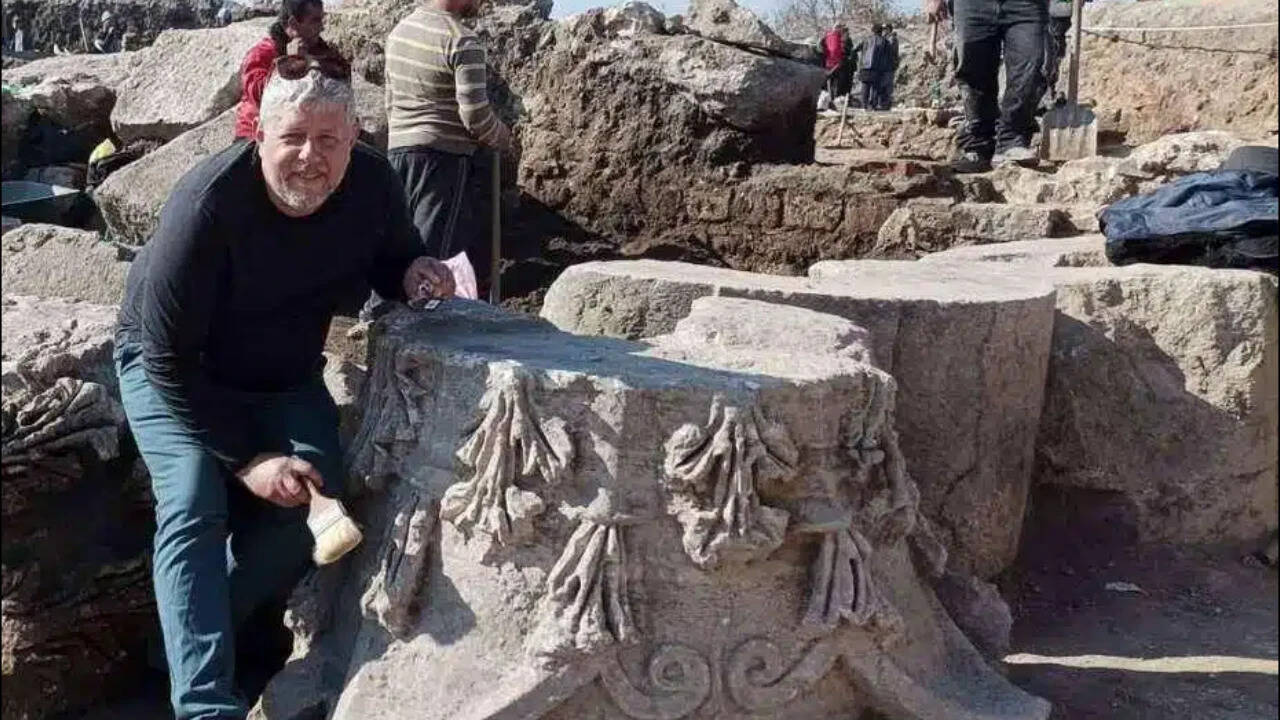
Imagine growing up in a hillside village where the garden walls and barns hold carved marble and limestone blocks that clearly don't belong on a farm. That's what happened to Božo Kokan in Dicmo, Croatia. Over nearly five decades, the retired architect gathered more than a thousand worked stone fragments from his family's estate and the surrounding hamlet of Kokani, and archaeologists have now tied those pieces to a lost Roman triumphal arch dedicated to Emperor Trajan.
Dating roughly to the early second century AD—during Trajan's rule from 98 to 117 AD—the monument makes the Roman arch in Dicmo nearly 1,900 years old. For years, researchers wondered whether the scattered masonry came from a temple. Curved stone elements, ornate moldings, and inscription fragments bearing imperial titles like Imperator and Germanicus pointed instead to a freestanding triumphal arch standing over a paved square at a busy provincial crossroads.
Most news summaries treat this like a quirky human-interest oddity: old man collects rocks, experts say they're ancient. Honest truth? That misses the bigger picture. Without Kokan's decades of patient preservation in a landscape where ancient blocks were routinely reused as building stone, a major piece of Roman Dalmatia's public architecture could have stayed scattered or lost context completely.
How Carved Stones Pointed to Emperor Trajan
You don't just guess that a pile of white limestone belonged to a second-century imperial arch. You read the epigraphy, the stoneworking, and the structural geometry.
Fragments of the inscription carried imperial titles associated with Trajan, including Imperator and Germanicus, alongside lettering styles that fit early second-century Roman monuments. Add in curved stone blocks and decorative reliefs—and, as reported in Croatian coverage of recent excavations, carved motifs including elements linked to the imperial eagle and Victoria figures—and the monument starts taking shape as an instrument of state propaganda, not a quiet local shrine.
Even so, let's be clear about what archaeologists still debate. Some local reconstructions and readings have sought to link the arch directly to Trajan's Dacian campaign routes based on imagery echoed on Trajan's Column in Rome. Scholars urge caution there: while the monument clearly honors Trajan and reflects Roman imperial authority in the province of Dalmatia, connecting it directly to a specific military march remains a hypothesis rather than a settled fact.
Why a Crossroads in Dalmatia Needed a Triumphal Arch
Dicmo sits in the hills inland from Split, near the site of ancient Salona, which served as the bustling capital of the Roman province of Dalmatia and once held tens of thousands of residents. In antiquity, the settlement was known as Decimin.
Look at the geography and the monument makes total sense. This wasn't nowhere. It was a junction where the road from Salona toward Aequum intersected routes linking military centers like Andetrium and Tilurium. Putting a triumphal arch over a paved crossroads meant travelers, merchants, and soldiers passed right under reminders of Rome's reach and legitimacy.
- Spolia in everyday life: Across the Mediterranean, dismantling older monuments to build houses, field walls, and barns—a practice archaeologists call spolia—was standard survival and convenience, not vandalism in the modern sense.
- Layered timelines: Excavations around the site show the crossroads stayed active well after Trajan's era, with later structures and phases extending into late antiquity.
- Fieldwork catches up: Formal archaeological work has continued to uncover foundations and carved pieces that Kokan never saw, including material from excavations reported in November 2026.
What Most People Get Wrong About Amateur Finds
People love a lone-genius story, and Kokan's persistence deserves real credit. He trained as an architect, returned to family land in Dicmo, studied scholarly literature, and kept track of fragments that others might have ignored or cemented into walls.
At the same time, amateur collecting has a flip side that archaeologists worry about constantly. When stones get moved from their original spot without careful recording, you lose provenance—the exact spatial context that helps experts figure out where a block sat on a wall or foundation. That's why modern archaeology pairs local knowledge with systematic excavation, as documented in work by researchers including Nikola Cesarik and Dražen Maršić alongside Božo Kokan (such as their 2024 study Trajan's Arch from Dicmo: Discovery and Preliminary Analysis).
If you're ever walking old farmland, vineyard terraces, or dry-stone walls in Croatia or anywhere else in the Mediterranean, keep your hands off loose carved stones and don't pry anything out of existing structures. Take clear photos with location data, note what you saw, and contact local heritage authorities or museum archaeologists. A single recorded stone in place tells a story ten unrecorded stones in a shed never can.