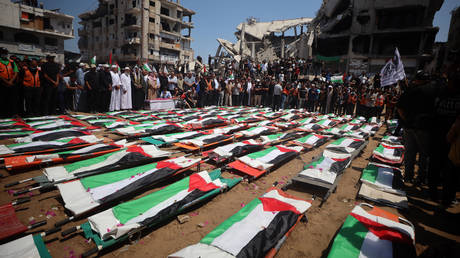
More than two years after a catastrophic military strike flattened a residential block in Gaza City, the true human cost is still being clawed out of the concrete. Hundreds of mourners gathered recently for a mass funeral in central Gaza, burying 112 people whose remains were only just recovered from the rubble.
This wasn't a recent tragedy. The victims—including 40 children—perished on November 22, 2023, when Israeli warplanes demolished multi-story buildings belonging to the Hassayna and Abu Sharia families in the Sabra neighborhood.
When people ask why closure remains impossible in this conflict, the answer lies in scenes like this. Heavy machinery is scarce, fuel is virtually nonexistent, and continuous military operations mean recovery teams spend years digging through pulverised concrete with basic tools and bare hands.
The Grim Reality of Recovery Under Fire
Back in late 2023, initial rescue efforts managed to pull only about 40 bodies from the smoldering ruins of the Sabra neighborhood. The rest of the extended family remained entombed deep beneath tons of shattered masonry.
It wasn't until a fragile ceasefire took hold that civil defence crews could bring in heavier manual excavation equipment to clear the site. They recovered 112 additional sets of remains, but roughly 157 people from that single strike are still unaccounted for.
Zaher al-Waheidi, head of the records department at Gaza's health ministry, points out that the official numbers hide an even darker reality. At least 7,400 people are officially reported by relatives as still missing under the wreckage across the territory. Yet, the real figure is widely believed to be much higher because entire family lineages were wiped out completely, leaving no surviving relatives to file a missing person report.
What the Numbers Actually Tell Us
The mathematics of this war defy normal comprehension. Since hostilities erupted following the October 7, 2023 attacks led by Hamas—which left roughly 1,200 people dead and 251 taken hostage in southern Israel—the retaliatory offensive has driven Palestinian casualties past 73,377.
Even after an October ceasefire aimed at freezing the bloodshed, violence persists. More than 1,250 people have died since that agreement was brokered. High-profile diplomatic efforts, including US-backed frameworks aiming for phased troop withdrawals and disarmament, continue to stall on the ground as distrust runs absolute.
Meanwhile, daily survival for the living in Gaza means navigating overcrowded tent camps, collapsing sanitation, and expanding outbreaks of preventable diseases like chickenpox.
Bearing Witness to the Unseen
At the mass funeral site, rows of white coffins draped in Palestinian flags stretched across the ground. Mourners offered final prayers before carrying the remains past blocks of hollowed-out buildings.
Families are not just mourning a loss; they are fighting for the basic dignity of a proper burial years after the bombs fell. Until every site is cleared, the past refuses to stay buried.