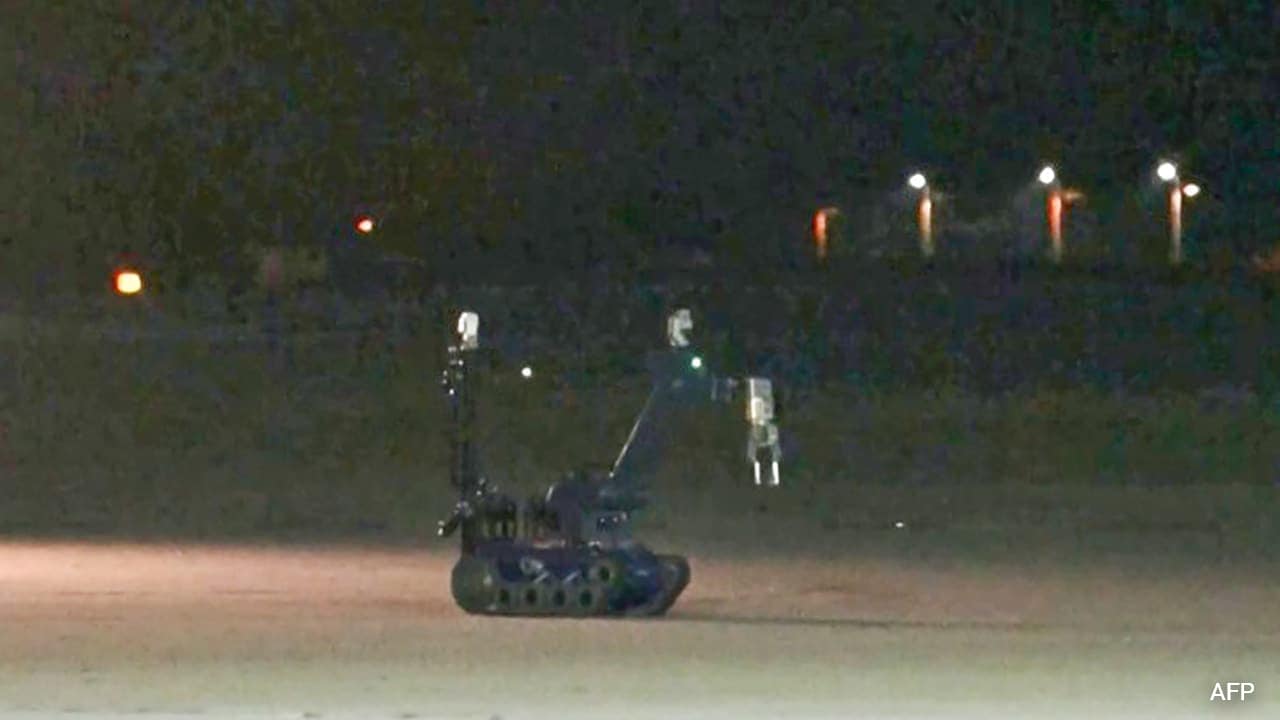
Unidentified drones hovering over high-security military sites aren't just isolated anomalies anymore. They're exposing deep vulnerabilities in Western defense infrastructure.
Late on a Thursday night in North Rhine-Westphalia, two unauthorized drones hummed above the Bundeswehr military base in Mechernich. This wasn't random hobbyist behavior. The facility houses critical underground storage for military hardware and plays a direct role in maintaining U.S. Patriot air defense systems. Coming just forty-eight hours after an explosive-laden drone turned up near cargo runways at Leipzig/Halle Airport—a vital NATO logistics hub parked right next to Ukrainian An-124 transport planes—the message is hard to ignore. Germany's skies are increasingly permeable, and current counter-measures are falling flat.
The Real Security Threat at Strategic Hubs
Let's look at what these locations actually mean. Mechernich sits roughly thirty-five kilometers from the Belgian border, serving as a massive logistical backbone. When low-altitude aircraft breach airspace here, it points to systematic scouting or worse.
Security analysts have spent years warning that critical infrastructure is ill-prepared for cheap, commercial-grade or customized UAV technology. Traditional radar systems often struggle to pick up small, low-flying signatures. Military police were deployed immediately after the Mechernich sighting, handing control over to local authorities in Euskirchen, but finding out who launched the devices remains an uphill battle.
The Geopolitical Finger-Pointing
Official Berlin is playing it cautious. Government spokespeople have avoided pointing direct fingers at foreign actors. But individual lawmakers aren't holding back. Several officials have openly blamed Moscow, citing ongoing hybrid warfare tactics tied to the conflict in Ukraine.
On the flip side, the Russian Embassy in Berlin has dismissed accusations surrounding the Leipzig incident as a fabricated provocation meant to stir anti-Russian sentiment without concrete evidence. Regardless of who is behind the joysticks, the operational impact is identical. Critical defense nodes are being mapped out from above with near-impunity.
Why Current Defense Models Fall Short
You can't protect modern military assets with Cold War mentalities. Traditional air defense focuses on fast jets and ballistic missiles, not slow-moving quadcopters creeping past perimeter fences at night.
- Detection Gaps: Standard military radar configurations often filter out low-speed, small-signature objects as clutter.
- Jurisdictional Red Tape: Handing investigations back and forth between military police and local municipal forces slows down immediate tactical responses.
- Countermeasure Limitations: Kinetic interceptors cost too much to use against cheap drones, while electronic jamming risks disrupting civilian infrastructure nearby.
Until procurement agencies fast-track dedicated counter-unmanned aerial systems (C-UAS) across every active barracks and logistics depot, these nocturnal flybys will continue. Stop treating airspace security as a passive administrative checklist and start treating it as an active frontline.
Unidentified Drones Detected Over U.S. Base in Germany
This video provides an in-depth look at ongoing security concerns regarding unidentified drone incursions over military installations in Germany.
http://googleusercontent.com/youtube_content/1