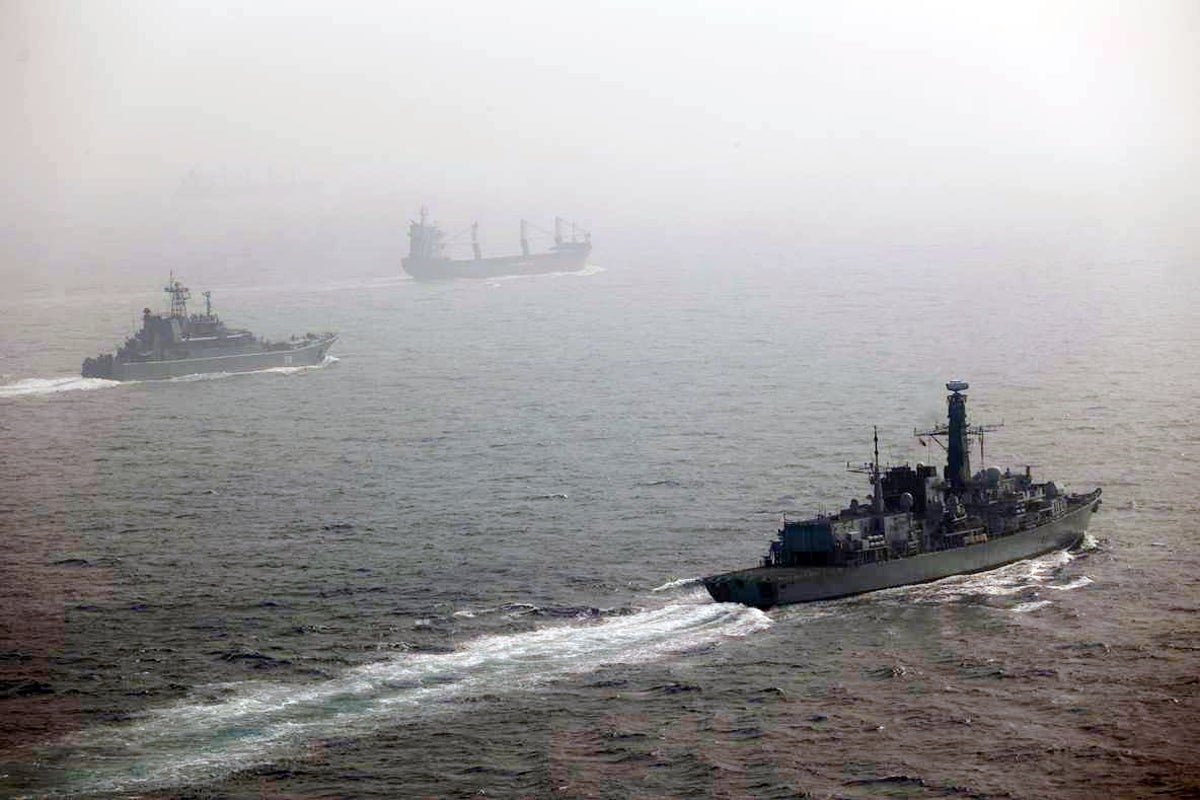
Don't fall for the idea that international waters are empty, peaceful spaces where nothing happens until a major conflict breaks out. Right now, a quiet, high-stakes game of maritime cat-and-mouse is playing out right off the British coastline. The Royal Navy just pulled back the curtain on a massive, 90-day surveillance operation, revealing that British warships and helicopters have spent three months maintaining an unbroken watch on Russian warships navigating through UK waters.
This isn't a routine patrol or a minor blip on a radar screen. It's a sustained, intense operation involving multiple frontline British vessels tracking Russian frigates, spy ships, and heavily sanctioned shadow fleet tankers. The timeline stretches across April, May, and into June 2026, painting a clear picture of just how crowded and tense the English Channel and the North Sea have become.
If you think this is just standard military posturing, you're missing the bigger picture. From warning shots fired near British civilian yachts to dramatic mid-sea boardings by Royal Marines, the maritime friction between London and Moscow is hitting levels we haven't seen in decades.
Ninety Days of Constant Tracking
The scale of the UK response shows exactly how seriously naval high command is taking these movements. Five separate Royal Navy vessels took turns keeping eyes on a single Russian warship, the Admiral Grigorovich. This specific frigate didn't just pass through quickly. It loitered. It moved back and forth. It made its presence felt.
The Admiral Grigorovich popped up in the English Channel during three separate, concentrated windows: from late April into early May, again in mid-May, and a third time during the final week of May. Royal Navy ships or aircraft monitored the vessel every single day throughout April, refusing to give the Russian crew a single moment of unobserved operational freedom.
Portsmouth-based patrol ships like HMS Tyne, HMS Ledbury, HMS Severn, and HMS Mersey carried the heavy workload of this relentless watch. They didn't do it alone. The Type 23 frigate HMS Sutherland joined the effort, bringing advanced sonar and radar tracking to bear on the Russian warship as it charted its course through some of the busiest shipping lanes in the world.
The Flurry of Incidents in the Channel
Things moved from tense tracking to open drama in mid-June. On June 14, green berets from 42 Commando launched a daring, six-hour maritime interdiction operation. Working alongside specialized law enforcement officers from the National Crime Agency, the elite troops boarded the MV Smyrtos, a sanctioned shadow fleet oil tanker flying a false Cameroonian flag.
The raid didn't happen in a vacuum. It was supported by an impressive array of British military hardware, including HMS Sutherland, HMS Ledbury, Merlin Mk4 helicopters from the Commando Helicopter Force, Wildcat helicopters, and massive RAF Chinook transport helicopters. The message was clear: Britain is willing to use hard power to police the illegal maritime networks funding Moscow's actions.
Just two days later, the situation grew even more unpredictable. On June 16, the Admiral Grigorovich found itself just 20 nautical miles south of the Isle of Wight. A British-registered civilian sailing yacht, the Bright Future, was navigating the same stretch of water. In what the Ministry of Defence later concluded was a frantic attempt to avoid a close-quarters collision in challenging sea conditions, the Russian frigate fired warning shots.
The Russian crew had tried and failed to establish radio contact with the yacht. When the radio stayed silent, they chose to make a loud, terrifying statement with their weapons. HMS Tyne immediately rushed to the scene to check on the shaken civilian couple aboard the yacht, highlighting the constant thin line between routine military transit and potential international incidents.
Eyes on Critical Infrastructure
The movements of the Russian fleet reveal a worrying pattern of focus on vital Western infrastructure. HMS Tyne recorded the Admiral Grigorovich performing a highly unusual maneuver known as a "raft-up" with a Russian Amur-class supply ship, the PM-82. A raft-up involves two ships tying up side-by-side while underway or at anchor to transfer personnel, supplies, or fuel.
This specific mid-sea logistical meeting didn't happen out in the deep Atlantic. It took place right next to the Galloper Wind Farm off the coast of Suffolk. This wind farm sits roughly 30 kilometers off Harwich, utilizing 56 massive turbines to generate clean electricity for more than 400,000 British homes.
[Image of an offshore wind farm with turbines in the sea]
Operating a floating military workshop capable of transferring fuel and heavy stores right beside a critical node of the UK energy grid is an overt statement. It signals that Russia knows exactly where Britain's energy vulnerabilities lie. It tests how quickly the Royal Navy can spot a logistical gathering near an economic asset, and it forces British commanders to keep precious assets tied down protecting domestic waters instead of deploying elsewhere.
The Hunt for Spy Ships and Landing Craft
The Admiral Grigorovich wasn't the only headache for British naval planners over this three-month stretch. Further north and west, the Type 23 frigate HMS Somerset found itself pulled into a high-priority interception mission. Somerset had to cut short a scheduled port visit to Dublin, tearing out of port ahead of schedule to track a Russian vessel operating inside the combined UK and Irish Exclusive Economic Zone.
The target was the Yury Ivanov, a highly specialized Russian Navy intelligence-gathering ship. This vessel isn't designed to fight other warships. It's built to listen. Packed to the brim with advanced electronic interception gear, spy ships like the Yury Ivanov sit off Western coasts to map undersea cables, intercept military communications, and track the radar signatures of domestic defense installations.
The hunt for the Yury Ivanov became a textbook example of modern multinational defense. HMS Somerset worked in lockstep with other NATO warships, maritime patrol aircraft, and vessels from the Irish Defence Forces. The combined effort ensured that the Russian spy ship was blanketed by radar and physical escorts for every mile of its journey through the economically vital waters between Britain and Ireland.
Once that mission wrapped up, HMS Somerset didn't get a break. Fleet commanders immediately ordered the frigate to sail down toward the Isles of Scilly. Her new task was to shadow the Aleksander Shabalin, a Ropucha-class Landing Ship Transport, alongside the accompanying Russian tanker MV Mikhail Britnev. Ropucha-class ships are designed for beach landings, capable of carrying hundreds of troops and heavy armor directly onto enemy shores. Seeing one moving through the English Channel puts everyone on high alert.
Why the Global Shadow Fleet Escalates the Risk
To understand why this three-month naval watch matters, you have to look beyond the gray hulls of the Russian Navy. You have to look at the rust-streaked commercial tankers sailing alongside them. Russia is relying heavily on an aging, poorly maintained network of merchant vessels known as the shadow fleet to keep its economy afloat and bypass international sanctions.
These ships often operate with murky ownership structures, fake flags, and completely inadequate insurance policies. When Russian combat vessels like the Admiral Grigorovich escort these tankers through narrow choke points like the English Channel, the risk of a major environmental disaster or a navigational accident skyrockets.
The boarding of the MV Smyrtos proved that the UK will not treat these shadow tankers as ordinary commercial traffic. When a ship hides its identity under a false flag and sneaks through the Channel, it invites aggressive military scrutiny. The Royal Navy is no longer just tracking potential combatants. They're acting as maritime detectives, customs enforcers, and defense guardians all at once.
What This Means for Future British Maritime Policy
This massive three-month operation exposes a hard truth about the current state of British defense. The Royal Navy is being pushed to its absolute limits to protect the home front. Using five different patrol ships and a major frigate to track a single Russian deployment means those ships aren't available for tasks elsewhere in the world.
Minister for the Armed Forces Louise Sandher-Jones made the official stance clear, praising the professionalism of the crews and stating that the UK will always defend its national waters and critical infrastructure. Fleet Commander Vice Admiral Steve Moorhouse echoed those thoughts, pointing out that the Navy worked tirelessly alongside NATO allies to counter increased Russian activity.
But behind the proud press releases lies a stark reality. The English Channel is no longer a safe, quiet backyard. It's a frontier. Every time a Russian warship rafts up next to a UK wind farm or fires a warning shot near a civilian yacht, the margin for error shrinks.
If you want to understand where the next major security flashpoint might be, stop looking exclusively at land borders on the other side of Europe. Look out at the grey, choppy waters of the English Channel. The Royal Navy is staying on watch, but the pressure isn't going away anytime soon.