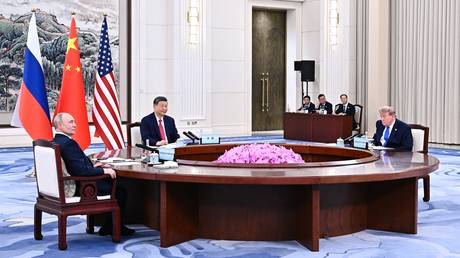
Vladimir Putin wants you to believe the world runs on a three-way handshake. Sitting in Shenzhen during the November 2026 APEC summit alongside Donald Trump and Xi Jinping, the Russian president pushed a familiar pitch: Moscow, Washington, and Beijing hold shared responsibility for global stability and should treat one another as equals.
Look closer at the room, though. Equals? Not even close.
The Shenzhen gathering marked a rare face-to-face meeting of the leaders holding the world's largest nuclear arsenals. Putin argued that the three nations have converging interests in ending regional conflicts, explicitly pointing to the war in Ukraine while touching on energy and food security rattled by fighting in Eastern Europe and the Middle East. Trump called the sit-down historic and talked up reducing nuclear risks. Xi urged restraint, called for avoiding nuclear war, and framed major-power coordination as a necessity rather than a choice.
State media in Moscow naturally played the footage on loop. For a Kremlin battered by years of sanctions, battlefield attrition, and economic strain, simply sitting at the same table as the presidents of the United States and China looks like a geopolitical reset.
It's theater. Useful theater for Putin, sure. Yet calling it a partnership of equals ignores who actually has leverage.
What Putin Means by a Partnership of Equals
When Putin talks about a partnership of equals, he isn't asking for a polite committee meeting. He wants two things that sanctions and battlefield setbacks have stripped away from Moscow: status and veto power.
For decades, the Kremlin has complained about a U.S.-led order that sidelined Russian security demands. By placing himself shoulder-to-shoulder with Trump and Xi in Shenzhen, Putin tried to project a new great-power concert—a kind of modern Yalta where big capitals settle big questions over the heads of smaller states.
That framing does heavy lifting for Moscow's domestic audience. Even as reports noted that Xi greeted Trump personally on the tarmac while giving Putin a more scaled-down welcome—and placed Putin at a separate table at the APEC dinner reception—Russian coverage focused on the optics of arrival and proximity. A handshake with two superpowers buys political oxygen back home.
Externally, "equals" is a shield against accountability. Look at the readout from the talks: the leaders stressed state consent, official immunity, and pushing back against what they cast as overreach by international bodies like the International Criminal Court—a court that issued an arrest warrant for Putin in 2023. Treat great powers as co-managers of the globe, and inconvenient rules start looking optional.
Why the Power Balance in Shenzhen Wasn't Even
If you've watched great-power summits over the years, you know the gap between diplomatic rhetoric and hard power is usually wide. Here, it's a canyon.
China brings massive manufacturing scale, supply-chain clout, and deep pockets—even while wrestling with domestic headwinds like real estate stress and unemployment. Russia has become heavily reliant on China as a critical trade and energy outlet since its full-scale invasion of Ukraine. That doesn't make Moscow Xi's junior in every single room, because Russia still carries nuclear weight, commodities, and diplomatic alignment that Beijing finds useful. Still, an economy leaning on Beijing for trade lifelines isn't operating from a position of parity.
The United States brings unmatched military reach, dollar and financial gravity, and alliance networks across Europe and the Indo-Pacific. Even when Trump leans into personal rapport—calling both Putin and Xi "friends" and promising big breakthroughs—Washington's structural weight dwarfs Russia's.
Honestly, that asymmetry is why Putin pushes the "equals" line so hard. Countries that already hold decisive economic or military advantages rarely need to insist on equality in every speech. Countries trying to claw back influence do.
Ukraine, Iran, and Nuclear Talks Under the Hood
Big headlines about "making history" often hide narrow, grinding disputes. Beneath the trilateral framing in Shenzhen sat real friction that didn't magically evaporate over ninety minutes.
On Ukraine, Putin reiterated that the three powers share an interest in resolving the conflict. Yet positions remain miles apart. Earlier talks in Abu Dhabi yielded little visible movement, and Moscow has resisted calls for a simple ceasefire in favor of terms that fit its broader war aims. Meanwhile, Ukrainian leaders and European partners worry about backroom deals made without them—a fear echoed by German Chancellor Friedrich Merz's warning against another "Anchorage moment" reminiscent of the August 2025 Trump-Putin talks in Alaska.
Middle powers aren't sitting quietly in the corner, either. Canadian Prime Minister Mark Carney warned earlier in 2026 at Davos that middle powers have to coordinate or risk ending up "on the menu," and Ukrainian President Volodymyr Zelenskyy has repeatedly pushed back against the idea of major powers deciding the fate of other nations behind closed doors.
Then there's Iran and energy. Fighting involving Iran has rattled global energy and food markets, and Washington faces ongoing tensions with Beijing over trade, rare earths, and ties to Tehran. Nuclear arms control got verbal support—with leaders reiterating that a nuclear war cannot be won and should not be fought, and pointing to dialogue on nuclear risk reduction—but turning broad statements into binding treaties takes years of grueling verification, not a single summit afternoon.
Common Misconceptions About Three-Way Summits
People love a neat story: three strongmen sit down, cut a grand bargain, and redraw the map. Real diplomacy rarely works like that.
- Misconception: A trilateral photo means a unified bloc. Trump, Xi, and Putin have overlapping tactical interests in some areas and sharp rivalries in others. Cooperation on avoiding nuclear catastrophe doesn't erase disputes over Taiwan, trade, or European security.
- Misconception: Talk of nuclear dialogue equals an immediate arms deal. Leaders routinely reaffirm old norms against nuclear war and express openness to talks. Actual warhead limits or inspection regimes require months or years of technical negotiation.
- Misconception: Smaller countries have zero say. Big capitals make noise, sure. Yet states like Ukraine, European capitals, and Indo-Pacific partners still shape sanctions enforcement, military logistics, trade rules, and regional security every single day.
What to Watch Next
If you're tracking whether Putin's push for a "partnership of equals" produces real change rather than recycled talking points, watch concrete actions over speeches.
- Follow up on nuclear and crisis channels: Look for scheduled working-level talks on nuclear risk reduction or crisis hotlines rather than one-off summit remarks.
- Watch energy and trade flows: Track oil, gas, and rare-earth movements alongside sanctions enforcement to see whether economic pressure actually shifts.
- Monitor negotiations involving Ukraine and regional allies: Pay attention to whether diplomatic movement includes direct stakeholders or stalls over core territorial and security demands.
- Separate optics from outcomes: Treat summit pageantry as a clue to how each leader wants to look at home, and judge the meeting by tangible policy shifts months later.