We treat trees like giant green sponges. Throw enough carbon dioxide at them, the thinking goes, and they will drink it up, grow faster, and fix our mess. Reality is messier.
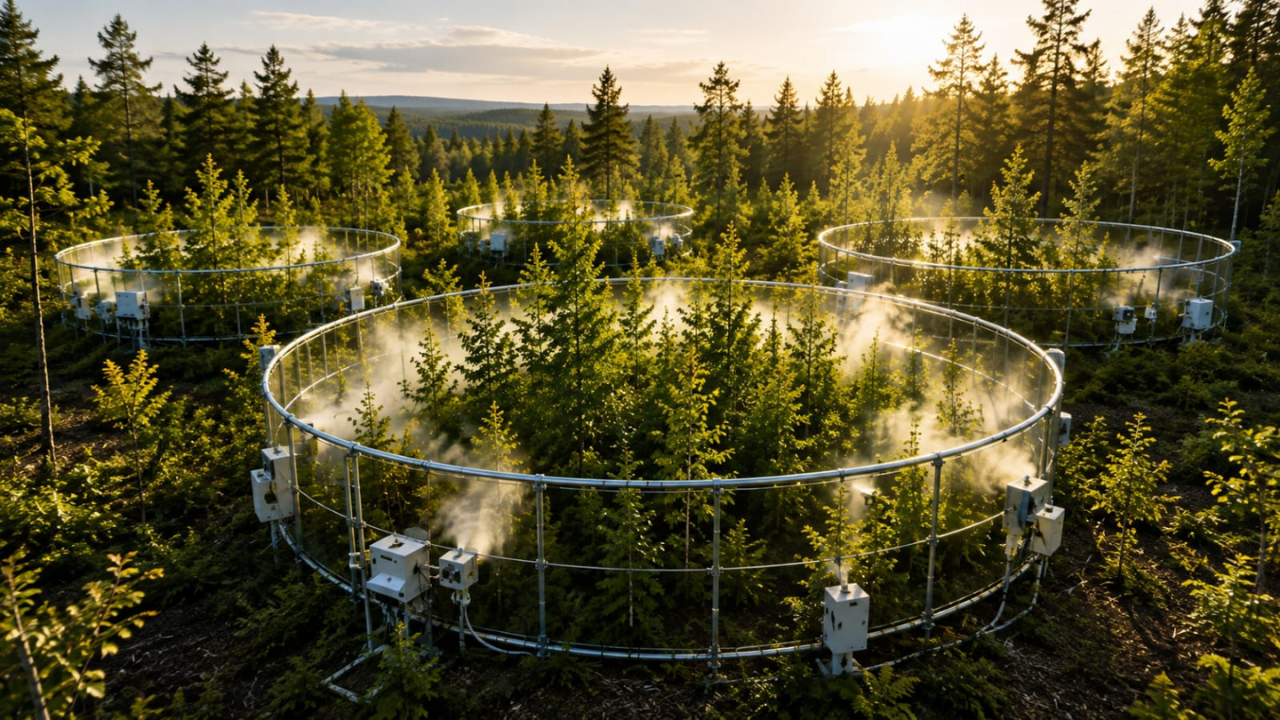
For eleven years, researchers manipulated the atmosphere around an entire tract of northern temperate woodland in Rhinelander, Wisconsin. Known as the Aspen-FACE experiment, this outdoor project didn't rely on sealed greenhouse pots or computer simulations. Scientists built massive open-air rings to pump extra carbon dioxide and ground-level ozone directly onto living stands of aspen, birch, and maple trees.
The results upend simplistic assumptions about plant biology and planetary carbon storage. Elevated carbon dioxide drove a stunning 39% increase in cumulative net primary productivity. Trees grew larger, packed more carbon into their woody stems and branches, and boosted overall ecosystem carbon storage by 11%.
Then came the dirty variable. Ground-level ozone entered the equation and punched a hole in those climate gains.
The 39 Percent Surge That Fooled the Optimists
When plants swim in a carbon-rich environment, photosynthesis shifts into a higher gear. During the long-term Wisconsin study led by researchers like Alan F. Talhelm, trees grabbed the extra molecular building blocks and converted them into heavy woody tissue. You see trees accounting for about 95% of that productivity jump. They bulked up their stems, branches, and coarse roots.
Total ecosystem carbon didn't just flicker upwards for a single season; it held a permanent 11% boost over eleven years. Canopy nitrogen and nitrogen productivity also climbed under the heavy CO2 regime.
If you stop reading right there, you walk away thinking carbon emissions have a built-in ecological safety valve. Trees eat the pollution, forests expand, problem solved.
Nature doesn't work in a vacuum.
The Toxic Counterweight of Ground-Level Ozone
While carbon dioxide acts as a plant fertilizer, ground-level ozone acts as a chemical abrasive. Ozone isn't just an urban smog problem. It drifts across rural landscapes, enters plant leaves through microscopic pores called stomata, and burns internal tissues from the inside out.
Over the same eleven-year duration, elevated ozone cut cumulative net primary productivity by 10%. It tanked total ecosystem carbon storage by 9%.
How did it happen? Ozone choked out canopy nitrogen, driving levels down by 21%. When leaves lose nitrogen, their photosynthetic machinery breaks down. Trees spend precious energy repairing cellular damage instead of building new wood.
The damage profile changed over time, too. As the forest matured, the immediate shock of ozone lessened slightly because older, denser forest canopies handle stress differently than young saplings. Even so, the negative footprint stayed etched into the ecosystem's carbon balance sheet.
What Happens When Both Gases Collide
Forests never face just one atmospheric shift at a time. Industrial zones churn out carbon dioxide alongside the chemical precursors that form ground-level ozone.
When researchers exposed the Wisconsin forest plots to both gases simultaneously, the math got weird. You might expect ozone to cancel out CO2 neatly on a spreadsheet—say, a 39% gain minus a 10% penalty leaving a clean 29% net win.
Instead, statistical analysis showed no simple linear interaction. The gases pulled in opposite directions. When combined, the total ecosystem carbon storage under dual treatment looked statistically identical to the baseline ambient control plots. Ozone effectively neutralized the carbon fertilization bonus, wiping out the storage gains that extra CO2 worked so hard to build.
Landscape-scale computer models later confirmed this wasn't a localized fluke. Across wider regional projections, carbon dioxide remains the primary driver of woody biomass growth, but regional ozone pollution acts as a constant drag, choking back the true potential of forest carbon sinks.
The Takeaway for Climate Policy
You cannot count on trees to bail us out of industrial emissions if we ignore co-pollutants. Planting millions of acres of trees won't secure our climate future if regional air quality remains degraded by smog and ozone. Forest ecosystems are complex biological communities shaped by nutrient availability, species competition, and atmospheric chemistry.
Keep an eye on how regional air quality policies interact with land-use planning. Protecting forests means cleaning the air they breathe, not just banking on their capacity to absorb our exhaust.