Why Pulling That Frida Kahlo Canvas Exposes Broken Art Rules
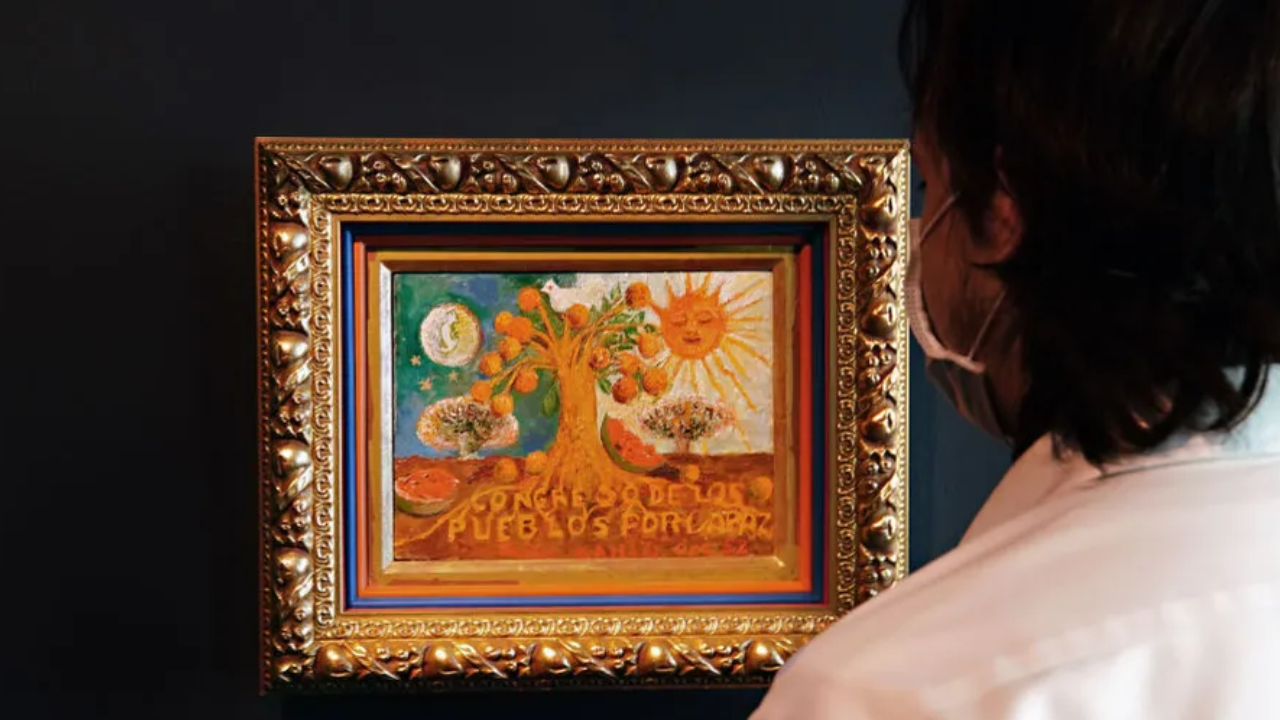
A small 1952 Frida Kahlo painting called Congreso de los pueblos por la paz (Congress of the Peoples for Peace) had a $2.5 million to $3.5 million estimate at Christie's New York 20th Century Evening Sale on November 17, 2026. Hours before bidding opened, Christie's pulled the lot.
The backstory is messy. And honestly, it exposes how fragile provenance tracking still is when a major auction house and national heritage authorities clash.
At first, Mexico's National Institute of Fine Arts and Literature (INBAL) argued the painting left Mexico before the country declared Kahlo's work an artistic monument in 1984. Under that logic, the permanent export ban wouldn't apply to a work already outside Mexico when the decree arrived.
Except records show the painting turned up back in Mexico in 1953 for Kahlo's solo exhibition at the Galería de Arte Contemporáneo in Mexico City. Once a work comes back, "it left before 1984" stops being a neat end-of-story excuse.
How a 1952 Peace Painting Turned Into an International Dispute
Kahlo painted Congreso de los pueblos por la paz in October 1952 as her health was failing. She linked the piece to the World Peace Council's peace congress held in Vienna that December.
Because she couldn't travel easily, the work went abroad in connection with that push, while her husband Diego Rivera and others around her moved in those political and artistic circles. After 1953, the public trail goes quiet for decades.
Later documented appearances include exhibitions in Madrid and Barcelona in 1997, a touring show in Japan in 2003 and 2004, and an appearance at Sotheby's in New York in June 2020, where it sold for $2.66 million. Back then, it went through without a public halt. Six years later, Christie's withdrawal changed the mood completely.
The 1953 Return Complicates Every Export Argument
Heritage law loves clean timelines. Real art history rarely gives you one.
If a work leaves in 1952, comes back for a 1953 exhibition in Mexico City, and disappears from public view for years afterward, two big questions pop up right away:
- When did it actually leave for good? A 1952 trip doesn't settle whether the painting later exited Mexico before or after the 1984 artistic monument decree.
- Who held clear title along the way? Mexican critics and heritage advocates—including the collective Defendamos la Colección Gelman—have pointed to trust and inventory questions tied to the Casa Azul trust overseen with the Bank of Mexico.
INBAL initially leaned on the pre-1984 departure point while also requesting documentation to clarify ownership history and departure timing. That shift matters. Asking for proof means the paper trail wasn't airtight enough to silence doubts before hammer time.
Why Auction Houses Still Get Caught Off Guard
Let's be real: auction houses aren't courts of law, yet buyers treat a major catalog entry like a stamp of safety. That's a mistake.
A painting can pass due diligence for one sale and still blow up at the next. Maybe new archival research surfaces. Maybe a watchdog group or museum raises an inventory flag. Or maybe a 1953 exhibition detail gets more scrutiny when the estimate climbs toward $3.5 million.
In my view, the art market has gotten way too comfortable treating "sold once at auction" as proof of clean title. Past sales don't erase gaps in ownership or export paperwork. When a painting has a multi-decade gap in its public record, risk doesn't vanish just because a gallery or auction house lists it.
What Collectors and Buyers Should Do Next
If you buy high-value art—or even mid-tier works with international history—don't rely on catalog confidence alone. Do this instead:
- Trace every gap, not just the highlights. Ask for dates and parties behind any decade-long stretch with no exhibition, publication, or sales record.
- Check export dates against national heritage laws. Know when a country passed monument or cultural property rules, and verify when the specific object left—not just when it first traveled abroad.
- Separate consignment history from legal title. A gallery or prior auction appearance tells you who handled the work, not whether every prior transfer was authorized.
- Put clear withdrawal and refund terms in writing. If you're bidding or buying privately on a work with complex provenance, make sure you understand what happens if a government or trust lodges a claim.
A last-minute pull hurts everyone's time and trust. Demand paper, not guesses, before money moves.