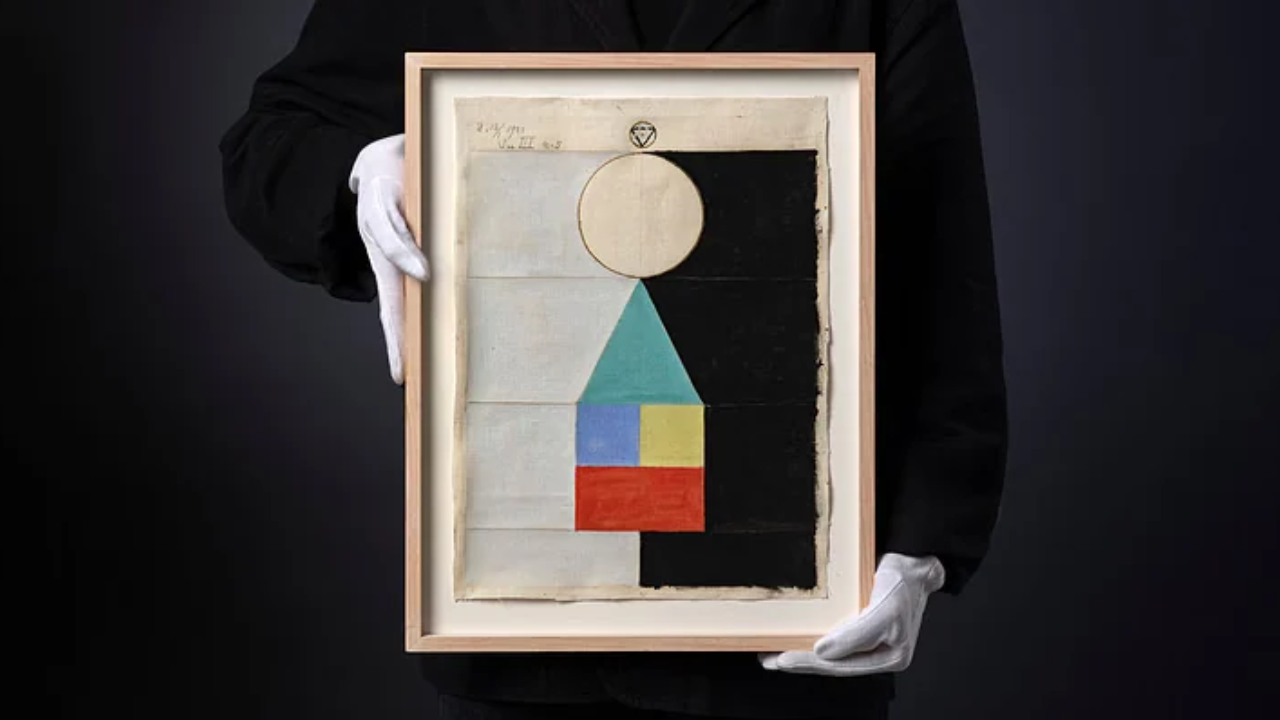
A tiny oil-and-graphite canvas measuring just 38.5 by 29 centimeters just blew up the Nordic art market.
Estimated at SEK 6 million to SEK 8 million ahead of the sale, Hilma af Klint's Ser III No. 5 hammered at SEK 108 million and reached a total of SEK 128.9 million (roughly $12.7 million) with buyer fees at Bukowskis in Stockholm on November 19, 2026. That makes it the most expensive work of art ever sold at auction in the Nordic region. It also crushes af Klint's previous auction record—set back in 2019 for The Power of the Spleen—by more than 6,000%.
Honestly, when you look at the numbers, it doesn't even look like a normal auction jump. It looks like a dam breaking after thirty years of pressure.
Most brief news recaps give you the headline figure and move on. They skip what makes this sale an earthquake for collectors, museums, and anyone who cares about modern art history. Let's look at why a work expected to top out around SEK 8 million ended up nearly sixteen times its high estimate, why it surfaced after three decades, and what this price tag actually means.
Why a Hilma af Klint Painting Almost Never Hits the Open Market
If you've followed the art market over the last decade, you know Hilma af Klint's museum fame has exploded while her auction supply has stayed practically frozen. When the Solomon R. Guggenheim Museum in New York staged Hilma af Klint: Paintings for the Future in 2018–2019, it broke attendance records for the institution. Blockbuster shows followed elsewhere around the globe, turning an artist who spent much of her life outside the mainstream art establishment into a household name.
Yet almost none of her abstract paintings ever come up for sale.
Why? Because the Hilma af Klint Foundation (Stiftelsen Hilma af Klints Verk) preserves and administers her non-figurative legacy. Only two abstract paintings by af Klint had previously sold at auction before Ser III No. 5 appeared on the block. The piece sold at Bukowskis had been bought in 1995 through Stockholm's Galleri Söderlund—following a small number of foundation sales in the early 1990s—and stayed within one family ever since.
Think about what happens when demand surges worldwide while supply stays locked in a vault or a single family collection for thirty years. Buyers don't get second chances. If you want an authentic abstract work by af Klint on the open market, you can't just call a gallery next week and pick one off a rack. You show up to the auction, or you miss out for another generation.
Inside the 1920 Painting That Sparked the Bidding War
Ser III No. 5 isn't a random sketch pulled from a drawer. It's dated January 18, 1920, a moment of intense creative output when af Klint produced 85 abstract works across eight series over just a few months.
According to art coverage from Hyperallergic, Ser III No. 5 features theosophical symbols, triangles, and circles, offering a window into af Klint's final phase of geometric abstraction before she shifted toward more naturalist watercolors in her later years. It also carries real exhibition pedigree: it appeared in The Spiritual in Art: Abstract Painting 1890–1985 at the Los Angeles County Museum of Art, the landmark show that helped bring her work into broader art-historical focus.
From an appraiser's standpoint, setting a pre-sale estimate of SEK 6 million to SEK 8 million makes sense on paper—or at least it used to. Historically, auction houses price thin or unprecedented modern works cautiously because comparable sales barely exist. Once two or three serious global bidders decide a once-in-a-lifetime lot is worth whatever it takes to win, traditional estimate ranges stop functioning as a ceiling and start looking like a starting gun.
The Bigger Debate Behind the Price Tag
Whenever an auction record shatters like this, two reactions happen right away. Half the art world celebrates validation for a female pioneer long sidelined in standard twentieth-century art histories. The other half asks whether the painting should have been on the auction block at all.
Af Klint envisioned her major spiritual works kept together as a unified whole—famously conceiving of a spiral temple where viewers could experience her series as a progression rather than scattered trophies on private walls. That tension isn't theoretical. The foundation has faced fierce internal debates among trustees and family members over public exhibitions, commercial partnerships, and how her legacy should be managed.
Here's where I stand as someone who watches both market mechanics and museum access: a private family selling a work they bought in 1995 is different from a foundation liquidating its core archive. Still, every time a major abstract work goes to a private buyer at SEK 128.9 million, it raises a fair question about public access. Will the new owner lend Ser III No. 5 to major museums so regular visitors can still see it in person, or will it vanish behind closed doors for another thirty years?
Common Mistakes Buyers and Readers Make With Auction Headlines
Auction headlines are notorious for flattening complex details into one shiny number. If you're reading art market news—or thinking about collecting—watch out for a few easy traps:
- Confusing hammer price with total price: At Bukowskis, the painting hammered at SEK 108 million, while the buyer paid SEK 128.9 million once all fees were included. Always check whether a reported figure includes buyer's premium and applicable fees.
- Treating one record as a price floor for everything: An ultra-rare work with a thirty-year gap between abstract auction appearances sets a ceiling for that rarity, not an automatic baseline for every print, sketch, or peripheral work associated with a name.
- Ignoring provenance and exhibition history: Works with documented exhibition history (like LACMA's The Spiritual in Art) and clean, traceable ownership carry weight that ambiguous works simply don't.
- Overlooking currency shifts: A jump in Swedish kronor looks dramatic on its own, and converting to US dollars or euros helps put global bidder demand into perspective—just remember exchange rates move over time, too.
Practical Next Steps If You Want to Go Deeper
You don't need a SEK 128.9 million budget to engage seriously with this story or learn how high-stakes art sales really work:
- Check the official auction and foundation records: Review the lot details and press release from Bukowskis to see exact measurements, medium notes, and provenance details.
- Compare multiple art-press reports: Read coverage across outlets like Smithsonian Magazine and Hyperallergic to weigh both market excitement and ethical debates around private ownership.
- Track museum loan announcements: Keep an eye on upcoming Nordic and international modern art exhibitions to see whether Ser III No. 5 is loaned back to the public or stays in private hands.
- Study hammer vs. total fees on future sales: Whenever you read an auction result, look for the exact split between hammer price and buyer fees so you read market data accurately.