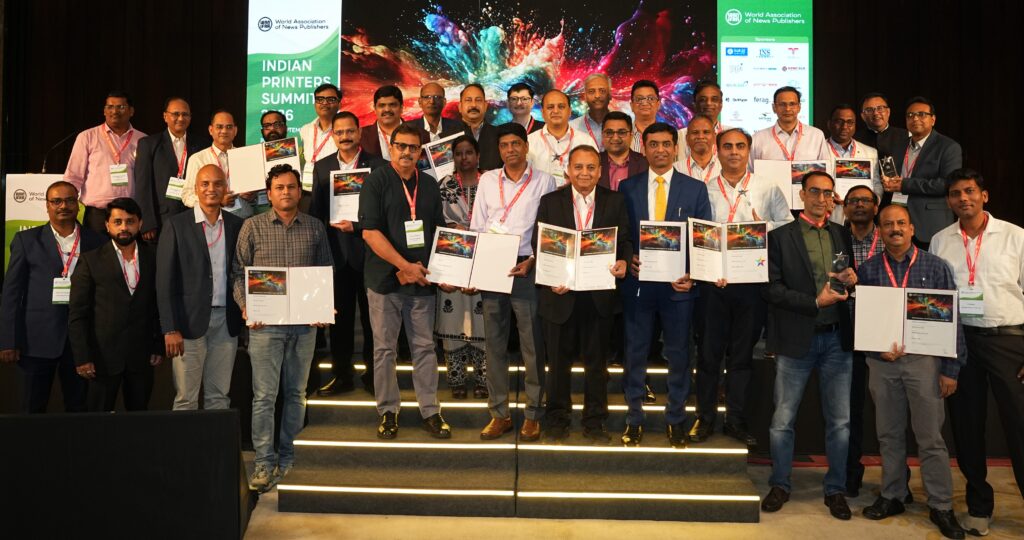
Everyone loves to declare print dead. People have been predicting the demise of physical newspapers and magazines for decades, basically since the internet became a household fixture. But if you walked into the 34th Indian Printers Summit in Pune, you would have seen a totally different reality. Publishers aren't packing up their presses; they are aggressively redesigning them.
The event brought together over 270 delegates from dozens of organizations to tackle an uncomfortable truth. Traditional business models are broken, and the old ways of chasing pageviews or relying entirely on display ads are simply not going to cut it anymore.
If you want to understand where print is heading, you have to look past the nostalgia. You have to look at cash flow, trust, and how media companies are learning to survive in an era flooded with synthetic content.
Flipping the Money Equation
Let us talk about the money first. Right now, most publishing houses rely on advertising for the lion's share of their revenue. We are talking about 70 to 80 percent coming from ads, while circulation and subscriptions scrape by with the rest.
That model is dangerously fragile.
During the CEO roundtable discussions in Pune, leadership figures from major media groups pointed out an urgent need to flip that equation upside down. Uday Jadhav of Sakal Media Group put it bluntly: publishers need to get to a point where 70 to 80 percent of revenue comes from subscriptions.
Why? Because ad markets fluctuate wildly based on economic trends and platform algorithms. Subscriptions, on the other hand, build a direct, accountable relationship with the reader. Monica Nayyar Patnaik of Sambad Group emphasized that first-party data is the new oil. When you actually know who is reading your pages, viewing your content, or surfing your platform, you can monetize that attention far more effectively.
Trust is the Ultimate Currency
We are living through an era of synthetic text and deepfakes. Anyone can spin up an entire website using automated tools in five minutes. Because information is infinitely abundant, confidence in what is real has plummeted.
This is actually massive news for established print publishers.
Ashwin Padmanabhan of WPP Media South Asia noted during his opening keynote that the real challenge isn't creating more content. It is about creating more value. Print has an inherent advantage here. Physical papers and established print brands carry built-in accountability. Readers know there is an editorial desk, a fact-checking process, and a legal name attached to the ink on paper.
Advertisers are starting to realize this too. Ashok Sharma from Amar Ujala pointed out that brands are moving away from empty impressions. They want solutions tied directly to real action, high relevance, and measurable return on investment. Print isn't just a medium for eyeballs anymore; it is a filter for authenticity.
Moving Beyond Demographics
Targeting audiences by broad age groups or rough income brackets is a lazy strategy that belongs in the past.
Devika Shreyamskumar of Mathrubhumi highlighted a shift toward segmenting readers by specific interests rather than tired demographic buckets. A twenty-something in a Tier 2 city might share the exact same niche hobby or financial goals as someone twice their age in a metro.
Speaking of smaller cities, consumer behavior outside major urban centers is evolving fast. Deepak Bhatt from India Today broke down the top drivers for regional readers: value, reviews, trust, convenience, and aspiration. Readers in smaller markets expect the same high-end presentation, speed, and quality as readers in Mumbai or Delhi. If you cannot deliver that, they will simply look elsewhere.
Practical Automation on the Factory Floor
Let us talk about production because print isn't just about editorial strategy—it is a heavy manufacturing business.
Debarshi Ray from The Times of India Group brought a dose of reality regarding Industry 5.0 and factory automation. For years, printing plants have generated massive amounts of machine data. The mistake most managers make is trying to automate everything immediately without a plan.
The fix is straightforward. You start with a clearly defined business problem. You clean up your data. You make sure your processes are robust before you let software make decisions on the factory floor. Artificial intelligence on the press line only works if the human mechanics and plant managers feed it clean, usable inputs.
Beyond the Page
Physical newspapers are no longer just products delivered to a doorstep at dawn. Rajeev Jalnapurkar, a veteran of the entertainment sector, pointed out that the future of media relies heavily on tangible experiences.
Publishers are starting to think of themselves as experience hubs. That means events, localized community gatherings, and physical extensions of the brand that bring audiences closer to the journalism.
Print is surviving because it is shedding its old skin. It is leaning hard into trust, tightening up operational costs through disciplined tech adoption, and treating readers like human beings instead of data points on an ad server.
Stop treating print as a dying industry. Look at it as a sector forced to get smart, lean, and intensely focused on actual value. Audit your current revenue streams today. If more than half your income depends on unpredictable ad dollars, start building direct reader relationships immediately.