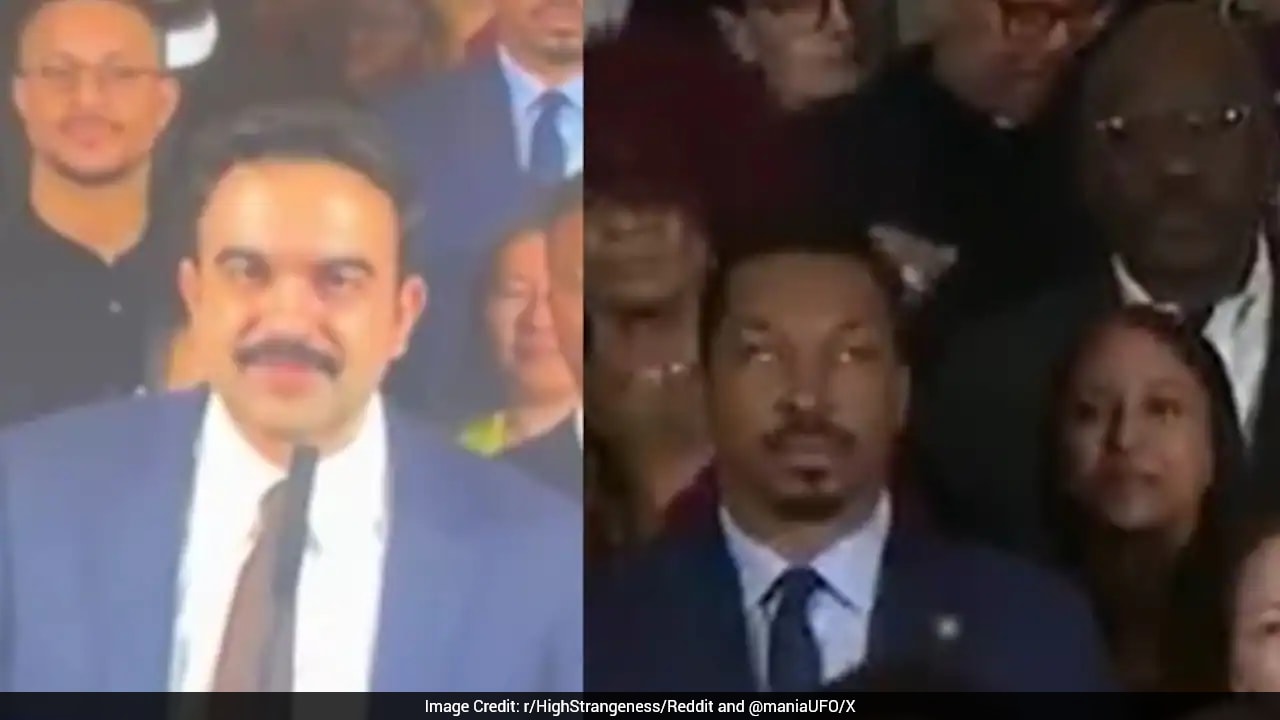
One split-second glance behind New York City Mayor Zohran Mamdani during his Rikers Island announcement was all it took for X to claim a secret lizard ruler was glitching live on camera.
Seriously. A man in a navy suit, light blue shirt, and tie stood in the background while Mamdani talked about safety, justice, and a vision for New York. His eyes rolled upward or shifted sharply for a fraction of a second, and suddenly thousands of posts were screaming about "reptilians," "shapeshifters," and "background characters" revealing their true nature.
Here's the plain truth. There's zero verified evidence of anything non-human, extraterrestrial, or supernatural in that footage. What people are actually watching is a normal human eye movement or facial expression caught at an awkward angle, amplified by slow-motion scrubbing, compressed video, and an internet ecosystem that makes money off outrage and absurdity.
Why a Blink Behind Zohran Mamdani Turned Into a Reptilian Theory
The NDTV report and similar viral roundups focused on the surface spectacle: a brief eye movement during Mamdani's remarks about standing beside New Yorkers devoted to safety and justice, followed by a collection of shocked and jokey replies on X. That's fine as a quick news hit, yet it leaves out the bigger picture of why a mundane clip explodes like this and what actual policy news got buried underneath it.
First, look at the timing and the speech itself. Reporting around Mamdani's late-November 2026 address highlights his administration's plan to close the notorious Rikers Island jail complex by the end of 2032, shifting detainees toward four borough-based facilities in Brooklyn, the Bronx, Queens, and Manhattan while aiming to cut the jail population dramatically from roughly 6,500–6,600 toward around 4,100. That's a massive, contentious policy shift involving a five-year extension past earlier 2027 statutory deadlines, court backlogs, diversion programs, and City Council approval.
Yet almost nobody scrolling past the viral clip on X was debating bed counts in Queens or pretrial diversion. Instead, they zoomed in on a guy in the background. When Mamdani spoke about a "vision" for the city, accounts on X clipped that exact fraction of a second, slowed it down, and slapped captions onto it claiming the man's pupils or irises vanished into white or that he was "glitching."
From my own experience tracking how viral clips mutate online, the pattern is almost always the same. A real, unedited broadcast moment happens. Someone posts a zoomed-in crop with dramatic framing ("look closely at what happens right here"). Other users add jokes, half-jokes, or outright conspiracy bait. Within two hours, people who haven't watched the full press conference are arguing about whether the camera operator cut to a tighter shot of Mamdani to "hide" the bystander.
Spoiler: switching from a wide shot of a podium group to a medium or close-up shot of the mayor speaking is standard camera direction at literally every press conference in history. Not every camera pan is a cover-up.
The Reptilian Conspiracy Theory Isn't New, and It Isn't Harmless
When people call a weird eye roll a "reptilian glitch," a lot of them are clearly joking or memeing. You can see the irony in posts calling background attendees "NPCs" or "lizards." Still, the reptilian trope has real history—and some pretty ugly roots that get brushed past when treated purely as a punchline.
As documented by conspiracy researchers and historians—including analyses of British writer David Icke's writings from the 1990s onward—the modern "reptilian elite" narrative blends sci-fi tropes, New Age ideas, and older conspiratorial motifs about hidden cabal rulers pulling global strings. Scholars who study conspiracism have also pointed out how reptilian narratives frequently overlap with or recycle tropes from antisemitic conspiracy lore, even when casual posters don't consciously connect those dots.
A 2013 Public Policy Polling survey famously found roughly 4% of registered American voters said they believed lizard people run the world (with a margin of error around ±2.8%), showing that even at tiny percentages, fringe ideas persist in the background of American political culture. Add algorithmic feeds that reward high-engagement shock content, and a harmless eye roll gets fed straight into an ancient myth machine.
Even when someone types "just kidding" in their head, repeating conspiratorial frames trains audiences to read every awkward blink, twitch, or shadow in political footage as proof of hidden manipulation. That erodes basic media literacy fast.
What Actually Happens on Camera During Live Speeches
Let's be honest about video compression and human biology. Live government streams and broadcast feeds go through heavy encoding before hitting social platforms. Bitrate drops, motion blur, harsh overhead press-room lighting, and sudden head or eye shifts can make a human eye look strange for a split second.
Humans roll their eyes when they're tired, irritated, squinting against bright lights, processing a thought, or reacting silently to someone nearby. Blinking mid-saccade (a rapid eye movement) or looking sharply upward exposes more of the sclera—the white part of the eye—for a fraction of a second. In normal viewing speed, you barely notice it. At 0.25x speed on a phone screen, it looks eerie.
There's also a well-known psychological trap here called pareidolia and confirmation bias. Once a caption tells you, "Watch his eyes turn white when he says vision," your brain hunts for white and treats any visual artifact or upward glance as confirmation.
I've seen this happen across sports broadcasts, award shows, and political hearings for years. Every few months, someone posts a freeze-frame of a politician, celebrity, or staffer looking mid-blink and declares it proof of clones, aliens, or mind control. It's almost never anything deeper than biology plus bad compression.
Common Mistakes People Make When Watching Viral Clips
If you don't want to get fooled—or accidentally spread nonsense—watch out for these traps:
- Mistake 1: Treating slow-motion zoom crops as primary evidence. Slowing a one-second clip down to 10 seconds distorts timing and makes normal reflexes look mechanical or sinister. Always look for the full, unedited press conference stream first.
- Mistake 2: Assuming a camera cut means secrecy. Broadcast directors cut to speakers constantly to keep viewers engaged and show facial expressions clearly. A tighter shot on Mamdani doesn't prove a cover-up.
- Mistake 3: Confusing jokes with facts. A meme about "reptilians" might start as dry humor, yet screenshots of that meme get reposted by accounts that treat it literally.
- Mistake 4: Ignoring the real story behind the clip. When a viral moment attaches itself to a major civic announcement like closing Rikers Island, the joke can distract from actual policy trade-offs that affect real people.
How to Fact-Check Bizarre Viral Videos Yourself
Next time a weird clip pops up in your feed claiming someone did something impossible on camera, run through a quick reality check before hitting repost:
- Find the original source broadcast. Look up the official city or network stream from that date rather than relying on a third-party screen recording.
- Check the context around the timestamp. Watch 30 seconds before and after the clip to see lighting, movement, and what else is happening in the room.
- Separate observation from interpretation. Write down what is literally visible (a person's eyes moving upward) before accepting an interpretation (a non-human entity).
- Look for credible corroboration. Extraordinary claims about altered biology or secret cover-ups require real evidence, not anonymous accounts posting exclamation points.
Viral clips are fun to talk about over coffee, especially when the internet gets weirdly creative. Just don't let a split-second eye roll trick you out of paying attention to what's actually real.