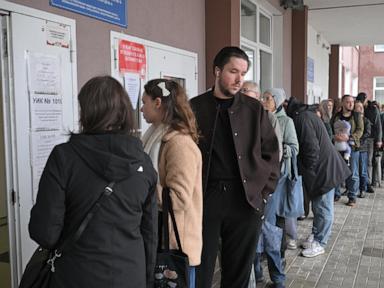
Elections during armed conflicts are rarely about changing leadership. They are about sending a message. Russia just wrapped up its first parliamentary election since launching its full-scale invasion of Ukraine in February 2022, and the outcome was predictable. President Vladimir Putin's grip on the State Duma remains utterly unshaken.
If you are looking at this vote as a traditional democratic contest, you are missing the entire point. The Kremlin treated this three-day exercise not as a competition, but as a loyalty test. Analysts and foreign observers watched closely, not to see who would win, but to understand how the Russian state manages domestic morale and political dissent while fighting a grinding war of attrition.
The Stifling of Real Opposition
You won't find genuine anti-war candidates on the ballot. Authorities systematically cleared the political field long before the polls opened on Friday. The only prominent liberal party that dared to criticize the conflict, Yabloko, was stripped of its ballot status by the country's Supreme Court following an appeal from a rival nationalist party. Independent politicians faced imprisonment, harassment, or exile.
What remains in the State Duma is the ruling United Russia party alongside the usual "systemic opposition"—groups like the Communist Party, the Liberal-Democratic Party, and A Just Russia. These factions routinely vote in sync with the Kremlin's major initiatives. They might squabble over minor domestic issues, but on foreign policy and the war effort, they march in lockstep.
Mark Galeotti, head of the Mayak Intelligence consultancy, notes that United Russia is poised to maintain its overwhelming majority, even if authorities slightly adjust downward expectations to match more realistic internal tallies. The goal is to project absolute internal stability.
Voting Under Drone Fire and Surveillance
Logistical reality heavily impacted this election cycle. The final day of voting coincided with intensive drone strikes. Ukrainian forces launched more than 1,000 drones at Russia overnight, targeting regions near Moscow and critical oil infrastructure. Meanwhile, electronic voting systems in the capital faced persistent cyberattacks, according to Ella Pamfilova, head of Russia's Central Election Commission.
Adding to the controversy, balloting was extended to residents of four Ukrainian regions—Donetsk, Luhansk, Zaporizhzhia, and Kherson—that Moscow illegally annexed and still does not fully control, alongside the Crimean peninsula annexed in 2014. Kyiv and Western governments immediately condemned these measures. The European Union dismissed the inclusion of occupied territories as a blatant violation of international law.
Observers from independent outlets documented various irregularities, from unsealed ballot boxes to pressure from armed security personnel stationed near polling booths. Independent monitors faced severe pushback, highlighting the tight operational leash governing the entire event.
Why Turnout Matters More Than the Count
When the final tallies settle, the raw numbers of seats won by United Russia will matter less to Moscow than the overall voter turnout figures. Chris Weafer, CEO of Macro-Advisory Ltd., points out that the Kremlin relies heavily on the "rally around the flag" effect.
State media framed participation as a direct endorsement of soldiers fighting on the front lines. High turnout allows the administration to claim a broad public consensus, effectively silencing internal doubts about the cost and longevity of the military campaign.
The public may feel fatigue from rising economic pressures and security anxieties, but without an organized political alternative, that discontent has nowhere to go inside the voting booth. The Kremlin achieved its core objective. The machinery of state power chugs onward, completely insulated from electoral surprises.
Stop expecting sudden democratic shifts in a system engineered to prevent them. Pay attention to the quiet indicators of public anxiety and state adaptation instead.